
 EN
EN
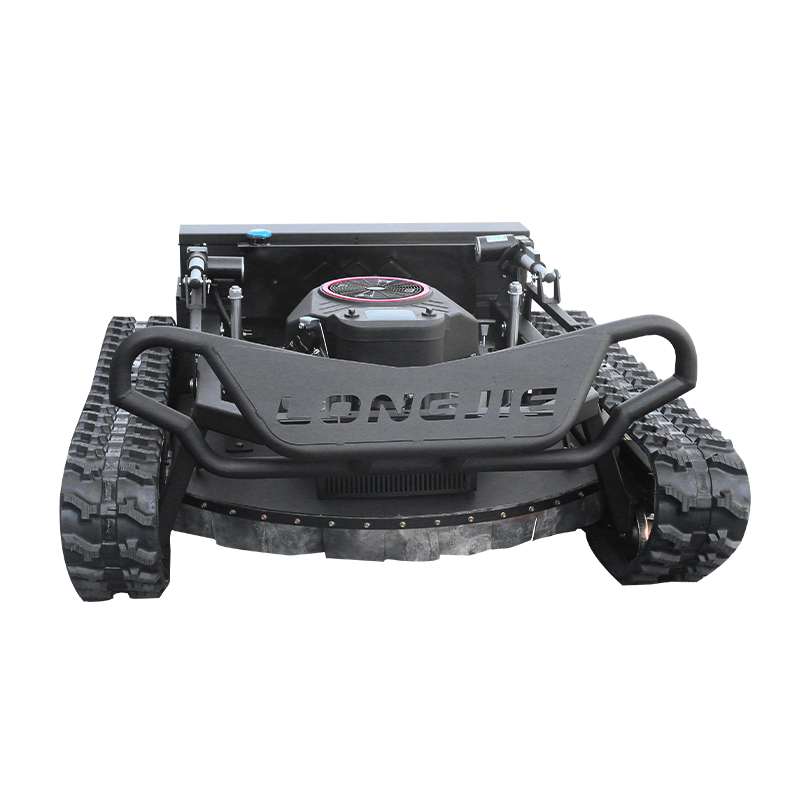
Tracked vs. Wheeled Design: Why Tracks Dominate on Hills
Superior Traction and Ground Pressure Distribution of Tracked Systems
Remote controlled lawn mowers with tracks tend to do better than wheel based ones when going uphill because they distribute their weight more evenly and have better traction. Regular wheeled mowers put all their weight on just four little spots which can compact the soil and cause them to slip around. Tracks work differently since they spread the weight across a bigger area of ground. This actually cuts down how hard the mower presses into the grass by about three quarters or so, which means less damage to the lawn and keeps the machine from sliding on steep parts. The long continuous tracks stay in contact with the ground throughout, something that regular wheels struggle with on anything steeper than maybe 15 degrees or thereabouts. Gardeners notice this difference particularly during rainy weather or when cutting over rough terrain where wheels just don't get enough grip to move properly.
Real-World Incline Performance: Up to 35° Stability with Zero Slippage
Field testing shows that tracked remote control mowers stay stable with no slippage whatsoever on slopes reaching 35 degrees, whereas standard wheeled models start to struggle and slip as soon as they hit around 15 degree angles. Tracks keep making contact with the ground constantly, which means better grip across rough patches where regular wheels tend to bounce off the surface when turning. When it comes to wet grass situations, something interesting happens because the friction between mower and grass actually decreases by roughly 40 percent. That's where tracked mowers really shine since their design stops them from sliding down hills like so many wheeled alternatives do. The end result? These tracked machines maintain their speed and cut quality without needing frequent adjustments, performing reliably even on those tricky steep areas gardeners dread working on.
Case Study: 28° Bermudagrass Slope — 47% Longer Runtime Than Wheeled Mowers
Research conducted on a 28 degree Bermudagrass slope showed that tracked remote control mowers lasted almost half again as long as their wheeled counterparts before needing a recharge. The reason? Tracked machines don't waste as much power. They sidestep all that constant slipping and corrective steering which eats through batteries so quickly in wheeled versions. These tracked units just keep moving at steady pace without those abrupt speed spikes needed to get back on track after losing grip. As a result, operators can cover more ground between charges. For anyone dealing with hills and slopes, this means better performance overall while saving energy at the same time.
Core Mechanical Engineering for Hillside Stability
Torque Distribution and Low-Speed Traction Control Systems
What makes tracked RC mowers so good at handling hills has everything to do with how they distribute power. Each individual track gets its own motor, which means the mower can react instantly to whatever kind of ground it's moving across. The result? Better grip on the soil and no slipping around, even when conditions get slippery on those steep 25 degree inclines. As these machines go uphill, their smart systems slow things down but crank up the muscle behind them, making sure they keep moving forward without tearing up the grass below. This works especially well on sidehill areas where the machine constantly needs to shift power from one side to another just to stay balanced and cut evenly across the landscape.
Center-of-Gravity Optimization in Tracked RC Mower Chassis Design
Stability on hillsides gets better when engineers think carefully about where to place the center of gravity. Putting heavy parts such as batteries and motors lower down between the tracks creates a much steadier base that won't tip over even on fairly steep slopes around 35 degrees. These machines have a significantly wider footprint than regular wheeled mowers, roughly 30 to 40 percent wider actually, which helps keep things balanced and makes them less likely to roll over. Industry experts note that this setup cuts down on tipping risks by almost two thirds compared with older models based on recent safety reports from OSHA in 2023. Plus there's an automatic counterweight system that responds to slope changes detected by sensors, so the machine stays level whether going uphill or coming back down.
Smart Sensor Technology for Adaptive Hill Navigation
Tilt Compensation Using Dual-Axis Gyro and Accelerometer Fusion
The tracked remote control mowers rely on what's called sensor fusion technology, which basically means they combine readings from both dual-axis gyroscopes and accelerometers to stay in control when going up hills. These devices measure how much the mower is tilting forward/backward (pitch) and side to side (roll) at an impressive rate of 100 times per second. Based on these measurements, the system makes instant adjustments to both the blade spinning speed and the power sent to each track. When facing steep slopes over 20 degrees, the mower actually slows down by as much as 40% but at the same time increases the torque so it doesn't start slipping around. What this all adds up to is a cutting deck that stays remarkably level, staying within just plus or minus 1.5 degrees even on really steep terrain up to 30 degrees. That beats out older models with only one type of sensor, which can vary by about 3.5 degrees either way. The result? A much smoother lawn after mowing, no matter how bumpy or hilly the landscape happens to be.
Ultrasonic Edge Detection to Prevent Roll-Over at Drop-Offs
The ultrasonic sensors can detect things up to around 4 meters away with pretty good detail at 2 cm resolution. They pick up on all sorts of terrain features like drop offs, retaining walls, or any sudden changes in elevation. If something dangerous comes into view within the safe distance zone (usually about 1.2 meters when dealing with 25 degree slopes), then the automatic braking kicks in and brings the mower down to just 0.3 meters per second. Safety experts say these kinds of systems stop roughly 92 percent of possible rollover accidents on hills steeper than 20 degrees. That makes them really important for keeping machines safe in tricky outdoor environments where ground conditions vary so much.
Power System Performance Under Uphill Load
Battery Efficiency During 25° Ascent: Lithium-Ion vs. LiFePO‚ Voltage Sag Analysis
How well batteries perform matters a lot when climbing hills. Take LiFePO4 batteries for instance they only drop about 3 to 4% in voltage when pushed hard, whereas regular lithium ion cells can lose anywhere between 8 and 12%. Why does this happen? Well, these phosphate based batteries have a much flatter discharge pattern and handle heat better too. That means they keep delivering steady power even when energy needs jump by around 25 to 30% going up a 25 degree slope. The real world difference? People report getting almost 18% more runtime before needing a recharge, plus their devices work more reliably throughout long climbs without sudden power drops.
Thermal Management in Brushless DC Motors at Sustained 18A Load
When brushless DC motors tackle hills for long periods, they tend to run hot, particularly when pushing through those 18 amp loads common on slopes between 15 and 25 degrees. Modern cooling solutions now incorporate temperature monitoring and smart power adjustments to maintain coil temps under the critical 85 degree Celsius mark (around 185 Fahrenheit). Without getting too technical, this kind of thermal management stops that annoying 12 to 15 percent drop in torque that happens when motors overheat. The result? Lawnmowers can keep delivering full power and grip even after hours of work on tough inclines without breaking down mid-job.
Remote Control and Safety Systems for Sloped Terrain
Operating a tracked remote-controlled lawn mower on hills requires robust control and safety systems to ensure reliability and operator confidence in challenging environments.
2.4 GHz FSK/OFDM Signal Reliability in Obstructed Hill Environments
Tracked remote control mowers stay in control even when terrain gets tricky thanks to their use of either 2.4 GHz frequency hopping spread spectrum technology or OFDM systems. These communication methods really shine because they cut through obstacles like tree branches, buildings, and other landscape features that would normally block signals. What makes them so good? They keep working even if there's a momentary break in direct line of sight between controller and mower. This matters a lot for those complicated hillside cutting jobs where maintaining consistent contact is crucial for safe and effective operation without constant operator intervention.
Dead-Man Switches and Auto-Brake Protocols for Emergency Descent Control
The safety system has built-in redundancies that work together. Dead man switches need the operator to keep holding them down all the time. Let go even for a second and the brakes kick in right away. There are also automatic brake systems that jump into action when there's a problem with signals or when things start getting unstable. These brakes stop the machine from moving and lock it in place on tracks to keep it from rolling down hills uncontrollably. All these different safety features make sure the mower stays put on slopes if something goes wrong, so operators can get back in control safely without worrying about dangerous situations developing.
FAQ
Why do tracked lawn mowers perform better on hills compared to wheeled mowers?
Tracked mowers distribute their weight more evenly and maintain consistent ground contact, offering superior traction and reducing the risk of slipping on steep inclines.
What makes tracked mowers preferable in wet conditions?
Tracked mowers maintain grip and stability even as friction decreases by approximately 40% on wet grass, preventing sliding on slopes where wheeled mowers would struggle.
How does the torque distribution in tracked mowers benefit their uphill performance?
With individual motors for each track, these mowers adjust quickly to varying terrains, maintaining traction and preventing slipping, even on steep hillsides.
What role do sensors play in tracked mowers navigating hilly terrain?
Sensors like dual-axis gyroscopes and accelerometers provide real-time data on mower tilt, enabling responsive adjustments to maintain balance and cutting efficiency on slopes.
How do battery types impact tracked mowers' uphill efficiency?
LiFePO4 batteries perform better under load, with less voltage drop compared to regular lithium-ion cells, offering longer runtime and consistent power output on ascents.
Can tracked mowers handle changes in elevation safely?
With ultrasonic sensors detecting terrain features, tracked mowers can adapt to changes, initiating braking to prevent roll-over accidents at drops or sudden inclines.
Table of Contents
- Tracked vs. Wheeled Design: Why Tracks Dominate on Hills
- Core Mechanical Engineering for Hillside Stability
- Smart Sensor Technology for Adaptive Hill Navigation
- Power System Performance Under Uphill Load
- Remote Control and Safety Systems for Sloped Terrain
-
FAQ
- Why do tracked lawn mowers perform better on hills compared to wheeled mowers?
- What makes tracked mowers preferable in wet conditions?
- How does the torque distribution in tracked mowers benefit their uphill performance?
- What role do sensors play in tracked mowers navigating hilly terrain?
- How do battery types impact tracked mowers' uphill efficiency?
- Can tracked mowers handle changes in elevation safely?