
 EN
EN
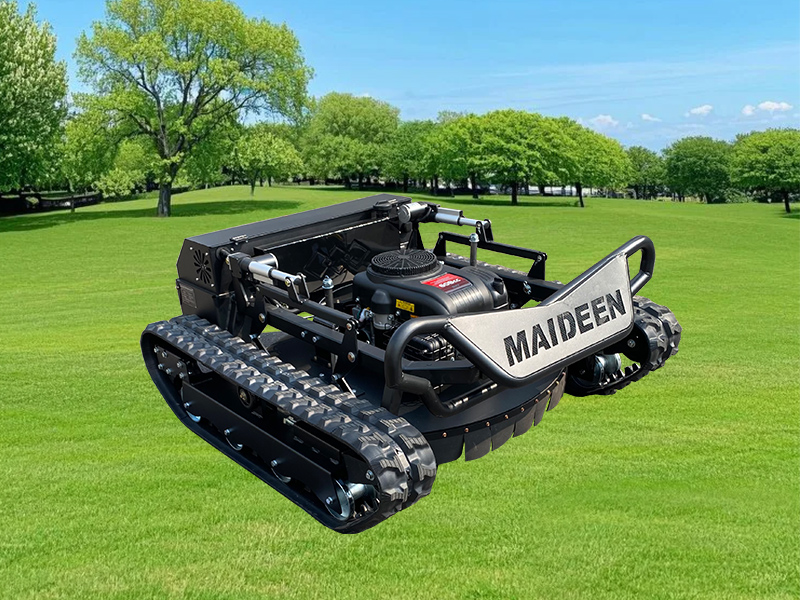
Tracked Drive Systems: Superior Traction and Stability on Challenging Terrain
Physics of Track Traction: Weight Distribution, Low Center of Gravity, and Slip Resistance on 45° Slopes
Tracked remote control lawnmowers handle steep hills better thanks to some basic engineering principles. These machines have those wide, continuous tracks that spread their weight across much more ground than regular wheels would. This means they put about 80% less pressure on the earth beneath them compared to standard wheeled models. Less pressure equals less damage to the soil and no sinking when cutting through muddy or soggy areas. Manufacturers also design these mowers with a lower center of gravity, which makes them rock steady even on pretty serious inclines. Most can tackle slopes around 45 degrees without flipping over, something wheeled versions struggle with badly. According to research from Biberger last year, these tracked systems maintain roughly 95% grip on wet grassy slopes because the tracks stay in constant contact with the ground instead of bouncing around like regular wheels do.
Tracked vs. Wheeled: Real-World Performance Comparison in Mud, Rock, Wet Grass, and Loose Gravel
When it comes to rough terrain, tracked systems really shine where regular wheeled mowers just can't keep up. Think about those muddy fields or gravel paths where standard equipment gets stuck or spins its wheels uselessly. The continuous tracks spread out the weight so much better than traditional wheels do. This means machines equipped with tracks can push through thick mud without getting bogged down, and they won't waste energy spinning on loose surfaces like gravel. Wet grass presents another challenge for conventional mowers too. With tracked systems, power gets distributed over the entire track surface instead of just at points where wheels touch ground. The difference is night and day when trying to maintain forward momentum without slipping all over the place.
| Terrain | Tracked Performance | Wheeled Limitations |
|---|---|---|
| Rocky slopes | Maintains traction | Loses grip on loose rocks |
| Mud (>4" deep) | Sustains 0.2 mph pace | Frequent immobilization |
| Wet grass | <5% slippage | 15–40% slippage |
| Loose gravel | No surface disruption | Creates ruts and divots |
Field validation shows tracked units complete slope-side mowing 30% faster and require 92% fewer operator interventions—direct outcomes of optimized weight distribution and inherent stability.
All-Terrain Versatility: Mowing Dense, Uneven, and Confined Landscapes Effectively
Overgrown Grass, Weeds, and Rocky Embankments: Field Validation from Tracked Remote Controlled Lawn Mower Models
Remote controlled tracked mowers really shine when tackling tough grass and rough terrain. Tests show these machines cut down slippage problems by around two thirds on rocky slopes and areas thick with weeds compared to regular wheel-based models. The secret lies in how they spread weight across the ground and maintain constant contact with it. With their lower center of gravity and better balance during operation, these mowers handle all sorts of challenging landscapes including hills prone to erosion, soggy marshlands, and slopes steeper than 45 degrees where standard equipment often gets stuck or loses traction completely.
Tight-Space Maneuverability: How Track Flexibility and Zero-Turn Radius Enable Precision in Irregular Zones
Articulated track systems really shine when dealing with tricky terrain where regular wheeled machines struggle. The segmented design adapts to rough ground conditions much better than traditional wheels can manage, allowing these machines to pivot on the spot right where they stand. Operators find themselves able to maneuver close to obstacles like trees, garden fences, wall planters, and decorative elements without tearing up grass or leaving areas untouched. Field tests have shown these systems cover about 98 percent of challenging property layouts. That kind of performance cuts down on those frustrating after-job fixes most equipment leaves behind. Plus, this level of precision makes integrating them into automated workflows actually feasible for many landscaping operations today.
Safety, Accessibility, and Operator Independence Through Remote Control
Operating lawn equipment remotely changes how safe and accessible landscaping work can be. When someone controls the mower from somewhere high up, inside a building, or just standing still instead of riding around on it, they stay out of dangerous situations. Think about those tricky spots where the ground isn't stable, there's junk hiding under the grass, surfaces get slick when wet, or sudden kicks back happen from the blades. Getting away from these risks cuts down on falls and strains, which matters a lot when dealing with hills or thick vegetation. What makes this tech really valuable is that people who might struggle with traditional mowers because of weak muscles, poor balance issues, or short stamina can still handle everything themselves. They pick where to cut, set how fast it goes, define boundaries for coverage areas. Most systems come with controls that make sense right away, so folks can tweak settings as needed while keeping their hands free and staying protected throughout the job, no special classes required either.
Proven Performance Across Mixed Terrain: Case Studies from Residential and Commercial Sites
Pacific Northwest Hillside Estate: 38° Slope + High Rainfall – 92% Reduction in Manual Intervention with Tracked Remote Controlled Lawn Mower
This hillside property gets hammered by rain most years, around 60 inches annually, and slopes at about 38 degrees in some spots. A tracked remote-controlled lawnmower made all the difference though. The machine stays planted thanks to its lower center of gravity and those continuous treads that grip even when the ground is soaked. We noticed the soil wasn't getting packed down nearly as much either, roughly 40% less compared to regular wheeled mowers. Looking at our maintenance logs after installing these machines, there was about a 92% drop in how often workers had to manually correct the mower's path on slopes. Makes sense really, because good engineering based on real physics principles just works better in tough conditions over time.
Midwest Vineyard Perimeter: Rocky Soil, Varying Grades, and Intermittent Overgrowth – Consistent Coverage Without Re-Deployment
Keeping vines trimmed along the edges requires several different machines really. Brush cutters tackle those dense thickets, while smaller mowers handle the flat areas, and special equipment deals with the rocky spots where regular machinery can't go. The tracked machine works wonders on slopes between about 7 to 15 degrees, even when there are limestone rocks sticking out and weeds growing up to waist height. What makes this thing stand out is how its tracks adapt to uneven ground without damaging the grapevines themselves. Farmers report it covers roughly 0.8 acres every hour no matter what obstacles lie ahead. Best part? There's no need to switch equipment depending on the terrain anymore. This cuts down on time spent moving gear around and saves money on extra machines sitting idle most of the year.
FAQ
What makes tracked lawn mowers better for steep and uneven terrains?
Tracked lawn mowers have wide, continuous tracks that distribute weight more evenly across the ground than wheels, allowing them to maintain traction on slopes and uneven terrain while reducing soil damage.
How do tracked mowers perform on muddy or wet surfaces?
Tracked mowers excel on muddy or wet surfaces by spreading their weight, preventing sinking, and maintaining a consistent grip due to constant track-ground contact.
Are tracked mowers suitable for use in tight or confined spaces?
Yes, tracked mowers can pivot on the spot and maneuver effectively close to obstacles, making them ideal for tight or irregularly shaped landscapes.
How does remote control operation enhance mower safety and accessibility?
Remote control operation keeps operators away from dangerous terrain, reduces injury risk, and enables individuals with limited physical ability to control lawn mowers effectively.
Table of Contents
- Tracked Drive Systems: Superior Traction and Stability on Challenging Terrain
- All-Terrain Versatility: Mowing Dense, Uneven, and Confined Landscapes Effectively
- Safety, Accessibility, and Operator Independence Through Remote Control
- Proven Performance Across Mixed Terrain: Case Studies from Residential and Commercial Sites
- FAQ