EN
EN
How To Plan Working Route For Large area lawn mower
Planning a route before starting a lawn mower is one of the simplest ways to make a large property easier to manage. On a broad lawn, field, orchard edge, or landscaped site, the route determines more than appearance. It affects how often the operator turns, whether grass is missed, how safely obstacles are approached, and whether the work can be repeated consistently on the next visit. A large area lawn mower route should be treated as a site plan, not as a series of improvised passes.
The practical goal is not to chase the shortest possible route. A good lawn mower plan balances coverage, turning space, surface conditions, operator visibility, and the machine instructions. Start slowly, validate the plan on a small section, and adjust it when grass height, moisture, or site access changes.
Start With a Walk-Through, Not the Lawn Mower
Before moving a lawn mower into the work area, walk the perimeter and identify the features that control the route. Note gates, narrow entries, ditches, drainage grates, tree roots, parked equipment, utility covers, uneven ground, and places where people or animals may enter. Mark no-go areas and decide where the lawn mower can turn without backing toward an obstacle or crossing an unsafe edge.
Divide the site into zones when one continuous pattern would create long deadhead travel or difficult transitions. A useful sequence is: perimeter and hazard review first, open central areas second, narrow strips and detail work last. This prevents an operator from discovering a blocked route after the larger mowing pattern has already been established.
- Confirm access width, ground bearing conditions, and the safe entry direction for each zone.
- Leave a clear buffer near water, drop-offs, loose material, fixed objects, and public walkways.
- Plan refueling, charging, inspection, and unloading locations outside the active mowing path.
- Keep a simple site sketch so the route can be reviewed by the operator and supervisor.
Choose the Main Direction for a Large Area Lawn Mower
For an open area, a back-and-forth pattern is often easier to control and audit than random circulation. Set the long passes in the direction that reduces unnecessary turns while respecting slopes, drainage, surface changes, and the operating guidance for the specific lawn mower. The ideal direction on one property may not be suitable on another, so terrain and machine documentation should take priority over a generic pattern.
Think about what happens at both ends of every pass. A route with fewer passes can still be inefficient if each turn requires repeated repositioning. Reserve turning headlands where the lawn mower can change direction with a safe margin. If obstacles interrupt the open area, split the zone rather than weaving around them on every row. That approach makes the route clearer and reduces the chance that a large area lawn mower will leave irregular patches.
Set Overlap Deliberately
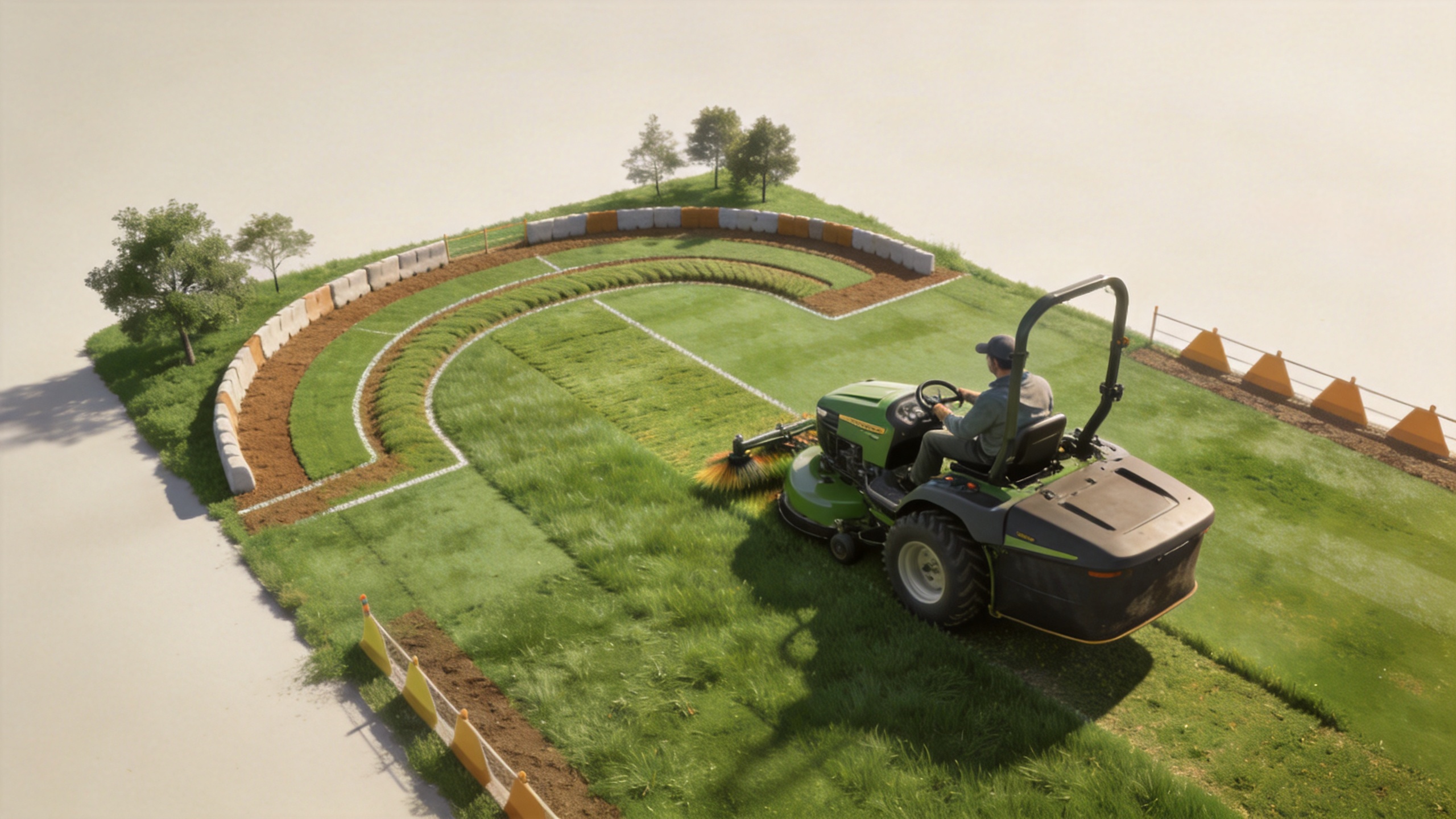
Overlap is a coverage control, not a fixed number to copy from another site. Too little overlap may leave narrow uncut strips when terrain, steering, grass lay, or blade discharge changes. Too much overlap repeats work and can make a lawn mower route unnecessarily slow. Use a modest, consistent overlap during the first trial, inspect the finished strip, then refine the plan only after the actual cutting result is visible.
For large sites, write the planned pass spacing and the reasons for it on the site sketch. A large area lawn mower operating on rough ground may need a different allowance than the same lawn mower working on a flat, maintained turf surface. A suitable setting provides clean coverage without relying on aggressive speed or repeated corrective passes.
Plan Obstacles, Borders, and Transitions as Separate Tasks
Do not force the main route to solve every edge condition. Treat borders, islands, trees, drainage channels, and structures as separate route elements. First establish the safety buffer, then decide whether the lawn mower can make a perimeter pass with adequate visibility and room to turn. Areas that cannot be approached safely should be excluded from the machine route and handled through an approved alternative method.
Transitions between zones deserve the same attention. Plan where the lawn mower stops cutting, travels with blades disengaged if required, and enters the next zone. Avoid routing across soft soil, steep banks, congested access points, or public paths. This is especially important when the large area lawn mower is used over several days or by different operators.
Use a Repeatable Route Sequence
- Inspect: Recheck the work area for new hazards, people, animals, loose debris, and weather-related changes.
- Define: Confirm exclusion areas, turning headlands, entry points, and the first zone.
- Cut: Mow the open pattern at a pace appropriate to visibility, grass conditions, and the lawn mower manual.
- Verify: Stop after the first few passes to inspect overlap, cut quality, turning room, and edge clearance.
- Finish: Complete borders and narrow sections only when the approach and exit remain controlled.
- Record: Update the site sketch with any route changes, recurring hazards, or areas that need a different method.
Adjust the Plan When Conditions Change
A lawn mower route is not permanent. Wet ground, taller grass, seasonal growth, new landscaping, equipment changes, and altered site traffic can all change what is safe and efficient. Review the route before each major mowing cycle. If the site has slopes, blind corners, or irregular terrain, use the manufacturer’s operating instructions and the site safety procedure to decide whether a route should be changed or postponed.
For teams comparing equipment for broad properties, route planning is also a useful specification exercise. Document the site size, vegetation, slopes, access widths, obstacle density, desired cut pattern, and service routine. Shandong Maide En Intelligent Technology Co., Ltd can use that field information as part of an equipment-matching discussion, but final configuration and operating suitability should be confirmed against the actual site and product documentation.
Final Route Planning Checklist
Before beginning work, verify that the lawn mower route has a clear start and finish, adequate buffers, safe turns, manageable zone transitions, and a coverage check. During the first run, prioritize observation over speed. A well-planned large area lawn mower route makes the work more predictable because it gives the operator a defined sequence for coverage, inspection, and adjustment.
When the plan is recorded and reviewed after each cycle, the lawn mower becomes part of a repeatable field workflow rather than an isolated task. That is the foundation for safer, more consistent results across a large mowing area.