EN
EN
What Anti-Slip Design Does a Remote Control Tracked Lawn Mower Adopt?
A tracked lawn mower is often chosen for banks, orchard rows, rough grass, and damp ground because its running gear spreads traction across a longer contact area than a conventional wheeled layout. But “tracked” is not a promise that any machine will stay planted everywhere. The anti-slip result comes from several design choices working together: track geometry, ground pressure, balance, drive control, and the way the operator plans the job.
When evaluating a remote control tracked lawn mower, it helps to look beyond the word “crawler.” The practical question is whether the machine can maintain controlled movement on the actual surface, vegetation, moisture level, and slope you intend to mow.
Why tracks help a tracked lawn mower resist slipping
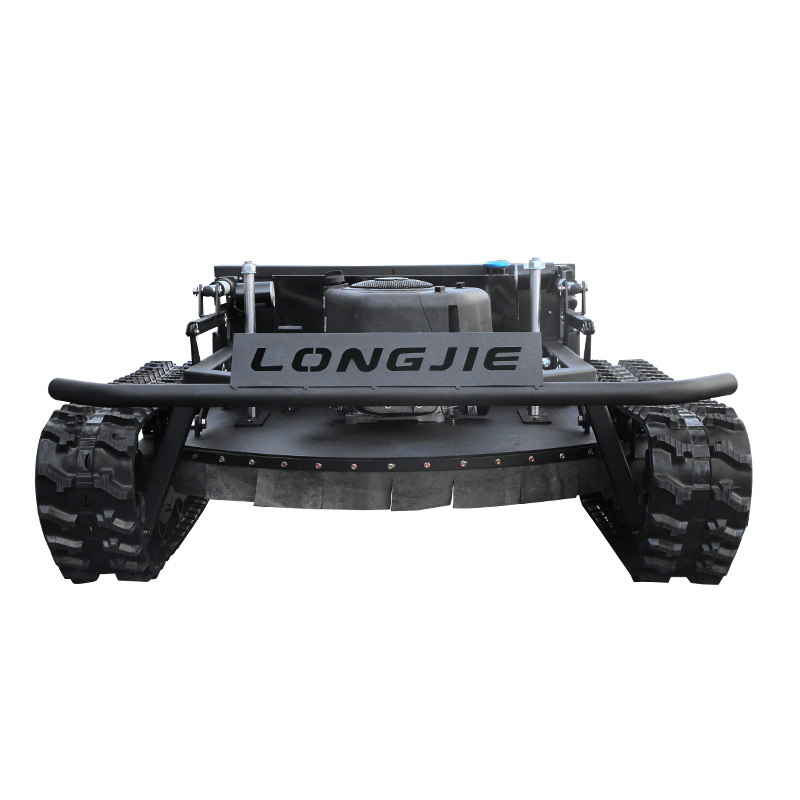
The main anti-slip feature of a tracked lawn mower is its continuous crawler track. Rather than placing the machine’s load on a few tire contact patches, each track lays a longer belt against the surface. That larger contact footprint can reduce localized ground pressure and create more opportunities for the track lugs to engage with grass, soil, or uneven ground.
A typical track system also wraps around drive and idler wheels. Keeping the belt correctly tensioned helps it follow those wheels without excessive slack, while the lug pattern is intended to bite into softer or irregular surfaces. In practice, the useful grip depends on conditions: packed dry soil, loose gravel, wet clay, leaf cover, and flattened grass do not offer the same resistance.
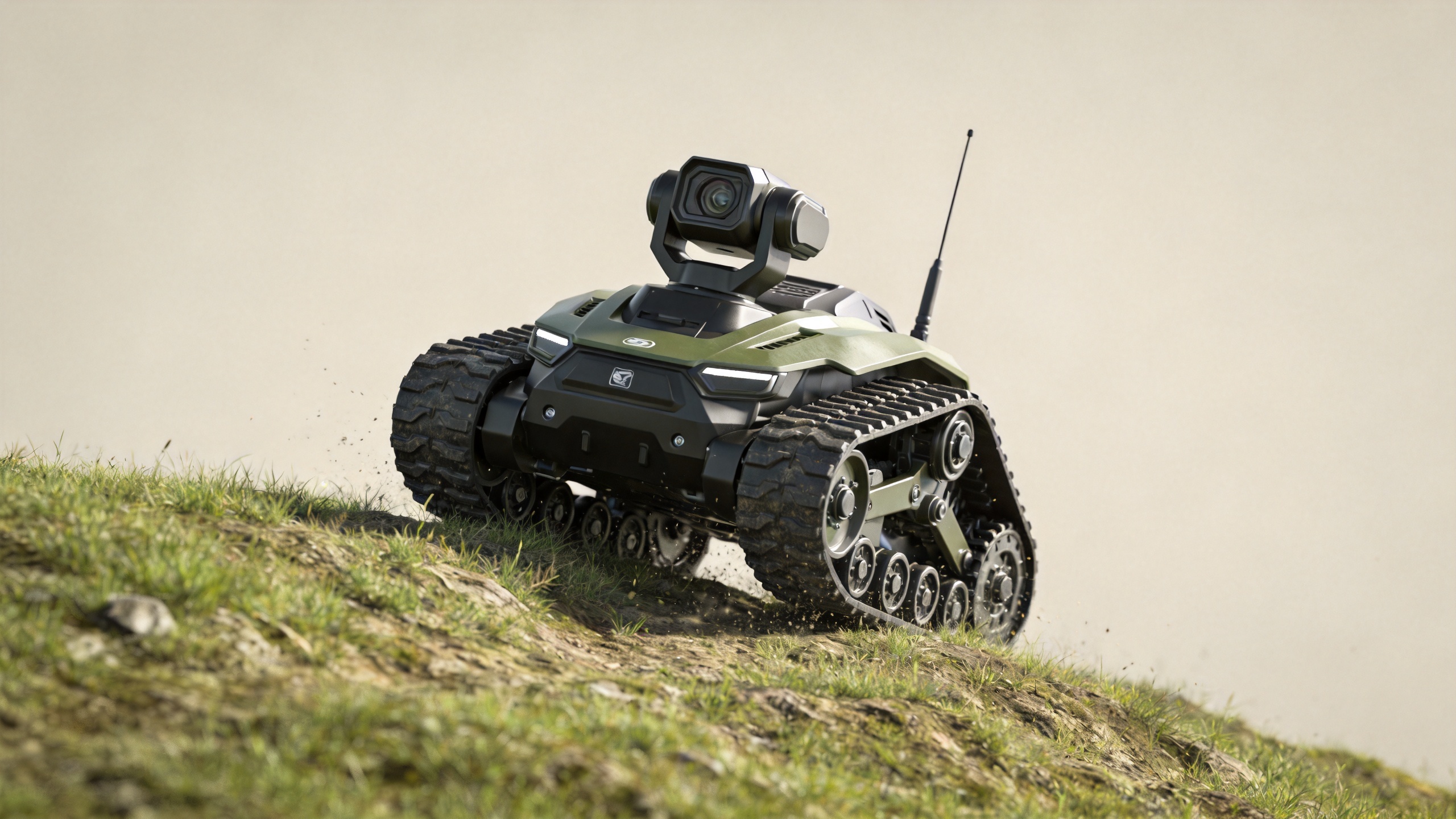
Search results for commercial slope mowers commonly highlight rubber tracks and a low center of gravity as the combination behind their traction on uneven terrain. That is a useful design principle, not a universal performance rating. Track material, lug shape, track width, tension setting, and wear condition all influence how a particular machine behaves.
Low center of gravity supports stability, not just traction
Good grip alone does not make a slope operation safe. A tracked lawn mower also needs stable weight distribution. Designers generally keep heavy components as low and as centrally located as practical, which can reduce the tendency to pitch or roll when the ground angle changes.
For a remote control tracked lawn mower, a broad track stance and a low-profile chassis may help the machine feel more settled on undulating ground. Still, stability is conditional. A hidden ditch, a sudden side slope, a soft shoulder, or a raised clump of vegetation can move the effective load path quickly. This is why a machine’s manual—not an online claim or a visual estimate—should determine the permitted slope and direction of travel.
Track design details worth checking
When comparing a tracked mower, ask the supplier for documented information on the running gear rather than relying on general sales language. These details are especially relevant:
- Track width and contact length: a wider or longer footprint may distribute load differently, but the appropriate choice depends on ground bearing strength and the required turning behavior.
- Lug pattern and rubber compound: the pattern should suit the expected mix of grass, soil, and debris; worn or packed lugs can reduce usable bite.
- Tension and guidance: correct tension and properly aligned guide components help the track run predictably. Over-tightening or under-tensioning should be addressed according to the manufacturer’s service instructions.
- Chassis clearance: enough clearance can help prevent vegetation or loose material from accumulating underneath and changing the machine’s balance.
- Left-right drive control: smooth, proportional control can help avoid abrupt steering inputs that disturb the surface or unload one side of the machine.
None of these items should be treated in isolation. A wide track with poor site planning can still slide, and a well-balanced chassis cannot compensate for a surface that is saturated, unstable, or beyond the model’s stated limit.
How remote control contributes to the anti-slip strategy
Remote operation does not create traction by itself. Its value is that it can allow the operator to remain away from the machine’s immediate path while observing the tracked lawn mower and the terrain. On a bank or around obstacles, that separation may make it easier to choose a safer viewing position and stop before the machine reaches a problem area.
However, a remote control tracked lawn mower still requires line of sight, a clear route, and deliberate speed control. Fast turns, sudden direction changes, and mowing across unknown soft ground can reduce the advantage of the crawler system. Remote control should be treated as part of a controlled workflow, not as permission to run the mower without supervision.
Operating practices that preserve available grip
Before starting, walk or visually inspect the work area. Look for drainage channels, loose stones, exposed roots, buried debris, wet patches, abrupt grade changes, and vegetation that hides the surface. OSHA’s mower-safety guidance recommends checking the equipment manual and using a slope indicator where needed; those habits remain useful when assessing any slope-oriented mowing equipment.
- Confirm the manufacturer’s operating limits for the exact tracked lawn mower and attachment configuration.
- Measure or verify the slope instead of guessing from a distance.
- Clear visible obstacles and identify a safe stopping area before mowing.
- Start at a controlled speed and assess how the tracks respond before committing to the full route.
- Keep turns gradual and avoid abrupt reversals where the surface is loose or wet.
- Stop if track slip, unexpected sideways movement, loss of visibility, or changing ground conditions appear.
It is worth correcting one common assumption: a remote control tracked lawn mower is not automatically suitable for every steep or wet site. Its anti-slip design can improve traction and reduce operator exposure in appropriate conditions, but the operator still has to manage the boundary conditions.
What to request before purchasing
For procurement, turn anti-slip claims into a verification checklist. Ask for the model’s documented slope limit, track dimensions, track material, recommended maintenance interval, operating manual, and test or demonstration conditions that resemble your own terrain. If the work includes wet grass, loose soil, orchards, or side slopes, describe those conditions clearly rather than asking only whether the unit is “all-terrain.”
The most useful evaluation is a supervised demonstration on a representative surface. Observe start-and-stop behavior, slow turns, straight travel, route visibility, and how the machine reacts near transitions. That gives a more realistic picture than looking at the tracks alone.
Conclusion
A tracked lawn mower adopts anti-slip design primarily through crawler tracks, distributed ground contact, a low and balanced chassis, and controllable drive behavior. A remote control tracked lawn mower can add distance and visibility benefits, but it does not remove the need to verify terrain, follow the model manual, and work within stated limits. The right decision comes from matching the track system and operating method to the ground you actually need to mow.