EN
What Requirements Must US Standard Lawn Mower Meet for North America?
For an importer, distributor, or equipment buyer, a lawn mower for North America is not simply a machine with a cutting deck and an engine. The product must be reviewed against the rules that apply to its design, guarding, labeling, instructions, electrical or fuel-system configuration, and evidence package. A US standard lawn mower program is stronger when compliance is treated as a product-development task before the first shipment, not as a document request after production.
From a procurement perspective, the practical question is: which requirements apply to this specific lawn mower, and what proof should the supplier provide? The answer depends on whether the equipment is walk-behind, ride-on, battery-powered, gasoline-powered, residential, commercial, or intended for another defined use. That classification should be fixed early because a rule that matters for one lawn mower category may not govern another.
Start With the Product Scope, Not a Generic Certificate
The first requirement for a lawn mower entering the United States is an accurate product definition. Record the propulsion method, operator position, cutting width, power source, intended environment, target user, and any remote-control or automated function. This information lets a compliance team identify the appropriate federal requirements, voluntary consensus standards, and state-level considerations.
For example, the U.S. Consumer Product Safety Commission identifies 16 CFR Part 1205 as the Safety Standard for Walk-Behind Power Lawn Mowers. It also lists ANSI/OPEI B71.1-2017 as a voluntary safety specification for consumer turf-care equipment that includes pedestrian-controlled and ride-on mowers. These references are useful starting points, but they are not a shortcut to claiming that every lawn mower has the same obligation. The supplier and importer should confirm the exact current edition, scope, exclusions, and applicability with qualified compliance professionals.
Build Safety Into the Lawn Mower Design
A compliant lawn mower design begins with foreseeable-use and foreseeable-misuse hazards. The engineering review should look at contact with rotating blades, thrown objects, hot surfaces, pinch points, sharp edges, fuel or battery hazards, unintended movement, and loss of control. Risk controls should be designed into the lawn mower rather than added as an afterthought.
- Blade and discharge protection: Review guards, shields, discharge openings, and the integrity of the cutting enclosure.
- Operator controls: Check starting, stopping, traction, braking, and blade-control functions for clear operation and predictable response.
- Stability: Evaluate the lawn mower on the terrain and operating conditions specified in its instructions; do not make broad slope claims without test evidence.
- Electrical or fuel safety: Match components, wiring, batteries, chargers, fuel lines, and thermal protection to the actual product configuration.
- Service access: Make sure maintenance points can be reached without encouraging unsafe contact with energized or moving parts.
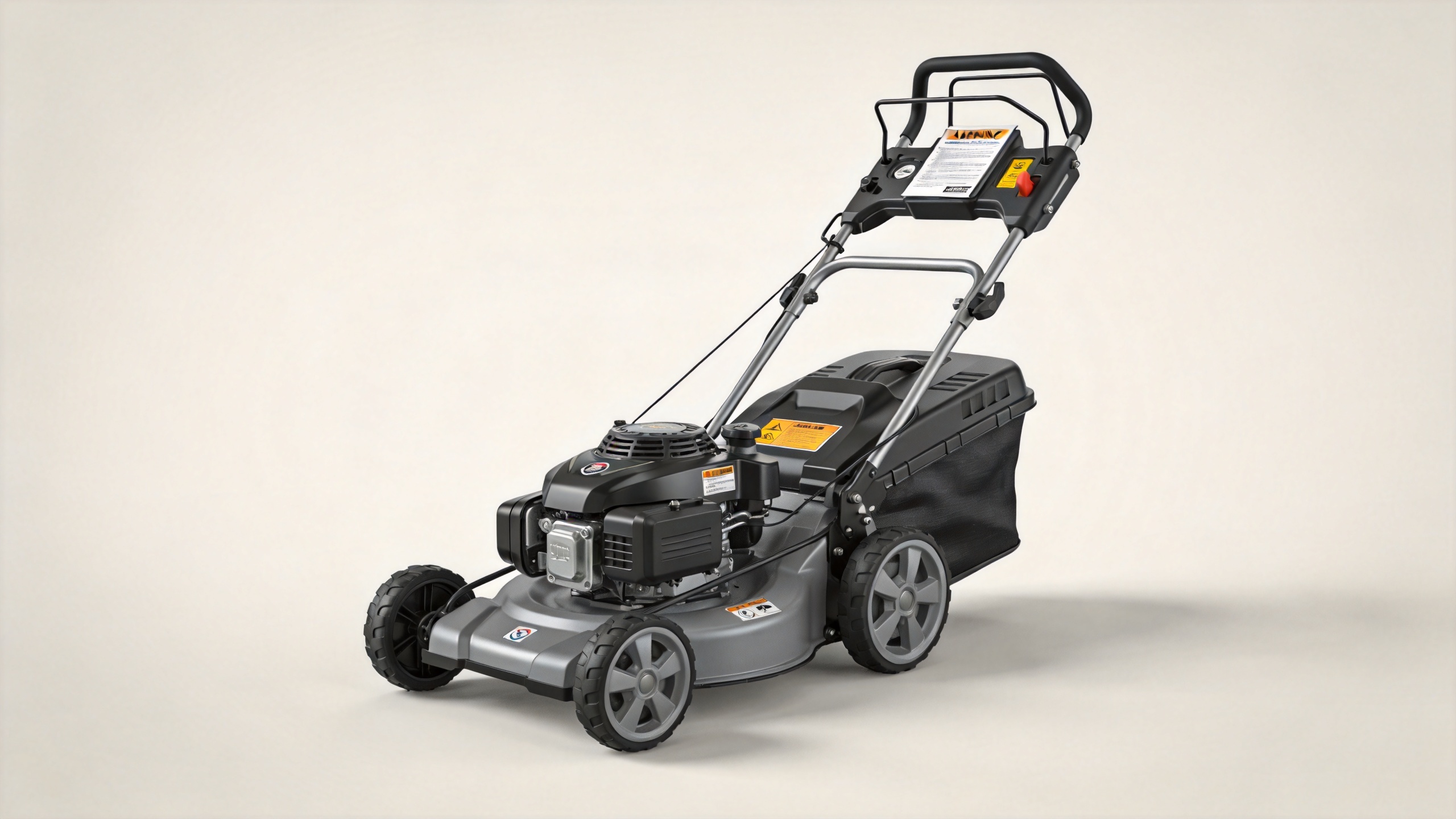
A US standard lawn mower should also use durable components and instructions that help the owner recognize when inspection, adjustment, or replacement is needed. Safety depends on the complete system: hardware, labels, instructions, packaging, and after-sales communication all matter.
Prepare Labels, Warnings, and Operating Instructions
Warnings are not a substitute for safer lawn mower design, but they are an essential communication layer. A product review should confirm that warning labels are legible, durable, understandable for the intended U.S. market, and placed near the relevant hazard. Typical topics include keeping bystanders away, clearing debris, disengaging cutting functions before service, using appropriate protective equipment, and following the stated slope and operating limits.
The operator manual should identify the exact lawn mower model and revision, explain startup and shutdown procedures, list inspection and maintenance intervals, describe storage requirements, and state the limits of intended use. If the lawn mower is supplied with a battery, charger, remote controller, or other electrical accessory, the manual and packaging should cover the matching configuration rather than relying on a generic template.
Verify the Evidence Before Ordering at Scale
Buyers should ask for evidence that can be traced to the finished lawn mower, not only to a similar model. A practical file may include drawings, bills of materials, risk assessments, component specifications, test reports, label artwork, manuals, quality-control records, and change-control history. If a supplier references a standard, request the test scope, laboratory identity, product configuration, sample identification, and report date.
This matters because a lawn mower can change substantially when its engine, battery pack, deck, control system, guard, wheel arrangement, or firmware changes. A report for one configuration may not automatically cover another. Establish a written process requiring the supplier to notify the buyer before relevant design, material, or production changes are released.
Consider Import, Marketing, and Market-Specific Requirements
Compliance planning should extend beyond the machine itself. The importer of record may have product-safety responsibilities, and claims made in listings, catalogs, and sales conversations should be supported by the available evidence. Avoid describing a lawn mower as “certified,” “approved,” or suitable for every terrain unless the claim is documented and accurately scoped.
For an electric lawn mower, evaluate applicable electrical-safety, battery, and charger expectations. For a gasoline-powered lawn mower, examine the emissions and engine-related requirements that may apply to the intended product and market. Remote or radio-enabled equipment can introduce additional requirements for its communication equipment. Because regulations and standards can change, a current review is more reliable than recycling a previous shipment’s checklist.
A Supplier Checklist for a US Standard Lawn Mower
- Define the lawn mower type, power source, controls, and intended use.
- Map applicable regulations and consensus standards to the specific configuration.
- Complete documented hazard and design reviews before mass production.
- Validate guards, controls, stability, shutdown behavior, and relevant electrical or fuel-system safety features.
- Finalize U.S.-appropriate warnings, model-specific manuals, and packaging information.
- Collect traceable test and quality records for the actual lawn mower configuration.
- Set a change-control process for components, software, labels, and production methods.
- Have a qualified U.S. compliance adviser review unresolved questions before shipment.
Conclusion
A US standard lawn mower needs more than an attractive specification sheet. It needs a clear product classification, a safety-led design review, accurate instructions and labels, and evidence tied to the exact configuration being sold. For North American buyers, this disciplined approach reduces uncertainty during supplier evaluation and creates a stronger foundation for responsible market entry. Shandong Maide En Intelligent Technology Co., Ltd can use this kind of requirements checklist to structure early discussions about site conditions, intended operation, and documentation needs without making unverified compliance claims.