EN
What Weight Range Does a Portable Lawn Mower Fall Into?
A portable lawn mower is usually a walk-behind machine that one person can push, fold, roll, or load with practical help. Deck width, handle design, wheel placement, battery location, and whether the machine is self-propelled all change how a mower feels in use. For a buyer comparing a portable lawn mower, the useful question is not simply, ‘How many pounds does it weigh?’ It is, ‘Can our team move, store, and operate it safely in the conditions we actually have?’
As a broad market guide, compact walk-behind models may be around 20–55 lb, many ordinary push and cordless machines fall roughly in the 40–80 lb area, and larger self-propelled or commercial walk-behind units can approach or exceed 100 lb. These are planning bands rather than product specifications. Confirm the manufacturer’s published net weight for the exact mower, then check whether that figure includes a battery, grass bag, attachments, fluids, or packaging.
A practical portable lawn mower weight range
There is no single formal weight class called ‘portable lawn mower.’ In practical purchasing terms, portability usually declines gradually rather than ending at one fixed number. A compact corded, reel, or small battery lawn mower can be light enough for straightforward lifting into a shed or vehicle. A mid-range cordless lawn mower may still be portable because it folds and rolls easily, even if lifting it repeatedly would be tiring. At the heavier end, a self-propelled lawn mower can remain movable on its wheels but may no longer be sensible for one-person lifting.
| Typical planning band | What it often means in practice | What to verify |
|---|---|---|
| About 20–40 lb | Often suited to compact storage and short manual lifts when handles and balance are favorable. | Battery weight, folded dimensions, and whether the user can safely lift the machine. |
| About 40–60 lb | A common portable lawn mower range for small-property walk-behind use; rolling and folding usually matter more than carrying. | Carry handles, wheel roll resistance, ramp use, and storage path clearance. |
| About 60–85 lb | May offer a wider deck, stronger construction, or self-propulsion, but usually benefits from a ramp or two-person lift for vehicle loading. | Whether the listed weight includes the battery, bag, or fuel, plus trailer or vehicle loading method. |
| About 85–110+ lb | Still a walk-behind lawn mower in many cases, but better treated as rollable equipment rather than a routinely carried tool. | Drive system, turning space, surface conditions, transport restraints, and safe lifting procedure. |
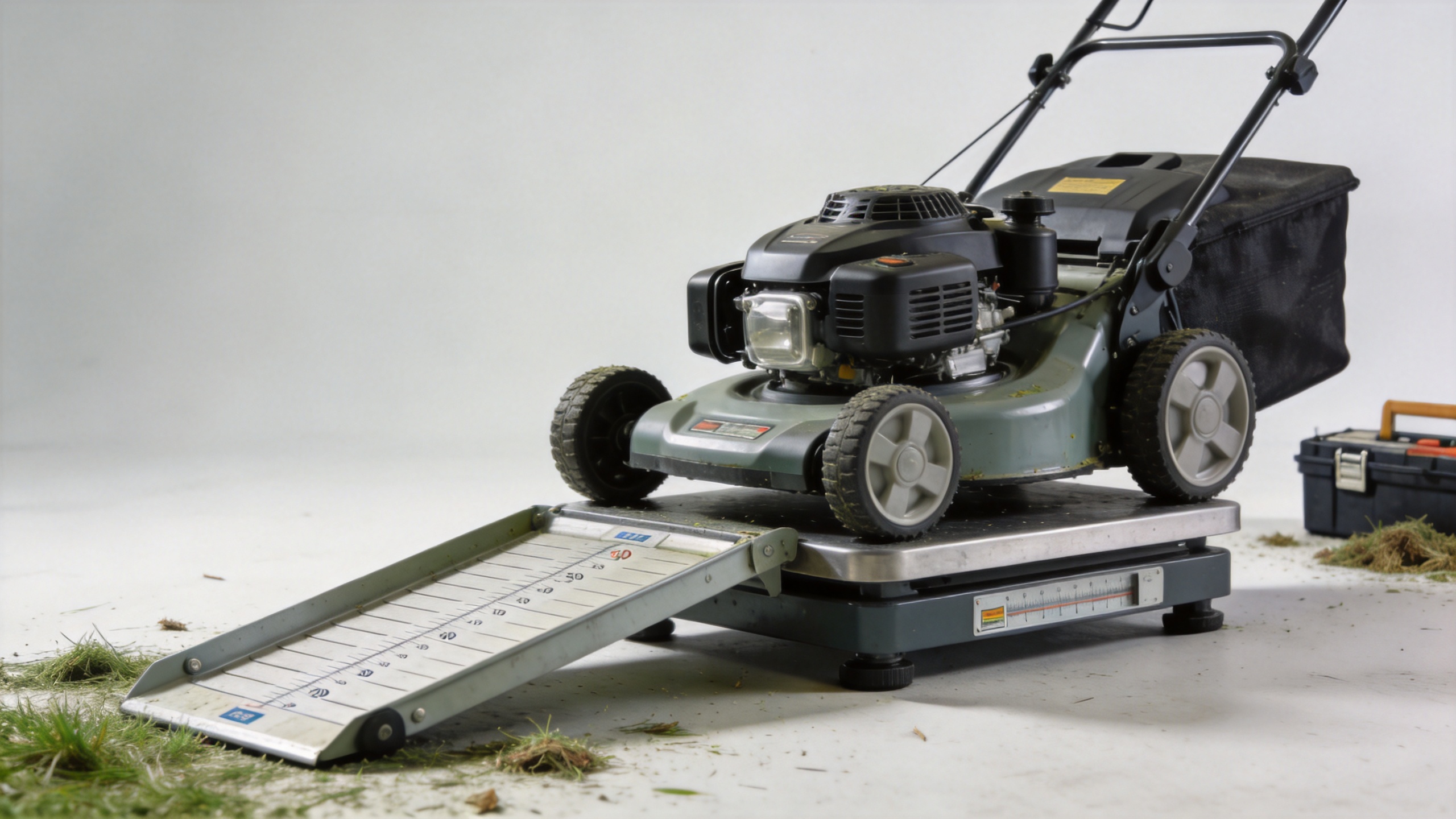
The ranges overlap because design matters. A 50-lb mower with a centered handle and large wheels may be easier to move than a lighter machine with an awkward grip or poor balance. Likewise, a battery can be removable; checking the bare-machine weight and the ready-to-mow weight gives a more realistic comparison.
Why the published weight can be confusing
First impressions often focus on deck size or motor power. More accurately, the comparison starts with what the number represents. A lawn mower listing may show net weight, shipping weight, bare-tool weight, or total operating weight. A battery mower may be listed without its battery; a gas mower may be listed without fuel; and a bagging system can add both mass and bulk. Before comparing two machines, ask each supplier for the same set of values: mower-only weight, operating weight, folded dimensions, and any removable component weights.
A published weight also says little about the route the machine must travel. A mower that rolls easily across a flat concrete floor may be difficult to guide through a narrow gate, up a ramp, or over uneven turf. Evaluate unloading, access, storage, work, and return routes. This is especially important for sites with slopes, drainage edges, trees, or frequent turns.
What makes a lawn mower feel portable?
1. Rolling effort matters more than carry weight for regular use
If a lawn mower will be moved daily, wheels, handle height, and propulsion can matter as much as the scale reading. A self-propelled model may weigh more but reduce push effort on appropriate ground. That does not remove the need for safe control, however. On a slope, wet grass, or uneven ground, follow the manufacturer’s operating guidance and local site rules rather than assuming propulsion makes the mower easier in every direction.
2. Storage dimensions can decide the purchase
Portable does not automatically mean small. Check whether the handle folds, whether the grass bag detaches, and whether the stored mower fits the available doorway and floor area. A compact storage plan should also leave room to inspect blades, clean the deck, charge or remove batteries, and keep the machine dry. If a team must lift a mower onto a shelf or into a vehicle, establish the lift method before purchase instead of treating it as an afterthought.
3. Terrain changes the right weight range
Two sites with the same grass area can need different equipment. A light mower can be convenient on smooth, open turf, but may need more careful handling around ruts, tall growth, or boundary obstacles. A heavier mower may track more steadily in some conditions, yet it can be harder to turn, transport, and recover if conditions change. The decision should start with terrain, vegetation density, access width, and work frequency—not with a weight target alone.
Choose by task, not by a single number
For a small residential lawn, a lower-weight portable lawn mower may be appealing if the route to storage is short and the deck width suits the coverage required. For facilities, orchards, large grounds, or irregular vegetation, the relevant comparison may shift toward stability, propulsion, operating controls, and route management. In those cases, a heavier walk-behind lawn mower is not automatically a poor choice; it simply needs a more deliberate loading, storage, and safety plan.
Weight should also be considered alongside the people who will use the mower. Confirm who will load it, whether ramps or lifting aids are available, how often the machine is moved, and how maintenance is performed. A practical buyer checklist is more useful than a generic claim that lighter is inherently better.
- Record mower-only, operating, and shipping weight separately.
- Measure gates, ramps, vehicle openings, storage doors, and turning areas.
- Confirm the deck width, folded dimensions, handle layout, and wheel type.
- Identify whether batteries, bags, or accessories are removable before loading.
- Review slope, surface, vegetation, and visibility conditions before selecting a work route.
- Request the manufacturer’s current manual and loading guidance for the exact configuration.
How weight affects transport and storage
Transport planning is where a portable lawn mower weight range becomes concrete. A machine that is easy to roll into a shed might still need a rated ramp, secure tie-down points, and two people for vehicle loading. Do not rely on a cardboard-box weight or a retailer category label. Confirm the operational configuration, remove components only when the manual permits it, and use equipment rated for the load. For B2B purchasing, documenting this process helps operations, procurement, and site managers compare the same requirements.
The same logic applies to seasonal storage. Battery packs, fuel systems, cleaning procedures, and storage position must follow the specific manufacturer instructions. Keep the mower on a stable surface and avoid creating a route that requires workers to lift or maneuver beyond what the site can safely support.
Frequently asked questions
Is a 60-lb lawn mower portable?
It can be portable in the sense that it is a movable walk-behind lawn mower, especially if it folds and rolls well. For routine lifting, 60 lb may be too heavy for some users or situations. Evaluate the full route, available ramp, grips, and handling procedure instead of using the number alone.
Do battery lawn mowers weigh less than gas lawn mowers?
Not necessarily. Battery systems can reduce some mechanical components, but batteries add mass and vary by capacity. Compare ready-to-mow weight, not only the mower body, and confirm whether the battery is included in the published figure.
What should I ask a supplier about lawn mower weight?
Ask for the exact configuration’s net weight, operating weight, battery or fuel inclusion, folded dimensions, wheel and handle arrangement, approved loading method, and operating limitations. If the worksite has slopes or restricted access, provide those details for a more relevant recommendation.
Final takeaway
A portable lawn mower commonly sits somewhere between a lightweight 20–40 lb tool and a roughly 80–100 lb rollable walk-behind machine, with many everyday models in between. The right range depends on how the mower must be moved, not just where it will cut. Start with site access and handling conditions, then compare verified operating weight, dimensions, and manufacturer guidance. That approach makes a lawn mower comparison more useful for the people who will transport, store, and operate it.