EN
Why A Crawler Remote Control Lawn Mower Excels On Rough Terrain
Rough ground changes the mowing decision. Ruts, loose soil, wet grass, hidden edges, and changing grades can make a conventional wheeled machine hard to place accurately. A crawler remote control lawn mower is often worth considering because its tracks spread the machine’s contact area and its remote controls let the operator choose a safer observation point. Those benefits are real only when the mower, the site, and the operating plan match. The practical question is not whether every crawler mower can handle every slope; it is whether a particular machine can work safely and consistently on your terrain.
As a technical explainer for remote mowing equipment, I recommend starting with the ground rather than a headline specification. A crawler remote control lawn mower can be a strong fit for embankments, uneven grassland, orchard rows, roadsides, and other irregular sites, but the manufacturer’s operating limits, vegetation, route, weather, and operator procedures still set the boundary.
Tracks change how the mower meets the ground
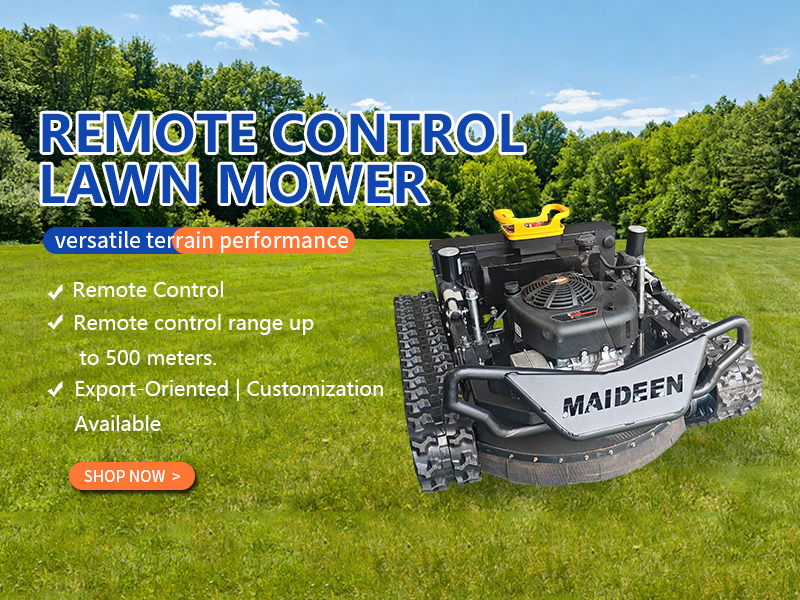
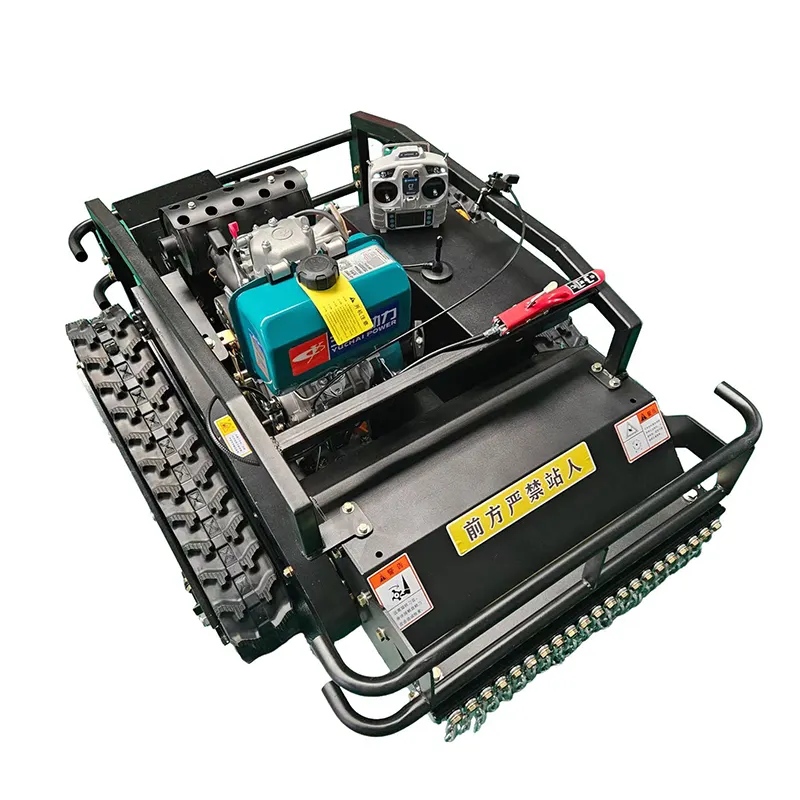
The main reason a crawler remote control lawn mower can perform well on rough terrain is the track system. A track creates a longer, broader contact patch than a typical tire. On soft or uneven ground, that can help distribute the machine’s load and reduce the tendency to sink or lose drive at a single wheel. Continuous track contact can also make movement feel more controlled where small holes, turf transitions, or loose material interrupt a route.
That does not make traction automatic. Wet clay, deep mud, concealed rocks, cross-slopes, and abrupt drop-offs can still defeat a crawler system. Track condition, tension, drive design, machine weight, and the way weight shifts while cutting all matter. Treat the undercarriage as a working system to inspect, not as a guarantee printed in a brochure.
Why remote control matters when terrain is unpredictable
A crawler remote control lawn mower separates the operator from the immediate path of the machine. On a rough bank or beside a drainage channel, that can allow the operator to stand on a more stable position while monitoring the route, obstacles, and discharge direction. It may also make it easier to pause, reverse, or change approach when the ground looks different from a distance.
Remote operation is a safety aid, not permission to work beyond the model’s limits. Before mowing, confirm the control range, line of sight, emergency-stop behavior, and manufacturer guidance for the planned slope. OSHA guidance for riding mowers similarly stresses following manufacturer slope limits; if a limit is not available, it advises avoiding slopes over 15 degrees. The exact limit for a remote crawler mower must come from its own documentation and site assessment, not from another machine type or an online claim.
Stability comes from planning the route, not from tracks alone
On rough terrain, the safest planned route is often not the shortest route. A crawler remote control lawn mower should be evaluated around grade changes, turn zones, wet patches, gullies, tree roots, curbs, fences, and places where the mower could slide toward an obstacle. Start with a slow perimeter pass on a dry, visible route when possible. If the surface changes, stop and reassess rather than trying to recover traction with speed.
- Check the surface: identify loose gravel, soft shoulders, holes, exposed roots, and hidden drainage features.
- Map the approach: choose entry, exit, turn, and stopping areas before the blades are engaged.
- Control vegetation risk: note grass height, tangled growth, branches, wire, and debris that could affect the cutter or tracks.
- Protect the operating zone: keep people, animals, and bystanders away from the machine’s route and discharge area.
This is where a multifunctional remote control lawn mower should be assessed carefully. Extra functions can be useful only if they support the actual work plan. A buyer should ask which functions are included, how they are controlled, and whether they change the machine’s balance, maintenance needs, or safe-use instructions.
Terrain, vegetation, and machine configuration must agree
A crawler remote control lawn mower is not selected by slope alone. Ground firmness, grass density, cutting frequency, obstacles, access width, and the required finish all influence the right configuration. Tall, dense growth raises the cutting load; irregular ground can increase shock and reduce visibility; narrow access can constrain how a machine turns or is transported. Review those conditions together before comparing engines, cutter styles, remote functions, or optional attachments.
| Site question | Why it matters | What to verify |
|---|---|---|
| What is the steepest continuous section? | Grade affects stability and route direction. | Model-specific slope limit and recommended travel pattern. |
| Is the soil firm, wet, loose, or mixed? | Surface condition affects traction and ground pressure. | Track condition, expected weather limits, and recovery plan. |
| What can the cutter encounter? | Brush, wire, stones, and roots can interrupt safe cutting. | Cutting-system guidance and the pre-mowing inspection process. |
| Where will the operator stand? | Remote control is useful only with clear sight and a stable position. | Control range, emergency stop, and exclusion-zone procedure. |
What buyers should request before choosing a crawler mower
The strongest buying conversation is evidence-based. Ask the supplier for the manual, the stated operating slope limit, dimensions, machine weight, track and cutter maintenance instructions, remote-control range, emergency-stop procedure, and configuration details that apply to your proposed site. A short site video, measured grade, photos of the surface, and notes on grass height help turn a general inquiry into a more useful suitability discussion.
For organizations managing several types of grounds, a multifunctional remote control lawn mower may deserve a separate configuration review. Do not assume an attachment or additional function is appropriate for slopes simply because it is offered for another task. Confirm its compatibility, operational limits, and service requirements in writing.
A practical decision framework
A crawler remote control lawn mower excels on rough terrain when track contact, remote positioning, cutting system, and work process all support the same job. It is especially relevant where wheeled traction is inconsistent and keeping the operator away from the immediate mowing path improves the working setup. Still, it should be treated as part of a controlled operating system: inspect the site, obey the model’s limits, plan the route, maintain the machine, and stop when ground conditions change.
Before placing an order, share your terrain measurements and task details with the supplier. A configuration discussion based on verified ground conditions is more useful than a blanket promise about rough-terrain capability.