EN
Why One key start lawn mower Improve Operation Convenience
A one-key start lawn mower can make the opening moments of a mowing job calmer and more repeatable. Instead of managing a pull cord or a multi-step ignition routine, the operator can use a defined control sequence to bring the machine to a ready state. That sounds like a small change, but on a property with repeated stops, handoffs, or scheduled maintenance work, reducing unnecessary start-up effort can improve the overall flow of the task.
Convenience is not the same as permission to skip preparation. A lawn mower still needs an appropriate operator, a clear work area, and the checks specified in its own manual. The useful question is not whether one-key starting makes every lawn mower easier in every setting. It is how the feature fits into a safe, practical routine from inspection through shutdown.
What One-Key Starting Changes in a Lawn Mower Routine
Traditional starting can require physical pulling, priming, choke adjustment, or several actions in a particular order. A one key start lawn mower commonly replaces some of that effort with an electrical or electronic start control. The exact sequence varies by model: a battery-powered lawn mower may require a safety key, a button, and a handle or presence-control bar, while another machine may use an ignition control and interlocks.
The convenience comes from consistency. When the operator knows the approved sequence, a lawn mower can move from prepared to running without the repeated force and timing associated with a recoil starter. This can be especially helpful where the workday includes several short mowing intervals rather than one uninterrupted pass. It may also reduce the hesitation of a trained operator returning to the machine after clearing a gate, changing a route, or pausing for a site check.
Still, a start button is not a shortcut around the controls designed to protect people and equipment. Safety guidance for mowers commonly stresses a clear area, proper guards, suitable ground conditions, and following the manufacturer’s operating instructions. For riding equipment, it also commonly emphasizes starting from the operator position with the machine in its approved start condition. Treat the one-key control as the final action in a prepared lawn mower workflow, not the first action of an unplanned one.
Why the Feature Feels More Convenient in Real Work
Less physical effort at the point of start
For an operator using a lawn mower repeatedly, removing a pull-start action can reduce a small but recurring source of effort. The benefit is not a promise of greater cutting capacity or a substitute for maintenance. It is a simpler start interaction that may be easier to repeat while wearing appropriate work gear and moving through a planned schedule.
A clearer handoff between operators
A consistent control sequence can make training and job handover more straightforward. Rather than relying on someone’s feel for a cord pull or fuel-start routine, a supervisor can document the approved steps for that specific lawn mower. The operator should still check the manual, safety devices, and site rules. But a visible, repeatable start procedure gives a team a more concrete point to teach and review.
Fewer interruptions in a segmented route
Many mowing tasks are not one long straight pass. Gates, obstacles, loading areas, and changing grass conditions can divide the route into sections. When a lawn mower must be stopped and restarted as the task changes, a simple approved start interface may reduce friction between those sections. It does not make an unsafe area safe, and it does not remove the need to assess slopes, wet grass, or bystanders before operation.
Build a Better Start Sequence Around the Control
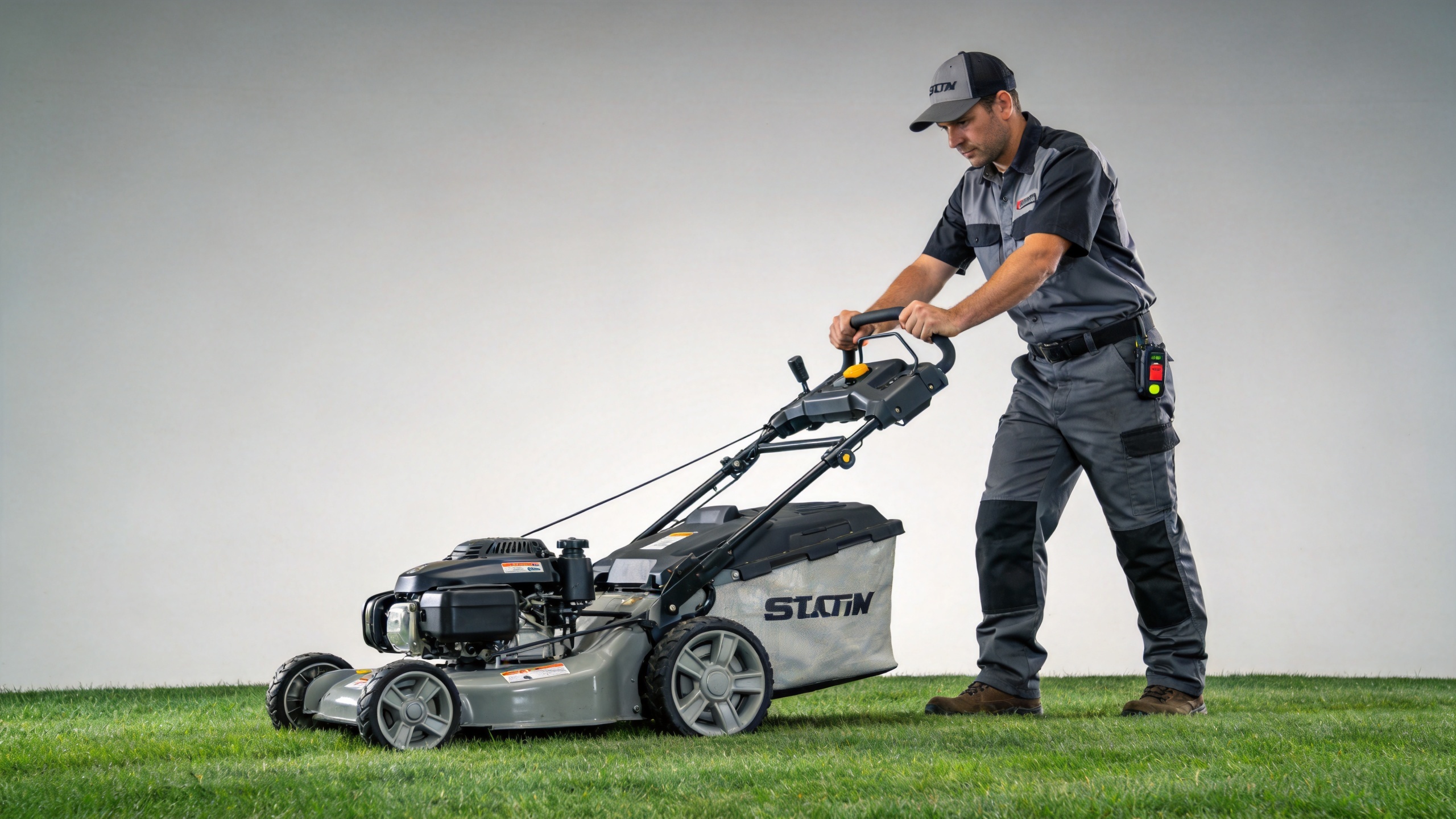
It is tempting to focus only on the button. A more useful approach is to split the lawn mower task into preparation, operation, and review. That makes the convenience feature support a disciplined process rather than distract from it.
Before starting
- Read the machine-specific manual and confirm the approved start sequence for the lawn mower.
- Walk the intended route and remove stones, branches, toys, wire, or other debris that could be struck or thrown.
- Check that guards, collection equipment, and controls are correctly positioned for the planned task.
- Assess grass conditions, weather, visibility, slope, and nearby people before bringing the lawn mower into operation.
- For battery equipment, confirm the battery, safety key, and charge condition as required by the manufacturer; for fuel-powered equipment, follow the stated fuel and ventilation instructions.
Once those checks are complete, the one key start lawn mower feature can do its intended job: offer a simple, defined way to activate the machine. In a well-run routine, the button is the last confirmation that the lawn mower is ready, not evidence that the area has been checked.
While mowing
After the lawn mower starts, pause long enough to confirm that the controls respond normally and the work area remains clear. Keep attention on the planned route, especially near changes in grade, trees, drains, parked equipment, and pedestrian areas. A convenient start system does not change a lawn mower’s traction, blade hazard, stopping distance, or stability. If the ground is wet, visibility is poor, or the machine behaves abnormally, stop and reassess according to the manual and local rules.
After the task
Convenience also matters at shutdown. Stop the lawn mower using its approved controls, secure it as specified, and record any condition that should be checked before the next shift. A team that makes start-up easy but ignores cleaning, inspection, or charging can create avoidable delays later. For a one key start lawn mower, confirm that the start key or relevant access control is handled according to the site’s storage and safety practice.
Questions to Ask When Comparing a One-Key Start Lawn Mower
When comparing options, do not treat a start button as an isolated selling point. Ask how it works with the rest of the lawn mower system:
- What actions must be completed before the start control becomes active?
- Which interlocks or safety controls are required, and how are they checked?
- Is the starting sequence practical for the actual operator, work gloves, and work schedule?
- How should the lawn mower be stopped, stored, charged, or refueled after use?
- What inspection and maintenance information does the supplier provide for the start system?
These questions keep convenience in proportion. A one-key control may be meaningful where repeated starts and operator comfort are relevant, but the appropriate lawn mower choice still depends on the terrain, vegetation, duty cycle, route design, and available training. If the site has slopes, tight boundaries, or changing surfaces, those conditions deserve attention before any convenience feature.
The Practical Value of a Simpler Start
A one key start lawn mower improves operation convenience when it turns an approved start procedure into a more repeatable action. It can reduce effort, simplify training conversations, and make short, interrupted mowing tasks easier to organize. Its value is strongest when the rest of the lawn mower workflow is equally clear: inspect first, start only in the approved condition, operate with attention to the site, and review the machine afterward.
For buyers and site managers, the next step is to request the model-specific operating information and compare the start control with the actual mowing environment. Put terrain, grass condition, operator training, maintenance expectations, and safety requirements ahead of a feature list. That approach makes it easier to decide whether a lawn mower with one-key starting is a useful fit for the job.