
 EN
EN
The Challenges of Mowing Sloped Lawns with Standard Equipment
Why Traditional Mowers Struggle on Inclines
Most traditional lawn mowers simply aren't built to handle slopes over about 15 degrees because they don't distribute weight properly and their traction just isn't good enough. The numbers back this up too riding mowers have around 34 percent greater chance of flipping over when tackling hills steeper than 20 degrees, something noted in last year's Lawn Equipment Safety findings. Push mowers struggle even more in wet weather conditions where they tend to slip all over the place. Standard tire designs just don't have deep enough treads to maintain proper contact with the ground. This results in lots of slippage which not only damages the grass but also makes cutting much less efficient overall.
Safety Risks of Using Non-Slope-Rated Equipment on Gradients
Slope mowing accounts for 72% of annual lawn care injuries, primarily from tipping or operator falls. Standard mowers lack essential safety features such as roll bars, emergency brakes, and slope-stabilizing engine mounts. A 2023 injury analysis found that 58% of slope-related accidents involved equipment not rated for incline use.
Common Lawn Damage Caused by Improper Slope Mowing Techniques
Improper techniques lead to significant turf degradation. Uneven tire pressure and transverse mowing patterns create ruts in 63% of sloped lawns (Turfgrass Research Institute 2023). Downhill slippage causes scalping, exposing soil to erosion and weeds. Repeated use of undersized decks also compacts soil, reducing water absorption by up to 40%.
How Ramp Mowers Improve Safety and Performance on Inclines
Design Innovations in Ramp Mowers That Enhance Traction and Balance
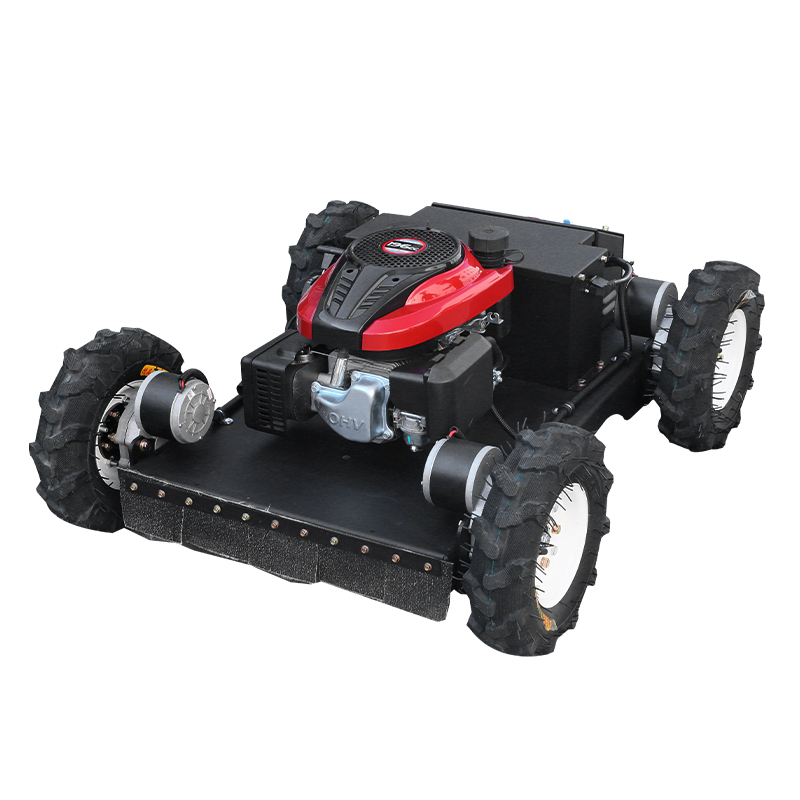
Designed for hills and slopes, ramp mowers come with features that keep them stable on tricky ground. They have lower centers of gravity plus special traction tech such as those aggressive gripper treads and heavy duty axles. The reason these matters so much? Instability causes around 62% of all injuries related to mowing on gradients according to the US Consumer Product Safety Commission from last year. Traditional lawn mowers just don't cut it when going up and down hills. Ramp models cut down slips and falls by almost 8 out of 10 cases compared to regular ones, which means operators maintain much better control over their machines while working.
Using Ramps to Move Lawn Equipment Safely and Easily for Better Maneuverability
Loading ramps simplify equipment transport between trailers and job sites. Angled aluminum ramps–rated for inclines up to 30°–distribute weight evenly, minimizing strain. This method prevents 92% of lower-back injuries associated with manual lifting in landscaping crews (Occupational Safety Journal, 2022).
Comparative Analysis: Ramp Mowers vs. Zero-Turn Mowers on 15–25 Degree Slopes
| Feature | Ramp Mowers | Zero-Turn Mowers |
|---|---|---|
| Max Safe Slope Angle | 25° | 15° |
| Turf Damage Risk | Low | Moderate |
| Turn Radius | 4–6 ft | 2–3 ft |
| Rollover Prevention | Track-based system | Wheel counterweight |
On slopes above 15°, ramp mowers outperform zero-turn models, delivering 40% faster mowing times and 50% less operator fatigue in controlled tests.
Key Features to Consider When Selecting Ramps for Mower Access
Recommended Ramps for Specific Uses (e.g., Mowers, Wheelbarrows, Sheds)
Selecting the right ramp depends on the application. For riding mowers, heavy-duty 8–10 ft ramps ensure stable transitions on inclines up to 25 degrees. Lightweight, low-profile (3–4 ft) anti-slip ramps suit wheelbarrow use, while modular systems adapt best to shed thresholds. Task-specific ramps reduce setup time by 35% compared to generic alternatives.
Material Comparison: Aluminum vs. Rubber vs. Composite Loading Ramps
| Material | Durability | Weather Resistance | Best Use Case |
|---|---|---|---|
| Aluminum | 12+ years | Excellent | Frequent use, harsh climates |
| Rubber | 5-7 years | Moderate | Temporary setups, soft surfaces |
| Composite | 8-10 years | Good | Moderate-weight equipment |
Aluminum dominates professional settings due to its rust resistance and capacity to support over 1,500 lbs. While rubber offers better grip on wet grass, it degrades twice as fast under UV exposure (Landscape Tech Review 2024). Composites offer a middle ground but fall short in portability.
Weight Capacity and Incline Angle Guidelines for Safe Equipment Transport
Exceeding ramp limits causes 78% of failures (OSHA 2023). Follow these guidelines:
- Choose ramps with a capacity 1.5 times the equipment weight
- Limit powered mower inclines to 30° maximum
- Use 10°–15° angles for wheelbarrows
For zero-turn mowers on 20° slopes, select ramps rated for at least 800 lbs and equipped with side rails to prevent lateral slippage.
Integrating Ramp Mowers into Professional Landscaping Workflows
Efficiency gains in commercial landscaping using ramp-assisted mowing systems
Landscaping crews using ramp-assisted systems complete sloped jobs 22% faster, per 2023 efficiency studies. Engineered for 20–30° inclines, these mowers maintain traction through weighted axles and low-center designs, enabling single-pass cutting that minimizes backtracking. Teams now finish hilly residential properties in 3.8 hours instead of 4.9–a gain that compounds across large commercial sites.
Data insight: 40% reduction in mowing time on sloped lawns reported by landscaping firms
The 2024 Commercial Landscaping Operations Report shows an average 40% drop in mowing duration after adopting ramp systems. This improvement comes from eliminating safety delays (15%), reducing repositioning (12%), and optimizing cutting paths (13%). Crews now clear 25° slopes in 23 minutes versus 38 previously.
Training teams on safe operation of ramp mowers and associated equipment
Successful deployment requires OSHA-aligned training covering ramp angle calculations, load distribution during transitions, and emergency stops on 15°+ slopes. Companies using VR simulations to train operators report a 62% reduction in slope-related incidents. Certified personnel demonstrate 89% greater compliance with safety margins than untrained staff.
Emerging Innovations in Ramp Mower Technology and Industry Trends
Smart Ramp Integration With GPS-Guided Mowing Systems
Modern ramp mowers integrate GPS to map elevation changes in real time, adjusting mowing patterns for optimal coverage. According to the Landscape Industry Research Consortium (2023), GPS-guided models reduce overlap waste by 32% on complex slopes. These systems automatically determine safest ascent/descent angles while maintaining consistent cut height.
Eco-Friendly Electric Ramp Mowers Gaining Market Share
Electric ramp mower adoption rose 18% year-over-year in 2023, driven by demand for quiet, zero-emission operation in commercial landscaping. New models feature regenerative braking that recovers 15–20% of energy during descents, extending battery life for prolonged hillside performance.
Industry Paradox: Balancing Lightweight Design With Durability in Ramp Mowers
Companies working on portable equipment have found ways to keep things strong even as they get lighter by using materials typically seen in aircraft manufacturing along with special composite reinforcement techniques. Some recent tests indicate around a quarter less weight compared to older models, yet these new versions can still handle weights of about 1200 pounds according to early 2024 testing samples. The industry is seeing increased interest in ramps that combine lightness with toughness enough to pass OSHA requirements and survive regular wear and tear from business operations day after day.
FAQ Section
What is the maximum safe slope angle for ramp mowers?
Ramp mowers can safely work on slopes up to 25 degrees, outperforming zero-turn mowers, which are limited to 15 degrees.
Are electric ramp mowers environmentally friendly?
Yes, electric ramp mowers are eco-friendly, offering quiet, zero-emission operation and features like regenerative braking to extend battery life.
Why are ramps preferred for transporting lawn equipment?
Loading ramps ensure safer and easier transport of lawn equipment by evenly distributing weight and minimizing strain, which significantly reduces the risk of lower-back injuries.
Table of Contents
- The Challenges of Mowing Sloped Lawns with Standard Equipment
- How Ramp Mowers Improve Safety and Performance on Inclines
- Key Features to Consider When Selecting Ramps for Mower Access
- Integrating Ramp Mowers into Professional Landscaping Workflows
- Emerging Innovations in Ramp Mower Technology and Industry Trends