
 EN
EN
Ground contact area creates basic traction advantage
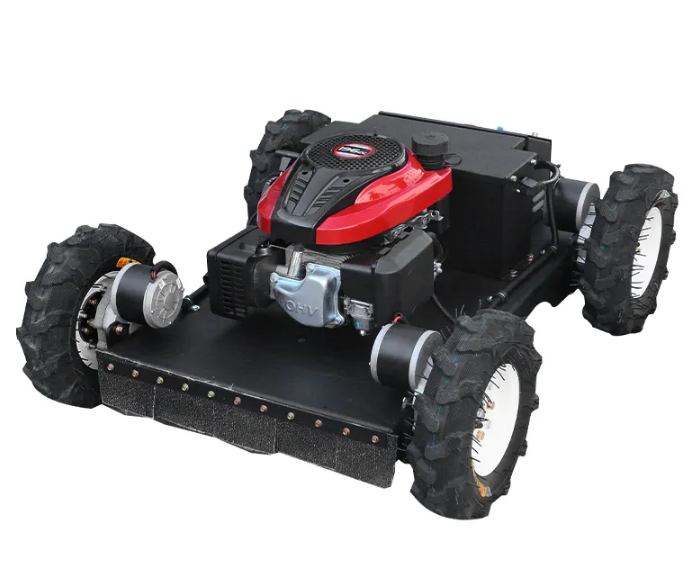
The core difference between tracked and wheeled garden equipment lies in the contact mode with the ground. Wheeled designs only rely on several narrow tire surfaces to touch the land with limited contact range and concentrated pressure. Once stepping on soft muddy soil the tires are easy to sink into the mud layer and slip in place. A tracked lawn mower adopts integrated belt structure to expand the contact area with the ground greatly dispersing the overall weight evenly on the soil surface. Uniform pressure distribution avoids local sinking fundamentally laying a solid foundation for stable walking on muddy ground.
Built in reinforced structure enhances anti slip performance
Ordinary rubber tires have smooth surface texture with limited friction on wet muddy ground easy to slide sideways when turning or climbing small slopes. Tracked versions use professional engineering rubber materials embedded with steel wire and steel plate inside to increase surface friction texture significantly. The special grain design on the track surface can bite into wet soil tightly locking the walking route firmly. Even on slippery muddy roads it will not drift or slip sideways maintaining straight and stable moving direction all the time.
Uniform pressure distribution prevents sinking effectively
Muddy ground is soft and porous unable to bear concentrated heavy pressure for a long time. Wheeled machines gather weight on four contact points which will gradually press into the soft mud and get stuck unable to move forward. The continuous track structure spreads the whole machine weight over a wide area making each unit of soil bear small pressure only. This balanced stress state lets the machine float on the mud surface instead of sinking deep down. It can pass through puddle interleaved muddy roads without stagnation completing trimming work smoothly.
Adaptive chassis fits uneven muddy terrain
Muddy ground is often accompanied by potholes small ridges and uneven undulations. Wheeled models are prone to jolting and tilting when passing bumpy points affecting cutting stability and even causing body roll over in serious cases. The flexible connection design of tracked structure can adapt to small height changes of the ground automatically keeping the chassis always fit the terrain contour. This fitting effect ensures the machine keeps balanced while moving on rugged muddy land and maintains consistent cutting height without frequent manual adjustment.
Stable power transmission improves walking efficiency
When wheeled machines slip on muddy ground most power is consumed in idle rotation wasting fuel and reducing working progress. The tight meshing structure inside tracked equipment transmits engine power to the ground efficiently with almost no idle slip loss. Power output can be fully converted into forward driving force allowing the machine to move steadily at a constant speed even on thick mud layers. It keeps high working efficiency without frequent stop and restart caused by slipping and stuck situations.
Strong terrain compatibility expands application scenarios
Besides ordinary muddy ground tracked equipment also performs well on wet grassland soft farmland and steep muddy slopes where wheeled models can hardly work normally. Its excellent traction and passing ability make it suitable for orchards rural green belts river bank green spaces and other complex wet terrain. Choosing a tracked lawn mower no longer limits trimming work only to flat dry ground and realizes all weather and all scenario lawn maintenance easily.
Table of Contents
- Ground contact area creates basic traction advantage
- Built in reinforced structure enhances anti slip performance
- Uniform pressure distribution prevents sinking effectively
- Adaptive chassis fits uneven muddy terrain
- Stable power transmission improves walking efficiency
- Strong terrain compatibility expands application scenarios