
 EN
EN
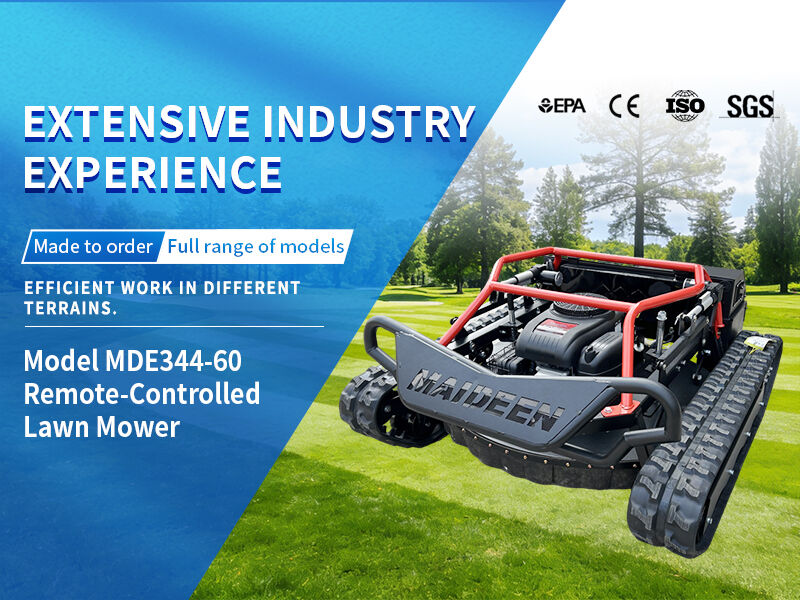
Why Tracked Remote-Controlled Lawn Mowers Excel on Steep Slopes
Tracked Mobility vs. Wheeled Systems: Physics of Traction, Weight Distribution, and 45–50° Climbing Stability
When it comes to tackling steep hills, tracked systems beat their wheeled counterparts thanks to how they interact with the ground. The continuous tracks spread out over a larger surface area, which means the weight gets distributed more evenly across the terrain. This actually cuts down on ground pressure by around 60 to 70 percent compared to regular wheels. What does this mean practically? Less slippage happens and there's significantly less damage to the soil, something that becomes really important when slopes exceed 30 degrees. On the flip side, standard wheeled mowers put all their weight into small contact patches. According to some studies looking at hillside stability, this setup can triple the chances of tipping over on slopes around 35 degrees. Tracked remote control mowers work reliably even on inclines between 45 and 50 degrees, whereas most wheeled models start struggling once they hit just 20 degrees. Another big advantage is their lower center of gravity, which drops by roughly 30 to 40 percent compared to traditional wheel designs. This makes them much harder to tip over when making those tricky sideways moves across uneven ground.
| Stability Factor | Tracked System | Wheeled System |
|---|---|---|
| Max Safe Slope Angle | 45–50° | 15–20° |
| Ground Pressure | 2–4 PSI (even spread) | 8–12 PSI (point load) |
| Traction Loss | <5% on wet 40° slopes | >40% on wet 25° slopes |
| Rollover Risk | Low (CG height <18") | High (CG height >28") |
This engineering enables reliable mowing on embankments, drainage ditches, and terraced landscapes—environments where wheeled units lose traction or destabilize.
Integrated Remote Control: Eliminating Operator Risk Without Compromising Precision or Responsiveness
Operating remotely takes workers off dangerous slopes while still maintaining super accurate cuts down to the millimeter level. The handheld controllers respond really fast, under half a second delay, which matters a lot when dealing with rocky terrain or unexpected drops beyond 1,000 feet away. No more worrying about falling, flipping over equipment, or getting hit by flying debris these days. According to landscape safety folks in their latest 2023 report, those three things cause around 70-75% of all injuries during hillside mowing jobs. With dual frequency signals and smart torque adjustments, blades keep spinning consistently even on steep 50 degree angles. When real time tilt sensors detect something's wrong, they shut everything down instantly. Plus there's this boundary mapping system that stops machines from going too close to cliff edges. What used to be death traps for operators has now become just another day at work for most crews.
Core Safety Engineering in Slope-Specific Tracked Remote-Controlled Lawn Mowers
Real-Time Tilt Detection, Automatic Emergency Shutdown, and ROPS Compliance for Incline Operations
About one third of all push mower accidents happen when people try to cut grass on hills steeper than 15 degrees according to a recent landscape safety report from 2023. That's why having proper safety features built into these machines isn't just nice to have it's absolutely essential. The newer tracked remote controlled mowers come equipped with several layers of protection starting with those fancy gyroscopic sensors that check the angle of tilt about 200 times every single second. If the machine starts tilting beyond what's safe usually somewhere between 30 and 45 degrees depending on what kind of ground it's working on the blades stop spinning within less than a fifth of a second. At the same time special counterweights kick in to keep everything balanced so the whole thing doesn't tip over. And there's something else too these machines have what's called ROPS Roll Over Protective Structures specifically designed for work on slopes. These structures form protective cages around important parts of the mower whenever there's any risk of it flipping over.
These systems deliver measurable safety gains:
- 91% reduction in blade-related accidents versus traditional mowers (2023 Outdoor Equipment Safety Reports)
- 72% decrease in human-error incidents via continuous diagnostics (2024 Smart Landscaping Survey)
- Instant traction redistribution through electronic stability control during instability events
The integrated architecture ensures full operational control from secure distances—and full compliance with OSHA and ANSI standards for slope-rated equipment. By merging predictive tilt response with structural rollover protection, these mowers transform high-risk terrain into controlled, repeatable work zones.
Performance That Delivers Consistent Results on Challenging Terrain
Field-Validated Mowing Efficiency: Cut Quality, Battery Endurance, and Obstacle Negotiation at 45°
Tracked remote-controlled lawn mowers achieve professional results on inclines up to 45° through three interdependent performance pillars:
- Precision Cut Quality: A low center of gravity and continuous track contact prevent scalping or uneven cuts on irregular surfaces. Independent suspension maintains consistent deck height across variable gradients.
- Extended Battery Endurance: Efficient brushless motors and intelligent power management deliver 90+ minutes of uninterrupted runtime—sufficient for 0.5-acre slopes without recharging.
- Intelligent Obstacle Negotiation: Integrated sensors detect rocks and debris, automatically modulating speed and torque. Track articulation provides 15 cm vertical clearance over roots and ruts—even at maximum incline.
Field validation confirms a 20% improvement in slope completion time versus wheeled alternatives, with no trade-off in finish quality or safety.
Selecting the Right Tracked Remote-Controlled Lawn Mower for Your Slope Requirements
Getting the right equipment starts with matching what engineers built into machines against what the land actually requires. First thing to check is how steep the hill really is. Machines designed for slopes at least 45 degrees have special weight balancing features and sit much lower to the ground, making them reliable even on super steep terrain. Then look at what kind of ground we're talking about here. Rocky or bumpy areas need stronger tracks and better shocks. For those soggy grass fields where wheels tend to spin out, deeper treads help keep things moving forward instead of getting stuck. Don't forget about safety stuff either. Real time tilt sensors combined with proper rollover protection can cut accident rates down by around 70% on hills steeper than 40 degrees according to recent safety reports from 2024. And last but not least, make sure batteries last long enough when working hard. The best commercial models typically run for over 90 minutes on moderate 35 degree slopes, though results might vary depending on conditions during actual field tests.
Key selection criteria include:
- Slope angle tolerance: Models certified for ≥45° operations
- Terrain adaptation: Track width and compound optimized for local soil type
- Safety redundancy: Dual-sensor tilt detection paired with auto-braking
- Operational efficiency: Verified battery capacity relative to slope energy demand
Matching technical capability to site-specific challenges ensures both uncompromised operator safety and consistently high-quality mowing outcomes.
Frequently Asked Questions (FAQ)
Why are tracked remote-controlled lawn mowers better for steep slopes?
Tracked mowers distribute weight over a larger area, reducing ground pressure and minimizing slippage, especially on slopes above 30 degrees, unlike wheeled mowers which have higher rollover risks.
What safety features do tracked remote-controlled mowers offer?
They come with real-time tilt detection, automatic shutdown systems, ROPS compliance to prevent rollovers, and multiple layers of safety protocols that significantly reduce accident rates.
How long can these mowers operate on a slope?
Most commercial models offer over 90 minutes of runtime on moderate slopes, thanks to efficient brushless motors and intelligent power management systems.
What should I consider when selecting a tracked lawn mower for my slope?
Key factors include slope angle tolerance, terrain adaptation, safety features like tilt sensors and rollover protection, and battery efficiency to match slope energy demands.
Table of Contents
- Why Tracked Remote-Controlled Lawn Mowers Excel on Steep Slopes
- Core Safety Engineering in Slope-Specific Tracked Remote-Controlled Lawn Mowers
- Performance That Delivers Consistent Results on Challenging Terrain
- Selecting the Right Tracked Remote-Controlled Lawn Mower for Your Slope Requirements
- Frequently Asked Questions (FAQ)