EN
How Does A Crawler Lawn Mower Distribute Weight On Soft Ground
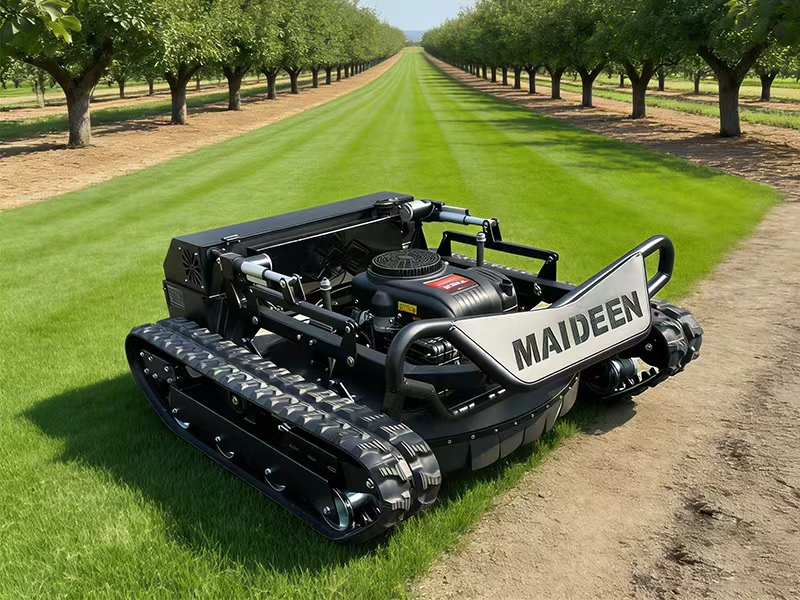
On wet turf, loose soil, or a recently softened orchard lane, the question is not simply whether a mower has enough drive power. It is whether the ground can support the crawler lawn mower without deep rutting, loss of steering control, or sudden sinkage. A crawler lawn mower addresses part of that problem by spreading its operating weight across two long tracks rather than concentrating it at a few tire contact patches. That wider footprint can reduce average pressure on the surface, but it does not make every soft site safe to mow.
From a technical selection perspective, the useful starting point is simple: ground pressure is related to load divided by the area supporting that load. A tracked machine increases the contact area, so the same crawler lawn mower mass is distributed over more ground. The real answer, however, also depends on soil moisture, slope, turns, obstacles, and the way the operator drives the crawler lawn mower.
The basic idea: a larger footprint lowers average pressure
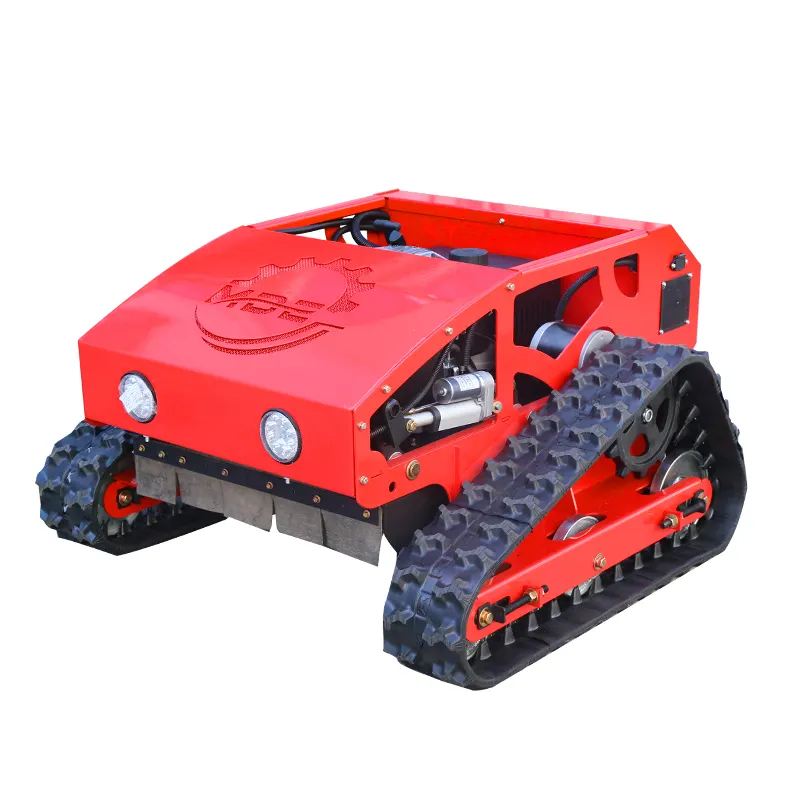
When a wheel rests on soft ground, much of the load passes through relatively small tire patches. A tracked crawler lawn mower uses two belts or track assemblies that contact the ground over a longer, wider rectangle. In simplified form, nominal ground pressure equals machine weight divided by the total track area actually touching the surface. Increase usable contact area and the average pressure tends to fall.
That matters because weak ground deforms when the applied load exceeds what it can support. By distributing weight across both tracks, a crawler may leave shallower impressions and maintain forward motion where a wheeled mower begins to sink or spin. It is an advantage of geometry, not a guarantee of flotation. Track width, track length on the ground, machine mass, attachment load, and the soil’s own bearing strength all still matter.
How the tracks share the load
1. Two track paths carry the machine instead of four small patches
At rest on level ground, the crawler lawn mower chassis transfers its weight through the left and right undercarriages. Each track supports roughly part of the total load, though the split can vary with terrain and machine condition. The track belt then passes that load into the soil along its contact length. A well-supported track system helps avoid a single high-pressure point that can break through a soft surface.
2. Rollers and the track frame spread load along the contact length
Inside the undercarriage, rollers and the track frame guide the belt and help distribute chassis load over the section of track on the ground. In practical terms, the pressure is not perfectly uniform from front to rear; local peaks can occur around rollers, idlers, terrain edges, and obstacles. Still, a longer supported contact patch generally creates a more forgiving load path than a narrow wheel footprint.
3. A low center of gravity can help, but it does not replace site assessment
Many tracked designs place substantial components low in the chassis. A lower center of gravity can reduce the tendency to tip on uneven ground, yet stability is affected by far more than height alone. Side slopes, holes, hidden stumps, wet grass, abrupt braking, and attachment position can move the crawler lawn mower load toward one side. Treat a crawler lawn mower as a machine that needs a defined operating envelope, not as a substitute for safe slope and ground-condition checks.
Why soft ground can still cause trouble
It is tempting to assume that tracks solve soft-ground mobility. In reality, soil response changes with water content, compaction, organic layers, roots, and previous traffic. Saturated ground may shear beneath the tracks even when the crawler lawn mower’s average pressure appears reasonable. A crust can feel firm during a walk-around but collapse when a heavier mower passes over it.
- Sinkage: If the soil compresses or shears, the tracks settle and create more rolling resistance.
- Unequal support: A rut, buried edge, or soft strip can load one track more heavily than the other.
- Dynamic load transfer: Climbing, descending, braking, or traversing across a slope shifts weight. The downhill, front, or outside track may carry more than its share.
- Turning scrub: Tight turns can drag a track sideways, disturbing turf and increasing local stress even when straight-line travel is acceptable.
So the better question is not “Will a crawler lawn mower float?” It is “Can this site support the crawler lawn mower while it travels, turns, cuts, and stops under today’s conditions?”
What changes the weight distribution during mowing?
Travel direction and slope
On an incline, gravity shifts load toward the downhill end of the machine. During uphill travel, the rear portion may carry more load; during descent, the front portion may be more heavily loaded. A cross-slope can increase the load on the downhill track. This is why a model’s general track layout should not be treated as proof that a particular slope is suitable. Follow the manufacturer’s stated slope limits and operating instructions for the actual crawler lawn mower configuration.
Acceleration, braking, and turning
Smooth inputs keep load changes gradual. Fast acceleration can transfer load rearward, while hard braking transfers it forward. On soft surfaces, pivot-like turns and repeated tight turns may tear vegetation or form ruts because the tracks must scrub across the surface. Plan wider turns where the site allows, slow down before a weak area, and avoid stopping with one track perched on a raised edge.
Grass, debris, and concealed obstacles
Dense grass can hide water channels, animal holes, roots, stones, and old wheel ruts. These conditions do not just affect traction; they interrupt support beneath the track. Before operating a crawler lawn mower, walk the route where practical, mark hazards, and identify a route back to firm ground. If the mower begins to sink noticeably or loses predictable response, stop rather than continuing to excavate itself with the tracks.
A practical soft-ground check before you mow
- Inspect moisture and drainage. Look for standing water, glossy mud, seepage, or ground that deforms deeply under a boot. These signs call for caution or postponement.
- Check the intended route. Identify ditches, culverts, soft shoulders, depressions, and transitions from firm ground to loose soil.
- Confirm machine-specific limits. Use the operating manual for permitted slope, payload or attachment condition, and track setup. Do not infer limits from another mower or a product listing.
- Start with a controlled pass. Test a small, low-risk area at slow speed in a straight line. Watch track marks, sinkage, steering response, and whether the turf shears.
- Plan turns and exits. Keep turns gentle on vulnerable ground and retain a clear path toward firmer terrain.
- Stop when conditions change. Rain, irrigation, shade, and repeated passes can turn a workable route into an unsuitable one during the same job.
How to compare crawler mower options for soft sites
When discussing a tracked mower with a supplier, move beyond a headline claim about all-terrain capability. Ask for the actual machine mass, track dimensions, track construction, recommended operating slopes, cutting configuration, and manual for the exact crawler lawn mower model. These details let a buyer estimate how the crawler lawn mower will distribute weight and whether its operating boundaries fit the job.
| Question to confirm | Why it affects soft-ground work |
|---|---|
| What is the operating mass in the proposed crawler lawn mower configuration? | Added equipment changes the total crawler lawn mower load the ground must carry. |
| What track width and ground-contact length does the model use? | Together they influence the nominal supporting area. |
| What slope and surface conditions does the manual permit? | Weight shifts on slopes and wet turf can reduce stability. |
| How does the machine turn? | Turning method affects turf disturbance and localized track loading. |
| What inspection and recovery procedure is recommended? | A clear procedure helps operators respond before sinkage becomes a recovery event. |
The bottom line
A crawler lawn mower distributes weight on soft ground by placing the load over a larger total track contact area. The tracks, rollers, and undercarriage share that load along two longer footprints, which can lower average surface pressure and improve mobility compared with a similar load concentrated on small wheels. Yet average pressure is only one part of the decision. Soil strength, water content, slope, maneuvering, and hidden features determine whether the site remains workable.
For reliable results, evaluate the crawler lawn mower and the ground together. Confirm the exact model’s documentation, inspect the route, test conservatively, and operate smoothly. That approach protects turf, reduces the chance of bogging down, and helps determine when a crawler configuration is appropriate—and when the safer choice is to wait for firmer conditions.