EN
Why Orchard Weeders Reduce Manual Weeding Costs
For an orchard manager, weed control is rarely one big expense. It is a repeating set of small jobs: clearing strips beneath trees, returning to missed patches, working around trunks and irrigation lines, and sending people back after fast regrowth. An orchard weeder can reduce manual weeding costs because it changes how much of that repeat work must be done by hand. It does not make supervision, boundary work, or maintenance disappear. It can, however, move the highest-volume work into a more repeatable machine-assisted pass.
The useful question is not “Will an orchard weeder eliminate labor?” It is “Which labor hours can this orchard weeder safely replace, and which hours will remain?” That distinction produces a more credible budget than a headline percentage saving.
Manual weeding costs more than the time spent pulling weeds
Hand crews usually face a stop-start workflow. Workers walk or drive between rows, adjust around trunks and obstacles, inspect the strip, remove weeds, and then repeat. In uneven ground, wet conditions, dense growth, or orchards with many young trees, pace changes again. A labor estimate based only on planted area can therefore miss the real cost.
Break the task into labor blocks instead: travel and setup, active weeding, rework of missed areas, supervision, cleanup, and the return visit when growth resumes. That is often where an orchard weeder earns its place. It can cover the open, repeatable portion of the task while people focus on inspection and the small areas where mechanical access is inappropriate.
Research on weed management consistently treats mechanical control as a way to remove emerged weeds and reduce weed pressure. Field-capacity results from other crops also show why manual work is often the slowest option, but those figures should not be transferred directly to a particular orchard. Tree spacing, slope, soil, vegetation, and operating procedure determine the result.
How an orchard weeder changes the labor equation
It turns repeated walking into repeatable passes
When rows are accessible and the surface is prepared, an orchard weeder lets one operator make a planned pass instead of having several people clear the same kind of growth by hand. The gain comes from repeatability: route planning, turning points, and coverage can be organized before work starts. A remote or ride-on machine does not remove the need for an operator, but it can concentrate that operator’s effort on controlling the work rather than physically removing every plant.
It reduces the rework caused by inconsistent coverage
Manual work can be thorough, especially near sensitive trunks, but quality can vary with fatigue, weather, and the size of the crew. A well-matched orchard weeder provides a consistent working method across the open portions of the orchard. This makes it easier to record which rows were completed, spot exceptions, and schedule touch-up work only where it is needed.
It shifts people toward higher-value decisions
Labor savings are most useful when people are reassigned rather than simply removed from the plan. After an orchard weeder handles suitable strips, staff can inspect young trees, check irrigation, remove debris, monitor plant health, or deal with tight spaces. Those tasks still need judgment. The machine-assisted pass creates time for them by reducing the volume of repetitive ground-cover work.
Build a cost comparison before buying
A practical comparison has two columns. The first is the current manual process. The second is the process after introducing an orchard weeder. Use the same time period, such as one growth cycle or one season, and include every meaningful input.
| Manual process | Machine-assisted process |
|---|---|
| Crew hours for routine strip clearing | Operator hours for planned passes |
| Travel, setup, and supervision time | Route setup, inspection, and supervision time |
| Repeat visits and touch-up work | Targeted hand finishing where access is limited |
| Tools and consumables | Fuel or charging, wear parts, servicing, and storage |
| Weather-related schedule changes | Weather, traction, visibility, and safe-operating limits |
Then calculate the difference in labor hours first, not just the difference in wage cost. Wage rates, seasonal staffing, and overtime vary by operation. Hours are the transferable measure. If an orchard weeder reduces repeat manual hours but requires frequent repairs or slow setup, the comparison will reveal that tradeoff before it becomes an unpleasant surprise.
Where remote-control mowing equipment fits
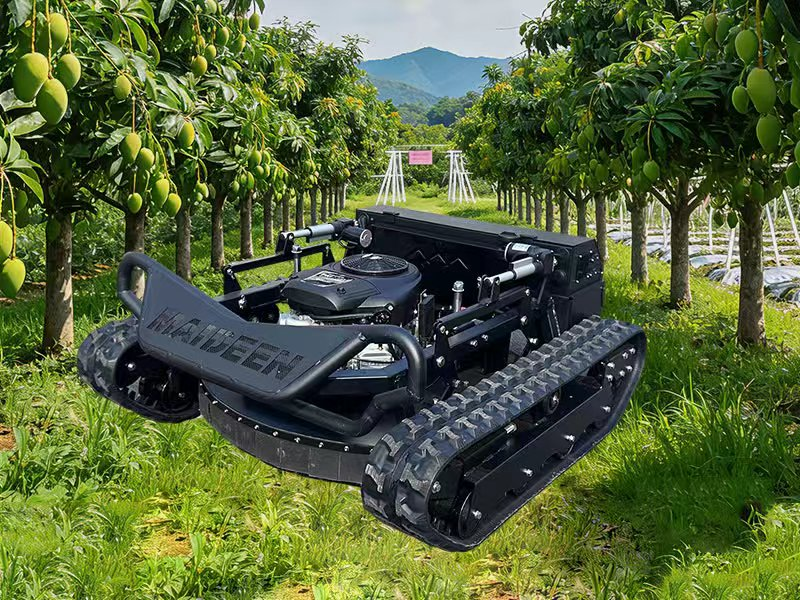
An offroad crawler remote control lawn mower can be relevant when the objective is managing vegetation across accessible orchard lanes, slopes, or rough ground. It is not automatically the same tool as an orchard weeder. Mowing cuts vegetation; a weeding method may target growth closer to trunks or disturb weeds in a different way. The right choice depends on the job definition.
For some sites, an offroad crawler remote control lawn mower may reduce the time spent keeping inter-row vegetation manageable, while an orchard weeder or a small hand crew handles the zones where precision matters. Treat these as complementary task assignments, not interchangeable labels. Before choosing either, map the ground: row width, turning room, trees, irrigation components, ditches, rocks, visibility, and the areas that require hand finishing.
Conditions that protect the savings
An orchard weeder delivers a better labor result when the operating plan is realistic. Start with a pre-work inspection. Remove loose obstacles, identify wet or unstable zones, set a safe route, and define how close the equipment may work near trunks and infrastructure. Efficiency matters, but it should not be used to skip safety checks.
- Match the machine to vegetation. Tall, dense, woody, or wet growth may change the workable speed and the number of passes.
- Account for terrain. Similar-sized blocks can require very different labor when slopes, ruts, or obstacles change.
- Plan maintenance. Wear parts, cleaning, inspection, and support arrangements belong in the cost model.
- Keep a hand-work allowance. Edges, protected young trees, and inaccessible corners often need a separate method.
- Review actual hours after each cycle. Compare planned and actual operator, hand-finishing, and downtime hours before scaling up.
A sensible way to test an orchard weeder
Choose one representative block rather than assuming that a demonstration proves suitability everywhere. Record the manual hours normally used there. During a trial, record setup time, operating time, touch-up time, stoppages, and the condition of the finished strip. Repeat the test in different vegetation and ground conditions if those conditions are common on the farm.
It also avoids a common mistake: choosing an orchard weeder solely by nominal power or size. More capacity does not automatically mean lower cost in narrow rows, around frequent obstacles, or where safe visibility is limited. A smaller, better-matched workflow may preserve more of the expected labor saving.
Conclusion: reduce repetitive work, then verify the total cost
An orchard weeder can reduce manual weeding costs by taking repeatable, high-volume vegetation work out of a hand-only routine. The strongest business case comes from measured labor hours, clear task boundaries, and an allowance for operation, maintenance, and finishing work. For orchards considering an offroad crawler remote control lawn mower, the same rule applies: define the vegetation task first, verify the site conditions, and compare the whole workflow rather than a single machine specification.
Before requesting a configuration or quotation, prepare a short site brief with row spacing, slope, vegetation type, obstacles, work frequency, and the labor hours currently spent on each task. That makes it much easier to judge whether an orchard weeder will genuinely lower recurring manual work in your orchard.