EN
How Does A Radio Controlled Lawn Mower Handle Uneven Terrain?
A radio controlled lawn mower can make rough-ground mowing more manageable because the operator can stand away from the machine while choosing its route. That benefit does not mean every uneven site is automatically suitable. A useful answer starts with the ground itself: slope angle, soil firmness, grass height, hidden holes, drainage channels, roots, rocks, and the room available to turn. For a buyer or site manager, the question is less “will it mow uneven terrain?” and more “which terrain conditions can this exact machine handle within its documented limits?”
As a practical equipment-selection rule, put the task before the specifications. A radio controlled lawn mower may be a better fit than a ride-on machine when the site includes awkward banks, rough verges, orchard rows, or areas where keeping the operator away from the cutting path improves workflow. But traction, stability, cutting quality, and safe control all change as the terrain becomes steeper, softer, wetter, or more broken up.
What uneven terrain changes for a radio controlled lawn mower
Uneven terrain asks the mower to maintain ground contact while the cutting deck and drive system move over rises, depressions, side slopes, and loose material. A radio controlled lawn mower generally handles mild undulation by allowing the operator to slow down, select a deliberate travel line, and watch the machine from a safer viewing position. However, the same terrain can become difficult when one wheel or track unloads, the deck catches a ridge, the machine crosses a rut at an angle, or wet grass reduces grip.
Three factors work together. First, the drive system must generate usable traction without tearing soft ground. Second, the machine’s weight distribution and center of gravity must remain appropriate for the direction of travel. Third, the cutting system needs enough clearance and correct height adjustment to avoid scalping high spots or packing wet clippings underneath. This is why a remote control grass mower should be judged by its complete operating setup rather than by a single advertised feature.
Traction is useful only when the surface can support it
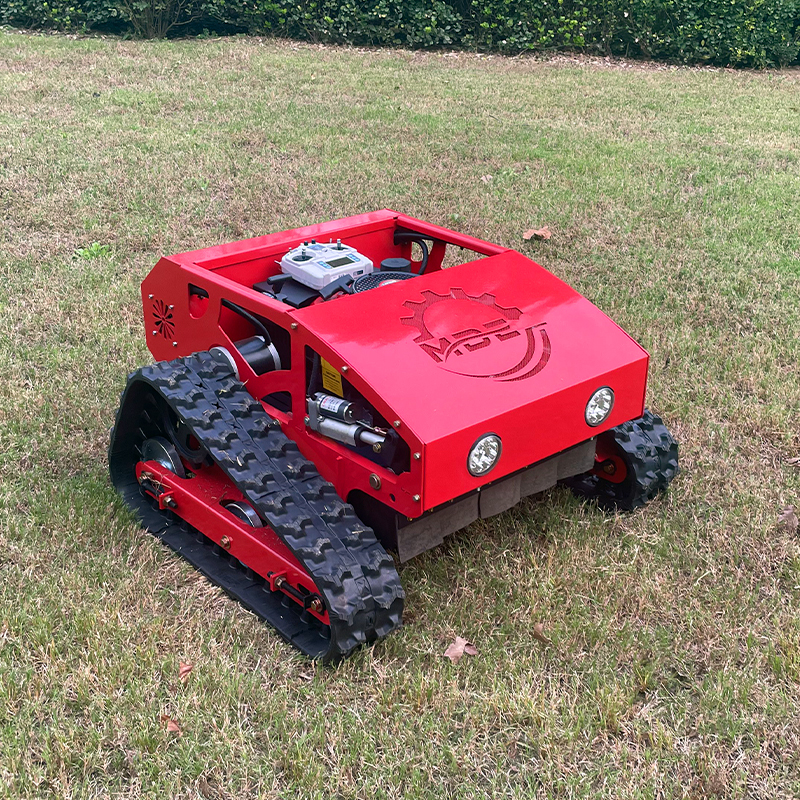
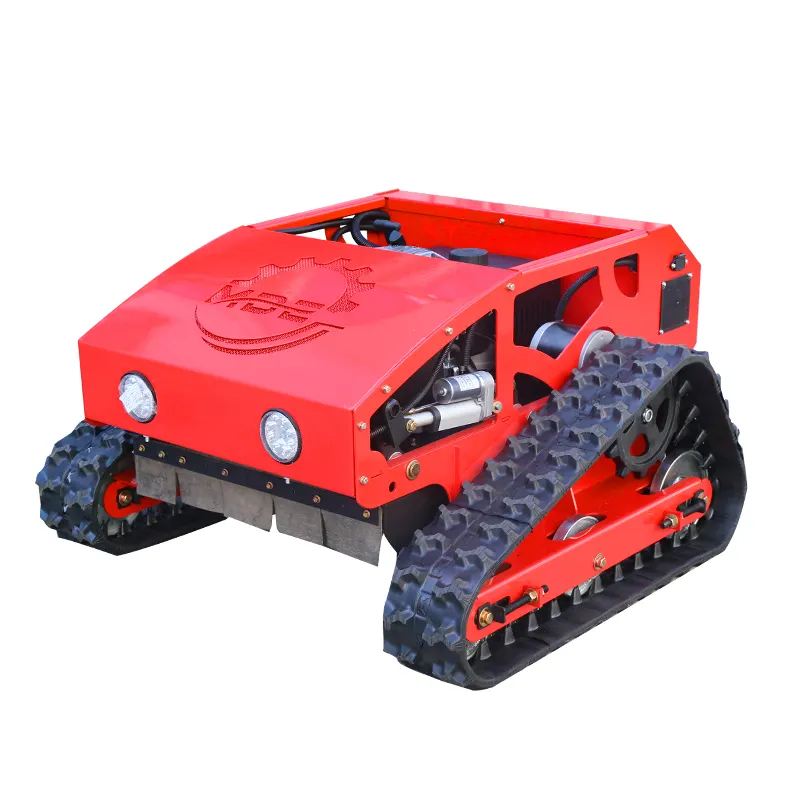
Wheels or tracks can help a radio controlled lawn mower maintain forward movement, but neither removes the effect of mud, loose gravel, wet leaves, or tall tangled vegetation. Tracks often spread load over a larger area and can be helpful on soft or irregular ground; wheel-based machines may be easier to maneuver on firmer turf. The better choice depends on the actual surface, not on a generic “all-terrain” label.
Before work begins, walk the planned route. Look for sink points, washouts, exposed roots, rocks, irrigation hardware, and grass that hides a sudden drop. If the ground is saturated, delay the job rather than assuming remote operation makes the condition safe. A remote control grass mower can keep a person farther from the machine, but it cannot create traction where the soil is failing.
Slopes require a model-specific, condition-specific decision
The slope rating for a radio controlled lawn mower is not a universal permission to mow every hill at that angle. It is a limit that must be read alongside the manufacturer’s instructions, surface condition, vegetation, attachment configuration, and direction of travel. A dry, uniform grassy incline can behave very differently from the same incline after rain or when crossed by ruts and side cambers.
OSHA’s guidance on mower rollover hazards emphasizes site assessment and terrain-appropriate equipment, and points to slope indicators as a way to determine angle. That is a sound planning principle here: measure rather than guess. Where a site includes sharp breaks, ditches, embankment edges, or uncertain footing, mark the area for a different method or obtain guidance for the exact mower before proceeding. Do not turn a product-specific slope claim into a blanket promise for every radio controlled lawn mower.
How to route the mower across bumps, ruts, and side slopes
Route planning often matters more than trying to travel at maximum speed. Start with a slow test pass in a visible, lower-risk section. Approach shallow ruts and humps at an angle that keeps the machine controlled, while avoiding a path that puts it close to a drop-off. On a side slope, watch for gradual sideways drift, sudden changes in engine or drive load, or any loss of steering response. Stop and reassess instead of correcting aggressively near a hazard.
Keep turns wide where possible. Tight turns on a slope can shift load quickly and disturb the turf. A radio controlled lawn mower also needs a route that preserves line of sight and radio-control range. Trees, banks, parked equipment, and vegetation can change what the operator can see, so position yourself where you can observe both the mower and its escape path.
Set cutting height for terrain, not just for grass appearance
A low cutting height may look tidy on flat turf, yet it can make a radio controlled lawn mower more likely to scalp crests, strike hidden obstacles, or collect clippings in dense growth. Begin with a conservative height when the ground is unknown, then adjust after observing clearance and cut quality. In taller vegetation, make more than one pass if the exact machine manual permits it. Trying to remove too much material in a single pass can reduce visibility and increase resistance at the deck.
For a remote control grass mower, grass condition is part of terrain assessment. Long, damp grass may conceal holes and debris, while dense stems can change how smoothly the cutting system works. Clear visible obstacles first and keep people, animals, and property outside the operating area.
A pre-operation checklist for uneven ground
- Confirm the exact radio controlled lawn mower model, approved configuration, and documented slope/terrain limits.
- Measure questionable slopes; do not rely only on visual estimates.
- Walk the route and flag holes, soft edges, drainage features, rocks, roots, and overhead or hidden obstacles.
- Check soil moisture, grass density, and whether the surface has become slippery since the last inspection.
- Set a conservative cutting height and plan a low-speed test pass.
- Maintain line of sight, establish an exclusion zone, and verify the stop-control procedure before engaging blades.
- Stop immediately if traction, steering, deck clearance, or visibility changes unexpectedly.
What to verify before selecting a machine
Ask the supplier for the operating manual, rated slope limit, recommended travel directions, drive-system details, deck clearance, emergency-stop behavior, and the conditions under which any traction aid is approved. Also describe the site with useful facts: maximum measured slope, wet areas, typical grass height, obstacle types, access width, turning space, frequency of mowing, and whether operators will work near roadsides or water.
That approach avoids treating a radio controlled lawn mower as a one-size-fits-all answer. It may provide a practical way to handle irregular ground when its design and operating limits match the job. The safest outcome comes from matching the machine to verified terrain conditions, using conservative routes, and stopping whenever the site moves outside the documented operating envelope.