EN
How Does Trackmounted remote lawn mower Keep Balance On Uneven Land
Uneven ground changes mowing from a cutting task into a stability task. A remote control lawn mower can help the operator work from a safer viewing position, but remote control alone does not make a machine stable. On rutted grass, side slopes, orchard rows, and rough verges, balance comes from the relationship between the mower’s geometry, tracks, center of gravity, ground conditions, and operating method.
For buyers evaluating a trackmounted machine, the useful question is not “Can it remain stable on this route?” No responsible supplier can promise that without a site assessment. The better question is how a remote control lawn mower is designed to resist sliding, pitching, and rollover—and what the operator must still verify before starting work.
Balance starts with the support footprint
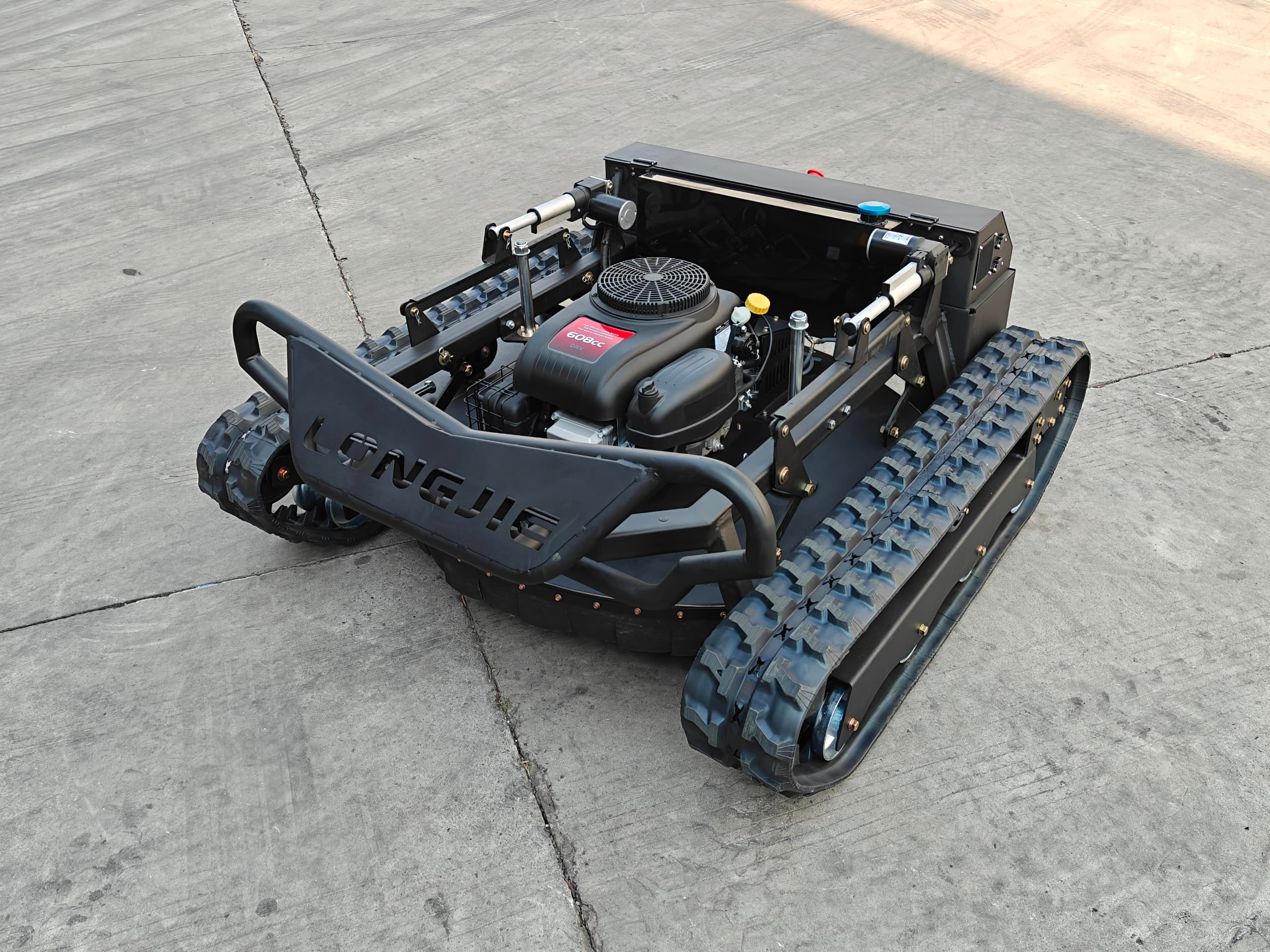
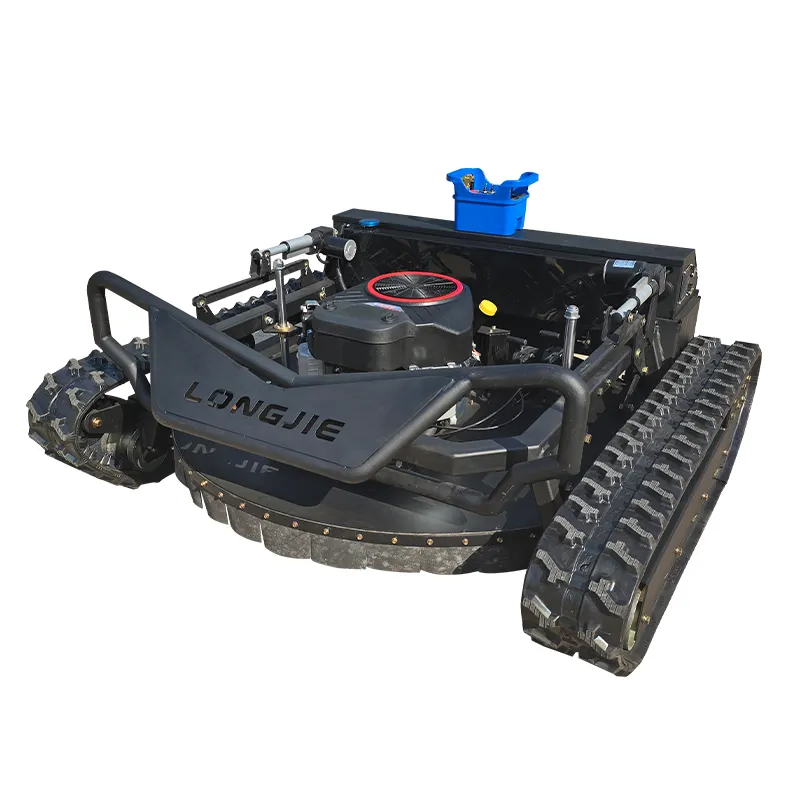
A tracked mower spreads its load across two long contact patches instead of concentrating it on four tire contact points. That larger footprint can reduce local ground pressure and gives the machine more longitudinal support when it crosses shallow holes, ridges, or soft patches. Tracks are not a substitute for sound ground, however. Deep mud, loose stones, hidden voids, and abrupt drop-offs can still upset a machine.
The space between the tracks matters too. A wider stance generally gives a remote control lawn mower more resistance to sideways rollover because the center of mass must travel farther before it passes outside the support area. Width alone is not an answer: it must be considered with the machine’s height, deck position, attachment configuration, and the route being mowed.
Why a low center of gravity matters
On a slope, gravity pulls the machine downhill. If the combined center of mass moves beyond the downhill edge of the track footprint, rollover becomes possible. A low-profile chassis places heavy components closer to the ground, reducing that overturning tendency. This is why low center of gravity is a useful design principle for a remote control lawn mower, particularly when the terrain is uneven rather than simply flat and inclined.
Real terrain is dynamic. When a track climbs a mound or falls into a rut, the chassis angle changes quickly. Tall grass can hide the feature that causes the change. Equipment configuration also matters: a raised deck, a loaded accessory, or a modification not approved by the manufacturer may alter the balance behavior. Operators should use the supplied manual and the actual machine’s permitted operating limits, rather than applying a slope figure from another model.
Tracks create traction, but traction is not the same as stability
Track lugs and a broad contact area can improve grip on soil, grass, and rough surfaces. Better grip helps a remote control lawn mower move predictably instead of spinning a wheel. Yet high traction does not remove rollover risk. In fact, when a track grips firmly while the chassis is badly positioned, the machine may be less able to slide gently out of a problem. The operator must manage both traction and body angle.
Surface moisture is especially important. Wet grass, clay, leaf cover, loose gravel, and recently disturbed earth can change friction during the same pass. Before regular work begins, inspect the route on foot where safe to do so. Identify drainage channels, culverts, roots, rocks, soft shoulders, and the downhill edge of the work zone. Marking those hazards is usually more valuable than relying on a general claim about terrain capability.
How differential track control helps on rough ground
A trackmounted remote control lawn mower normally turns by changing the relative speed or direction of its left and right tracks. Controlled differential steering lets the operator make gradual corrections while maintaining a deliberate path. Smooth inputs reduce sudden weight transfer, especially when one track is climbing and the other is still on lower ground.
A practical habit is to avoid sharp turns on a side slope whenever the terrain allows. A tight pivot can disturb the surface, shift the machine’s orientation, and place the deck near an obstacle. Choose a route that keeps transitions gradual. If a turn is needed, slow down first, keep an adequate buffer from hazards, and follow the operating guidance for that specific mower.
Terrain assessment determines whether the job is appropriate
Even a well-designed remote control lawn mower cannot compensate for a route that should not be mowed mechanically. Look beyond the average slope. A site may have a moderate overall grade but contain a concealed ditch, an off-camber shoulder, or a steep transition at the top or bottom. Check:
- the steepest local section, not only the general hill;
- cross-slope ruts, holes, rocks, roots, and buried debris;
- soil moisture and whether the ground has softened after rain;
- clearance around trees, fencing, water, walls, and drop-offs;
- safe entry, exit, stopping, and recovery space; and
- visibility and a clear line of sight for the remote operator.
With this information, a buyer can discuss site conditions with a supplier in concrete terms. Shandong Maide En’s remote mowing content can serve as a starting point for that conversation: provide photos, ground type, vegetation condition, local slope measurements, and the planned work pattern so the proposed configuration can be checked against the task.
Operating choices that protect balance
Once the site is suitable, technique still matters. Start on a low-risk area to confirm steering response and track behavior. Keep speed conservative on rough ground. Make gradual control inputs, avoid sudden acceleration or braking, and stop to reassess when the machine behaves differently from expected. A remote control lawn mower should be observed continuously; the distance between operator and machine does not eliminate responsibility for the work area.
Plan mowing passes before entering the slope. The safest direction depends on the machine manual, the grade, the surface, the obstacles, and the manufacturer’s limits. Do not infer a universal rule from this article. Instead, use the approved operating instructions and risk assessment for the exact model. Keep people, animals, and property outside the exclusion zone, and do not assume that a remote machine can be left unattended.
Maintenance supports predictable handling
Balance also depends on condition. Inspect track tension, rollers, drive components, fasteners, deck condition, and guards at the intervals specified by the manufacturer. Remove packed grass, mud, and debris after work because buildup can affect visibility, cooling, movement, and inspection. If a track pulls unevenly, a control response changes, or a component is damaged, pause the job and investigate before returning to uneven land.
Key takeaway
A trackmounted remote control lawn mower keeps balance through a low, well-distributed mass; a broad tracked footprint; controlled steering; and traction matched to the surface. Those features only work as intended when the terrain has been inspected, the route is planned, the machine is maintained, and the operator stays within the manufacturer’s verified limits. For uneven land, careful site assessment is not an extra step—it is part of the stability system.