EN
How Does Crawler type remote lawn mower Reduce Ground Pressure
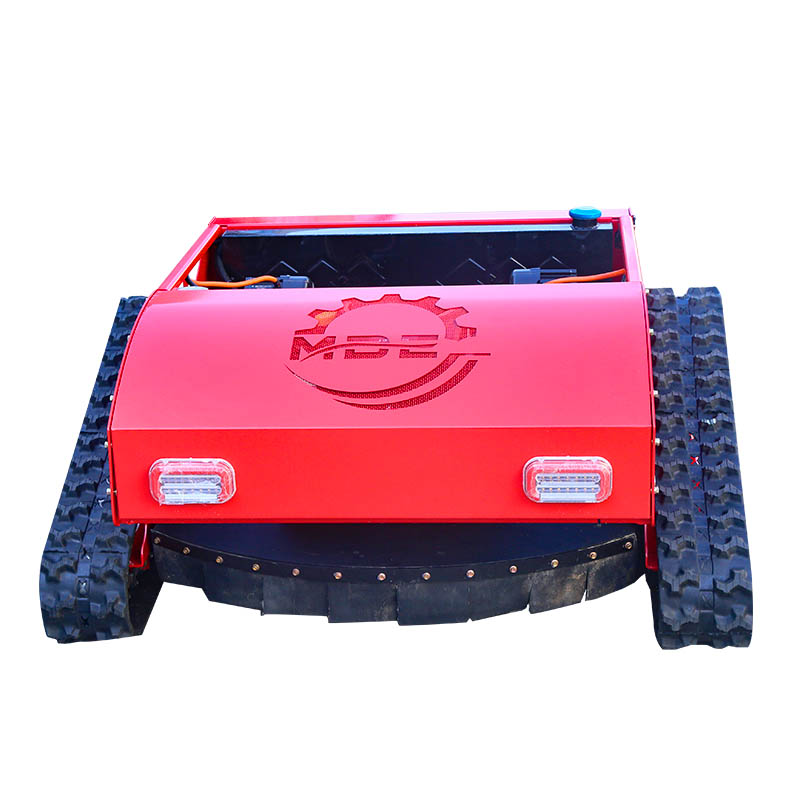
A crawler remote control lawn mower can be a sensible option when a mowing site has soft turf, uneven ground, or slopes that make concentrated wheel loading a concern. The reason is not that tracks make a machine weightless. Rather, a crawler undercarriage can spread the machine’s supported weight across a broader effective contact area. That usually lowers the average pressure applied to the surface compared with a similarly weighted machine supported on smaller tire contact patches.
For buyers and operators, that distinction matters. Ground pressure affects how readily turf marks, soil sinkage, traction loss, and surface disturbance may occur. But it is only one part of a safe equipment decision. Soil moisture, grade, turns, vegetation, machine mass, and the way the mower is operated can all change the real result.
Start with the basic ground-pressure relationship
Ground pressure is often approximated with a simple relationship: supported weight divided by effective contact area. If the supported weight stays broadly the same while the contact area becomes larger, the average pressure becomes lower. A crawler remote control lawn mower uses two tracks that contact the surface along a length of belt rather than relying on several relatively small tire footprints.
That is the core mechanical advantage. On a firm, level surface, a wheeled mower may perform well because the ground can easily support the loads beneath its tires. On softer soil or delicate turf, a crawler remote control lawn mower may distribute its load over a longer, wider area. The outcome can be better flotation: the machine is less likely to sink as deeply for a given load and condition.
Average pressure is not the same as pressure at every point. Track rollers, drive sprockets, terrain changes, and acceleration can create local load variations. Therefore, use the calculation as a comparison tool, not as an assurance that a site will avoid rutting or compaction.
Why tracks create a larger effective contact patch
With tires, the footprint is limited by tire size, inflation, load, and soil deformation. With tracks, the footprint is generally distributed along the ground-contacting portion of each belt. A crawler remote control lawn mower can therefore support its weight through two elongated contact zones instead of several compact patches.
This geometry can help in three practical ways:
- Lower average surface loading: More effective contact area can reduce the average load per unit area.
- Improved flotation: On soft ground, spreading the load may reduce sinkage relative to a comparable concentrated footprint.
- More available traction: A broad track can provide a larger interface with the surface, although traction still depends on soil, grass, moisture, tread design, and slope direction.
Search evidence from tracked-tractor research illustrates the principle, not a mower specification: one study result reported a tracked tractor at 35 kPa and cited wheeled values of 46 and 54 kPa for that particular comparison. Those figures cannot be transferred to a crawler remote control lawn mower because vehicle weight, track dimensions, tire setup, and soil conditions differ. They do show why contact area and machine configuration must be considered together.
How lower pressure can protect turf and soil
On lawns, orchards, embankments, and managed green areas, surface condition can matter as much as cutting capacity. When pressure is concentrated in a small area, a wet or weak surface can deform more readily. The visible symptoms may include tire impressions, sinkage, displaced grass, or disturbed soil at repeated travel points.
A crawler remote control lawn mower may reduce those risks when the track contact area is appropriate for the machine’s mass and the site’s bearing capacity. This can be useful where an operator wants to cross variable ground while remaining outside the immediate cutting zone. Remote operation can improve operator separation from vegetation or slopes, but it does not remove the need for a site assessment, line-of-sight control, and adherence to the model’s operating instructions.
University Extension guidance on compaction likewise identifies load, tire pressure, and vehicle choice as relevant factors. The practical lesson is broader than a simple preference for tracks. Soil response depends on the complete loading and operating situation. A heavier tracked machine can still compact soil, especially when repeatedly run over wet ground.
Tracks also change traction and stability, not just pressure
It is tempting to select a crawler remote control lawn mower only by looking at the word “crawler.” A more useful approach is to assess ground pressure together with traction, slope behavior, and maneuvering. A larger contact patch can help traction, but it will not make every slope suitable. Loose material, hidden holes, side slopes, abrupt transitions, and obstacles may still exceed the safe operating limits stated by the manufacturer.
Turning deserves special attention. Straight-line travel normally spreads loading more evenly than tight pivot turns. During a sharp turn, tracks can scrub across turf and create shear forces at the surface. On soft, wet, newly seeded, or high-value grass, a low-pressure crawler configuration may still mark the ground if it repeatedly pivots in one place. Plan smoother turns and vary travel paths where site conditions allow.
What buyers should verify before choosing a crawler model
From a technical-selection perspective, a crawler remote control lawn mower should be evaluated with site data rather than with a single marketing claim. Ask a supplier for the specific model’s operating weight, track width, contact length, and any documented ground-pressure information. If a quoted pressure value is supplied, confirm the assumed load state, surface condition, and whether the figure represents a calculated average or a measured result.
- Map the surface: Identify soft zones, drainage paths, wet areas, ruts, drop-offs, stones, roots, and areas where turning space is limited.
- Record the task: Note grass height, vegetation density, target cutting frequency, travel distance, and whether the mower will cross the same route repeatedly.
- Check machine geometry: Compare weight, overall width, track width, contact length, center of gravity information, and manufacturer-stated slope limits.
- Verify the operating procedure: Confirm remote-control range, line-of-sight requirements, emergency-stop practice, exclusion zones, and the recommended turning method.
- Arrange a representative demonstration: A demonstration should resemble the actual terrain and vegetation. A short run on dry, level ground cannot prove performance on a wet slope.
Use a site-first decision, not a track-only decision
For many applications, a more useful question is not “Are tracks good?” It is “What load does this crawler remote control lawn mower place on this surface while completing this task?” That framing makes it easier to compare models and to identify where additional information is needed.
First, verify ground conditions after rain and during the season when mowing will actually occur. Next, compare the machine’s documented weight and track dimensions with the available access routes and turning zones. Then confirm safety limits and test the machine under controlled conditions. If the site contains sensitive turf, limit repeated turns, avoid saturated ground, and inspect the surface after the first passes.
Frequently asked questions
Will a tracked mower necessarily have lower ground pressure than a wheeled mower?
No. Tracks often provide a larger contact area, which can lower average ground pressure for a comparable load, but the actual result depends on machine mass, track dimensions, tire configuration, and ground conditions. Compare documented data for the specific machines.
Can a crawler remote control lawn mower prevent soil compaction?
It can help reduce average surface loading in some conditions, but it cannot guarantee zero compaction. Wet soil, repeated passes, heavy equipment, abrupt turns, and local load peaks can still cause damage.
Is lower ground pressure enough for safe slope mowing?
No. Ground pressure is only one variable. Follow the manufacturer’s slope limits and safety instructions, assess the surface and obstacles, maintain appropriate separation, and stop work if conditions change.
Conclusion
A crawler remote control lawn mower reduces ground pressure mainly by distributing supported weight across the longer, broader contact area of its tracks. That design can improve flotation and reduce average surface loading on suitable ground, but it is not a substitute for checking soil moisture, terrain, turning patterns, and safe operating limits. The most reliable selection process compares the specific machine’s documented geometry and weight with the real mowing site, then validates the choice through a controlled, representative trial.