EN
How Much Working Efficiency Gain Does a High Efficiency Lawn Mower Bring?
A high efficiency lawn mower can improve a mowing operation, but there is no honest universal percentage to promise before the site, route, grass condition, and work process are known. The useful question is not simply whether one lawn mower has more power than another. It is how much productive cutting time it creates after turning, obstacle avoidance, inspections, refueling or charging, and cleanup are included.
From a work-planning perspective, a high efficiency lawn mower should be assessed against the task it will perform. A machine that moves quickly on an open, level field may deliver little gain on a small, irregular site with trees, gates, slopes, and frequent stops. For buyers comparing equipment, a practical baseline is completed area per active work hour, measured under the same site conditions.
What “working efficiency gain” really means
Working efficiency is more than rated travel speed or cutting width. It is the amount of acceptable mowing completed in a defined shift. A lawn mower may have strong theoretical capacity but lose time when the operator repeatedly overlaps passes, slows for rough ground, clears heavy grass, turns in confined spaces, or pauses for safety checks.
A useful comparison separates three layers:
- Theoretical coverage: cutting width multiplied by travel speed, before real-site losses.
- Effective coverage: area cut after normal turns, route overlap, and obstacle handling.
- Shift productivity: effective coverage after preparation, inspections, fueling or charging, clearing debris, and routine maintenance are counted.
This distinction matters because a high efficiency lawn mower can reduce avoidable losses without making every condition faster. The expected gain should be treated as a site-specific result, not as a fixed product claim.
Where a high efficiency lawn mower can save time
1. Less route overlap
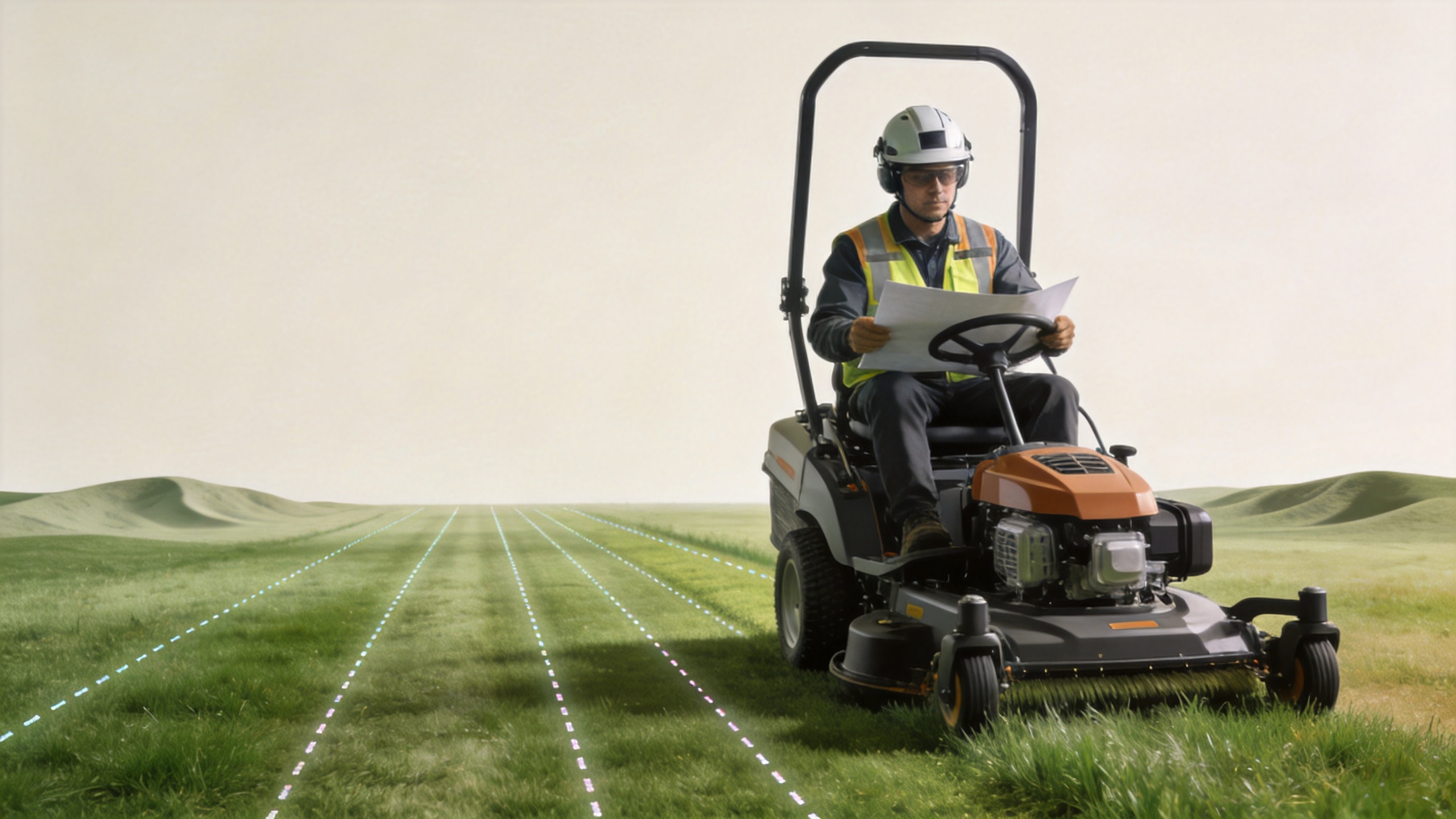
Overlap is a quiet productivity loss. When operators cannot see a clear lane, they often cover already-cut grass again to avoid leaving strips. Search evidence on autonomous mowing describes efficient coverage as avoiding previously covered paths while targeting uncut vegetation. The same operational principle applies to a manually guided or remotely controlled lawn mower: a clear route, visible boundaries, and a workable pass pattern can increase useful cutting time.
2. Fewer slowdowns at turns and obstacles
On an open site, wider passes and stable handling may reduce the number of turns. On a complex site, the important issue is not width alone but whether the lawn mower can follow a practical path around trees, drainage edges, buildings, and access points. Before treating a larger machine as an efficiency upgrade, map the tightest turns, bottlenecks, and safe turnaround areas.
3. Better fit for vegetation and ground conditions
Dense, tall, wet, or mixed vegetation can change real output substantially. If cutting capacity is mismatched to grass volume or terrain, an operator may need multiple passes or may reduce speed to maintain cut quality. A high efficiency lawn mower should therefore be evaluated with the actual grass height, density, moisture condition, slope, and surface irregularity recorded. A specification that looks suitable on paper still needs confirmation in the intended work condition.
4. Less operator burden in repeat work
Repeated mowing often exposes workflow issues that a short demonstration does not show. Controls, visibility, vibration, starting procedures, refueling or charging access, and routine inspection points can all affect the usable time in a shift. For remote-control or mechanized mowing, efficiency does not remove the need for route checks, safe separation, and operator training. It can make a workflow more consistent only when those controls are planned into the job.
How to calculate the gain without guessing
Use a simple before-and-after field record. Select comparable areas and keep the grass condition, weather window, target cutting quality, and crew arrangement as consistent as possible. For each lawn mower setup, record total area completed, active cutting minutes, non-cutting minutes, number of turns, unplanned stops, and any second-pass work.
| Measure | Why it matters | What to note |
|---|---|---|
| Completed area | Defines the useful output | Use the same boundary and cut standard |
| Active cutting time | Shows operating capacity | Exclude planned setup if comparing machine motion |
| Non-cutting time | Reveals workflow loss | Turns, checks, unloading, fueling, charging, and clearing |
| Overlap and rework | Shows route quality | Missed strips, second passes, or avoidable duplicate coverage |
| Safety-related pauses | Protects valid planning | Do not classify necessary safety checks as waste |
Then compare completed area per total work hour, not only machine speed. The gain can be stated as: (new measured output − baseline measured output) ÷ baseline measured output × 100. That result is meaningful only for the documented task. It should not be reused as a blanket promise for every property or terrain type.
What may limit the efficiency gain
Efficiency claims deserve verification where the worksite has steep slopes, soft ground, hidden debris, close boundaries, frequent public access, or variable vegetation. In these conditions, a lawn mower may need slower travel, additional spot work, or a different routing approach. Safety conditions and the applicable operating instructions take priority over any target output.
Maintenance also affects repeatable performance. Blade condition, belt or drive inspection, tire or track condition, cleaning access, and parts support should be part of the evaluation. A faster first day does not prove a better long-term workflow if downtime and service requirements are unclear.
A buyer checklist for a high efficiency lawn mower
- Define the area, terrain, grass condition, and desired cut standard.
- Measure the current lawn mower’s completed area per total hour.
- Identify where time is lost: overlap, turning, loading, stops, cleanup, or rework.
- Ask for configuration and operating information relevant to those losses.
- Request a demonstration or trial plan that uses comparable conditions.
- Confirm safety procedures, maintenance requirements, and support information before setting productivity targets.
Conclusion
A high efficiency lawn mower may create a meaningful working-efficiency gain when its cutting approach, route planning, and operating process fit the site. The most reliable way to assess that gain is to measure completed area against total work time and explain every major loss category. Rather than accepting a generic percentage, document terrain, vegetation, boundaries, operator process, and maintenance expectations. That produces a purchasing discussion based on verifiable operating conditions rather than an unsupported performance claim.