EN
What Advantages Does a Tracked Remote Control Lawn Mower Have Over Wheeled Models?
When a mowing route includes wet turf, rough ground, orchard rows, or a bank that feels uncomfortable to walk beside, the drive system matters as much as the cutter. A tracked lawn mower spreads its contact area across the ground instead of relying on a few tire footprints. That can make a real difference in traction, approach confidence, and work-zone control. It does not make every site easy, however, and it is not automatically the right choice for every property.
From a lawn-equipment selection perspective, the useful comparison starts with the job: ground condition, slope changes, grass density, access width, and how often the area is cut. A tracked remote control lawn mower is usually chosen because those conditions are demanding—not simply because tracks look more capable.
Tracked vs. Wheeled: The Basic Difference
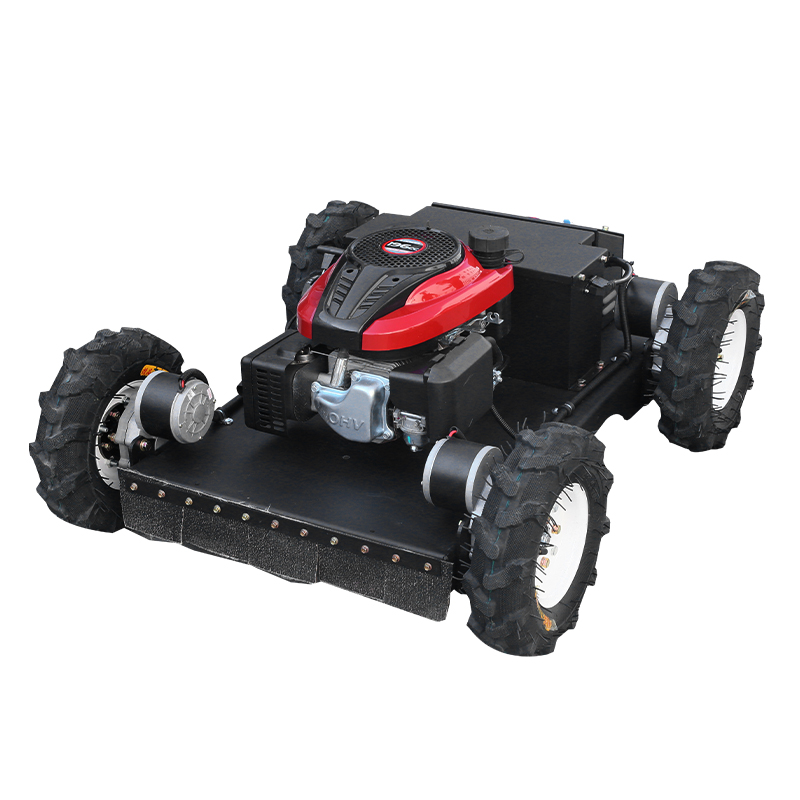
Wheeled mowers place the machine’s load through tire contact patches. A tracked lawn mower uses continuous rubber tracks that generally distribute load over a longer and wider area. On a real worksite, that changes how the machine interacts with loose soil, damp grass, ruts, and uneven transitions.
The benefit is conditional. Tracks can provide more usable contact on irregular terrain, while wheels can be quicker and more agile on firm, open, regularly maintained lawns. The appropriate choice depends on whether the job is dominated by mobility on good turf or by maintaining controlled movement where traction is uncertain.
1. Better Traction on Loose, Wet, and Uneven Ground
The clearest advantage of a tracked lawn mower is traction. A larger contact area can help the machine maintain a steadier drive path when the surface is soft, broken, or inconsistent. That is especially relevant around ditches, rough fields, embankment approaches, and sites where dew or recent rain changes the ground from one pass to the next.
With a wheeled model, a tire can lose grip when weight shifts onto a small part of the tread. A tracked remote control lawn mower can spread that loading and maintain a more consistent drive feel. This does not mean it should be used on every wet surface. Soil type, grass cover, turning behavior, and the operator’s route still determine whether the ground is suitable.
2. More Confidence When Working Across Slopes
Slope work is where many buyers first consider tracks. The advantage is not a promised slope rating; verify the approved rating in the manufacturer’s manual for the exact model, cutting setup, and ground condition. Instead, the advantage is the way a tracked lawn mower can combine a broad contact patch with a low, stable working posture.
For a remote-control mowing task, the operator can stay off the immediate cutting line while keeping visual control of the machine. That may reduce exposure to the most uncomfortable section of a bank, but it does not remove the need to inspect the site, maintain line of sight, set an exclusion zone, and stop for hidden obstacles or unstable ground. Remote operation is a work-zone benefit; it is not a substitute for a safe procedure.
3. Useful Flotation on Softer Sites
Because a tracked lawn mower distributes load differently, it may be a better fit for surfaces that are prone to localized sinking or wheel spin. Examples include a field edge after rain, a lightly compacted access path, or a property with changing soil conditions. The goal is not to promise zero turf marking. Sharp turns, repeated passes, and saturated turf can still leave impressions with any heavy mowing machine.
Instead, evaluate flotation as one part of the job. If the site repeatedly forces a wheeled mower to spin, rut, or reverse, a tracked remote control lawn mower may provide a more predictable route. If the site is flat, dry, and manicured, the extra traction may offer little practical return.
4. Stable Travel Through Rough Vegetation
Long grass and rough vegetation create a different challenge from a neat lawn. The machine may encounter hidden bumps, uneven residue, narrow changes in grade, and variable resistance under the deck. A tracked lawn mower can help maintain forward movement where a tire-driven unit may hunt for grip. That can be valuable for maintenance work in orchards, utility corridors, field margins, and undeveloped sections of a larger property.
Still, drive stability and cutting quality are separate questions. Before selecting a unit, confirm the intended grass height, vegetation type, cutting method, deck clearance, and cleaning procedure. A buyer should also check whether the route includes rocks, wire, stumps, drainage openings, or branches that could make any mower unsafe to operate.
5. Why Remote Control Adds Value to a Tracked Platform
Tracks address movement; remote control changes where the operator can stand. Together, they can be useful when a job includes a slope, a narrow shoulder, or an area where walking beside a conventional mower would be tiring or undesirable. A tracked remote control lawn mower lets the operator choose a safer observation point where visibility and footing are better.
That combination is most useful when the operator follows a repeatable routine:
- Walk the route first and identify drop-offs, holes, debris, and soft patches.
- Confirm the machine’s approved slope, distance, and operating limits for the actual configuration.
- Keep people, animals, and vehicles outside the mowing zone.
- Use deliberate passes and avoid abrupt directional changes on vulnerable turf.
- Stop work when traction, visibility, or control becomes uncertain.
Where Wheeled Models Still Make Sense
A wheeled mower is not a lesser option by default. On flat, firm, open areas, wheels may offer quicker turns, simpler transport, and an efficient feel during frequent routine mowing. They can also be a sensible choice when the main job is maintaining established turf rather than reaching difficult ground.
The trade-off is that wheeled models may be less forgiving when a route changes from dry lawn to loose soil, wet grass, or uneven banks. If the property has only occasional rough areas, it may be more practical to improve access or split the task than to specify a tracked machine for the entire job.
A Practical Buying Checklist
Rather than beginning with engine size or a single marketing claim, put the mowing task into a comparison sheet. Ask the supplier to address:
- Typical and maximum slope conditions, including side-slope versus uphill travel.
- Ground condition after rain and the likelihood of soft or rutted sections.
- Grass height, vegetation density, and hidden-obstacle risk.
- Required access width, turning space, transport method, and storage area.
- Approved remote-control range, line-of-sight procedure, emergency stop, and operating instructions.
- Track inspection, tensioning, cleaning, and spare-parts support requirements.
The checklist turns a general question about tracks into a more grounded equipment decision. It also prevents a common mistake: buying a tracked lawn mower for a site that is mostly smooth turf, or choosing wheels for a property whose difficult areas determine the real workload.
Final Takeaway
A tracked lawn mower has its strongest advantages where traction, stable movement, and controlled remote work matter more than quick turns on consistently firm turf. It can be a strong option for irregular ground, soft approaches, rough vegetation, and slope-related mowing—provided the exact machine is approved for the task and the operator follows the required safety process.
For flat, dry, regularly maintained land, a wheeled model may remain the simpler and more efficient choice. Start with the worksite, then compare configuration, maintenance needs, and verified operating limits. That is the most reliable way to decide whether a tracked remote control lawn mower delivers a meaningful advantage for your mowing program.