EN
What Design Protect Remote control lawn mowers for steep hills From Tipping Over
A remote control lawn mower changes where the operator stands, but it does not remove the forces that can make equipment unstable. On steep ground, safe results come from a match between machine design, the actual surface, and disciplined operation. That is why a remote control lawn mower should be evaluated as a slope-management tool, not as a promise that every hill can be cut safely.
From a technical-explainer perspective, it helps to separate what the mower is designed to do from what the site allows. Weight, track or wheel contact, center of gravity, steering behavior, and remote-control response all affect stability. Yet a well-designed remote control lawn mower can still be the wrong choice for loose soil, hidden holes, wet vegetation, or a slope beyond the manufacturer’s approved limit.
Start with the rollover problem, not the feature list
Tipping begins when gravity and movement shift the mower’s effective load outside the area supported by its tracks or wheels. A remote control lawn mower faces that risk when it travels across a slope, turns sharply, climbs over a bump, catches a cutting deck on an obstacle, or loses traction on wet ground. The danger can increase when grass hides ruts, rocks, drainage channels, or soft shoulders.
It is tempting to think that engine output decides everything. More accurately, slope safety depends on how the whole remote control lawn mower holds its line while cutting. Before comparing models, map the slope direction, measure the grade with an inclinometer, identify escape routes, and note where the surface changes. OSHA guidance for riding mowers emphasizes following the equipment maker’s angle limits and using a slope indicator; those principles remain useful for planning remote mowing even though each machine’s manual is the controlling document.
Low center of gravity: the foundation of stability
A lower center of gravity reduces the overturning leverage created when a remote control lawn mower is on an incline. Designers can pursue this by locating heavier components low in the chassis and by avoiding unnecessarily tall, top-heavy structures. The effect is not a blanket slope rating. Instead, it gives the machine more stability margin before the combined load shifts toward the downhill edge.
Ask the supplier how the battery, engine, fuel system, hydraulic parts, and cutting assembly are positioned. A compact profile may help, but the discussion should include the full working configuration, not an unloaded showroom image. Attachments, accumulated grass, a raised deck, and transported tools can change the balance of a remote control lawn mower.
Wide stance, tracks, and ground contact
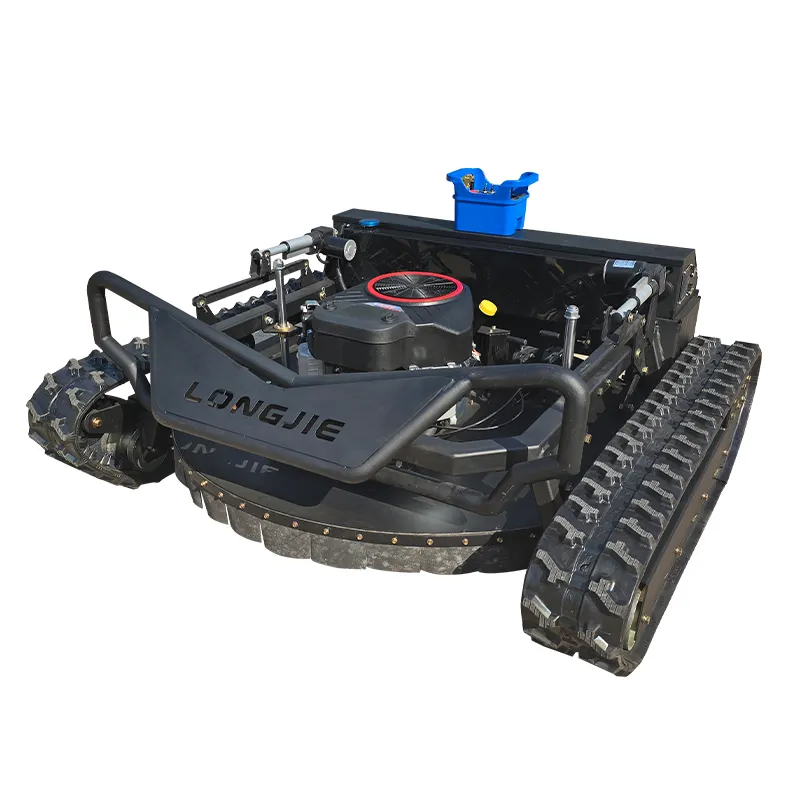
Stability also depends on the support footprint. A wider track width or wheel stance gives a remote control lawn mower a broader base across the slope. That can improve resistance to lateral load transfer, especially when the machine is moving slowly and the ground is firm. It is one reason commercial slope-mower search results often highlight a low center of gravity together with tracked undercarriages.
Tracks can spread load over a larger contact area and may provide useful grip on certain surfaces. But traction is not the same as rollover protection. On saturated soil, loose gravel, or grass lying over hard clay, a tracked remote control lawn mower may still slide or suddenly gain traction in a way that alters its path. Check the track pattern, tensioning method, ground pressure information if available, and the manufacturer’s rules for wet or side-slope operation.
Drive control that avoids sudden load shifts
A stable chassis needs predictable motion. Smooth proportional control lets the operator bring a remote control lawn mower up to speed gradually, make small steering corrections, and slow before a turn. Abrupt reversing, aggressive pivot turns, or rapid downhill acceleration can transfer weight quickly and reduce the time available to recover.
For remote control lawn mowers for steep hills, ask how steering is implemented and whether the control system limits abrupt commands. A gradual-response setting can be valuable when working beside ditches, trees, fences, or uneven edges. If a machine offers multiple operating modes, verify which mode and speed range the manufacturer approves for slope work instead of assuming that the fastest setting is suitable.
Cutting layout and obstacle clearance matter
The cutting system can influence stability too. A low-mounted, well-protected cutting assembly helps keep mass low, while adequate clearance reduces the chance that the deck catches on a mound or embedded object. If an obstacle stops one side of a moving remote control lawn mower, the reaction can shift the machine unexpectedly. The safer workflow is to walk the route first, remove debris where practical, and set a cutting height that suits the terrain rather than forcing a low first pass.
Vegetation changes the decision. Tall grass can conceal a washout; dense brush can pull against the deck; wet clippings can reduce grip. This is why site conditions should be confirmed before relying on a remote control lawn mower for a new hillside.
Remote operation protects people only when the route is controlled
Remote control can allow the operator to stand away from the immediate fall line and maintain a clearer position. That is a meaningful design advantage of a remote control lawn mower, but it does not replace supervision. The operator still needs an unobstructed view, a defined exclusion zone, reliable communication if a spotter is used, and a plan for loss of signal or an emergency stop.
Inspect the emergency-stop function, radio range, battery condition, and response after a stop command. Work at a pace that preserves visibility. If the mower begins to slide, approaches a drop-off, or behaves differently from the approved operating guidance, stop and reassess rather than trying to correct it with a sharp command.
A practical design-and-site checklist
- Confirm the exact remote control lawn mower model’s approved slope limit, direction-of-travel guidance, and prohibited conditions.
- Measure the hill; do not estimate the angle by eye.
- Check center-of-gravity layout, machine width, total operating weight, and whether the intended configuration changes balance.
- Review tracks or tires, traction conditions, steering response, braking behavior, and emergency-stop operation.
- Walk the route for holes, loose edges, stumps, rocks, drainage crossings, wet areas, and hidden obstacles.
- Set a slow, repeatable route and keep people, animals, and vehicles outside the work area.
The design is only part of the answer
A more useful question is not “Can this remote control lawn mower climb the hill?” It is “Can this specific mower complete this specific route within its documented limits?” A low center of gravity, broad contact patch, controlled drive response, guarded cutting layout, and dependable remote safety functions all contribute to rollover resistance. Still, no collection of features can make unsuitable terrain safe.
For buyers planning a slope-mowing application, provide the supplier with the measured grade, surface type, grass condition, obstacles, required travel direction, work frequency, and preferred cutting height. Shandong Maide En can use that site information to structure a model-and-configuration discussion around the work conditions rather than unsupported assumptions. Confirm the final operating limits and safety instructions in the documentation supplied for the selected remote control lawn mower before work begins.