EN
What Makes Crawler Remote Control Lawn Mowers Ideal For Orchards
Orchard mowing is rarely a simple open-field job. Rows narrow and widen, tree canopies reduce visibility, ground can turn uneven after rain, and grass height can change from one block to the next. A crawler remote control lawn mower can be a practical option when the job calls for distance between the operator and the cutting area, stable movement over irregular ground, and a repeatable route through the orchard. It is not automatically the right answer for every property, but it can be a strong fit when the site, workflow, and operating rules support it.
From an orchard and landscape equipment planning perspective, the useful question is not simply whether a crawler remote control lawn mower has more features. The better question is whether its track layout, remote operation, and cutting setup suit the rows, slopes, vegetation, access points, and maintenance routine you actually manage.
Orchards create a different mowing environment
Unlike a broad lawn, an orchard has trunks, irrigation components, dropped branches, headlands, changing light, and repeated turns. The operator needs to maintain grass and vegetation without treating every pass as identical. Orchard-floor management also matters beyond appearance: Washington State University Tree Fruit notes that mowing fallen limbs and leaves can help them break down more quickly. That does not make any mower a sanitation tool by itself, but it explains why regular, controlled mowing can be part of a wider orchard-floor plan.
A crawler remote control lawn mower suits this setting because it can be evaluated as a task tool rather than a conventional lawn machine. Before comparing models, map the row width, canopy clearance, turning space, ground firmness, obstacles, and frequency of mowing. Those conditions determine whether a crawler remote control lawn mower can work efficiently and safely in your orchard.
Why the crawler layout can help on uneven orchard ground
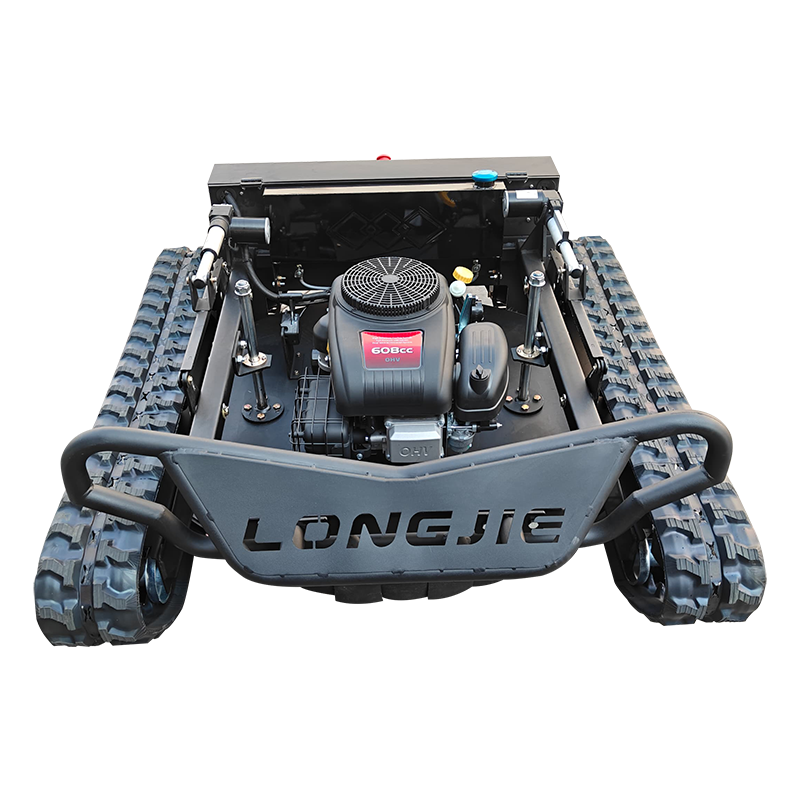
Tracks can distribute the machine's contact across more surface area than a narrow wheeled arrangement. In practical terms, that may help a crawler remote control lawn mower maintain predictable travel on uneven orchard lanes, loose soil, shallow ruts, or mixed grass cover. It does not eliminate the need to assess traction, ground moisture, or slope limits; those depend on the exact machine and site.
What matters is controlled movement. A crawler remote control lawn mower should be judged by how it starts, turns, climbs, descends, and stops in the conditions it will meet. A promising specification on a flat demonstration area is not enough evidence for a wet, sloped orchard row. Ask for the applicable operating manual, confirmed slope guidance, and an explanation of how the machine should be positioned and recovered if traction changes.
Remote control changes the operator's working position
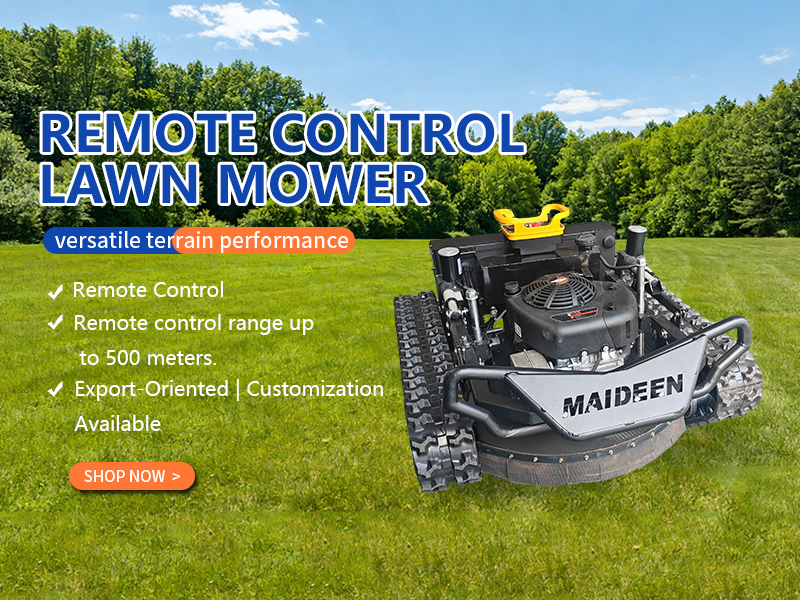
One major reason growers consider a crawler remote control lawn mower is the ability to stand away from the cutting path rather than ride directly on the machine. That can make it easier to choose a safer viewing point when working near rough ground, branches, or a slope. It can also reduce the repeated physical effort associated with walking behind a machine over a large block.
However, remote operation is not hands-off operation. The operator still needs a clear view of the route, a reliable control position, and a defined exclusion area. OSHA's mower guidance emphasizes following manufacturer limits, evaluating terrain, and understanding the manual's operating, maintenance, limitation, and warning sections. Apply the same discipline to a crawler remote control lawn mower: inspect the ground, remove obvious debris, establish where people and animals must stay clear, and stop if visibility or control is compromised.
It supports a repeatable orchard maintenance workflow
Orchard mowing is often scheduled around growth, weather, irrigation access, spraying, harvesting, and labor availability. A crawler remote control lawn mower can fit a repeatable workflow when its operating route is planned instead of improvised. Divide the property into workable zones: row interiors, headlands, steeper edges, and areas that require a different method. This makes it easier to identify where the mower is suitable and where it is not.
A sensible workflow has three parts:
- Prepare: walk the route, check for wires, branches, holes, irrigation hardware, soft soil, and bystanders.
- Operate: use a controlled speed, keep the crawler remote control lawn mower within clear sight, and make turns where the ground and row geometry allow them.
- Review: inspect cut quality, track condition, guards, debris buildup, and any area where the machine lost predictable movement.
That structure is more useful than assuming a crawler remote control lawn mower should cover every acre in the same way. Some blocks may be ideal for remote mowing, while tight, obstructed, or poorly visible areas may require a different process.
What to verify before selecting a crawler remote control lawn mower
A crawler remote control lawn mower is ideal for an orchard only when its confirmed capabilities match the job. Use a selection checklist rather than relying on general claims:
- Terrain: Document typical and maximum slopes, soil firmness, ruts, drainage patterns, and wet-weather restrictions.
- Row geometry: Measure row width, turning space, tree spacing, low branches, and access between blocks.
- Vegetation: Describe grass height, density, woody debris, and the expected mowing interval.
- Controls and visibility: Confirm usable remote range, stop functions, sight lines, and the operating method specified for the machine.
- Support: Request the parts list, maintenance schedule, training information, and written clarification of any optional configuration.
This is also where the phrase multifunctional cordless lawn mower with remote control needs careful interpretation. “Multifunctional” and “cordless” are descriptions, not proof that a unit fits an orchard. Verify the actual functions, power system, runtime expectations, cutting configuration, and approved operating conditions in the product documentation before making a purchase decision.
Safety boundaries remain the deciding factor
Efficiency matters, but it should not come before safety. A crawler remote control lawn mower does not remove the need for training, suitable personal protective equipment, emergency-stop familiarity, or site-specific procedures. Do not assume a track layout makes every slope acceptable. Use only the slope limits and travel directions confirmed by the manufacturer, and reassess when surface conditions change.
It is also important to avoid treating remote control as permission to operate out of sight. If a tree row, contour, or vegetation blocks the operator's view, pause and reposition. If there are unknown holes, concealed debris, people nearby, or unstable soil, resolve those conditions first. A crawler remote control lawn mower is most valuable when it gives the operator more deliberate control over a well-prepared task.
Is a crawler remote control lawn mower right for your orchard?
For orchards with irregular ground, recurring vegetation management, and a need to keep the operator away from the immediate cutting path, a crawler remote control lawn mower can be a compelling option. Its real advantage is not one isolated feature. It is the combination of mobility, remote positioning, and a workflow that can be tailored to orchard rows and maintenance priorities.
Start with site conditions, then confirm the exact equipment documentation. When the slope limits, row dimensions, visibility, vegetation, maintenance support, and safety process align, a crawler remote control lawn mower can become a practical part of an orchard-floor management routine. When they do not align, changing the route, configuration, or equipment type is the more responsible decision.