EN
What Shock Absorption Design For Rough Terrain Lawn Mower
When a lawn mower is expected to work across ruts, loose soil, uneven turf, or mixed vegetation, shock absorption becomes more than a comfort feature. A well-considered rough terrain lawn mower design can help keep tires in contact with the ground, reduce repeated impacts transmitted through the frame, and make the operator’s task easier to assess. It does not make every surface safe, however. Safe use still depends on the site, the machine’s instructions, and the operating plan.
As a technical explanation of mower design, this article starts with the job rather than a single headline specification. The useful question is not simply whether a lawn mower has suspension. It is which parts absorb which kind of movement, and whether that design fits the terrain, vegetation, travel speed, and working routine.
Why rough ground changes what a lawn mower needs
A smooth lawn produces small, predictable inputs. Rough ground is different: wheels may meet holes, roots, stones, ridges, soft patches, and changing side-to-side levels in short succession. Those impacts can travel through the tires, axles, chassis, seat, deck, and controls. The result may be an uncomfortable ride, but the more important practical issue is that motion can affect traction, cutting consistency, component loading, and the operator’s ability to observe the route.
Two sites with the same area can call for different equipment decisions. A compact field with shallow bumps may require a different approach from a similarly sized site with wet depressions, tree roots, narrow turns, or drainage edges. That is why a lawn mower should be assessed against actual ground conditions instead of being selected by acreage alone.
What a shock-absorption system is trying to do
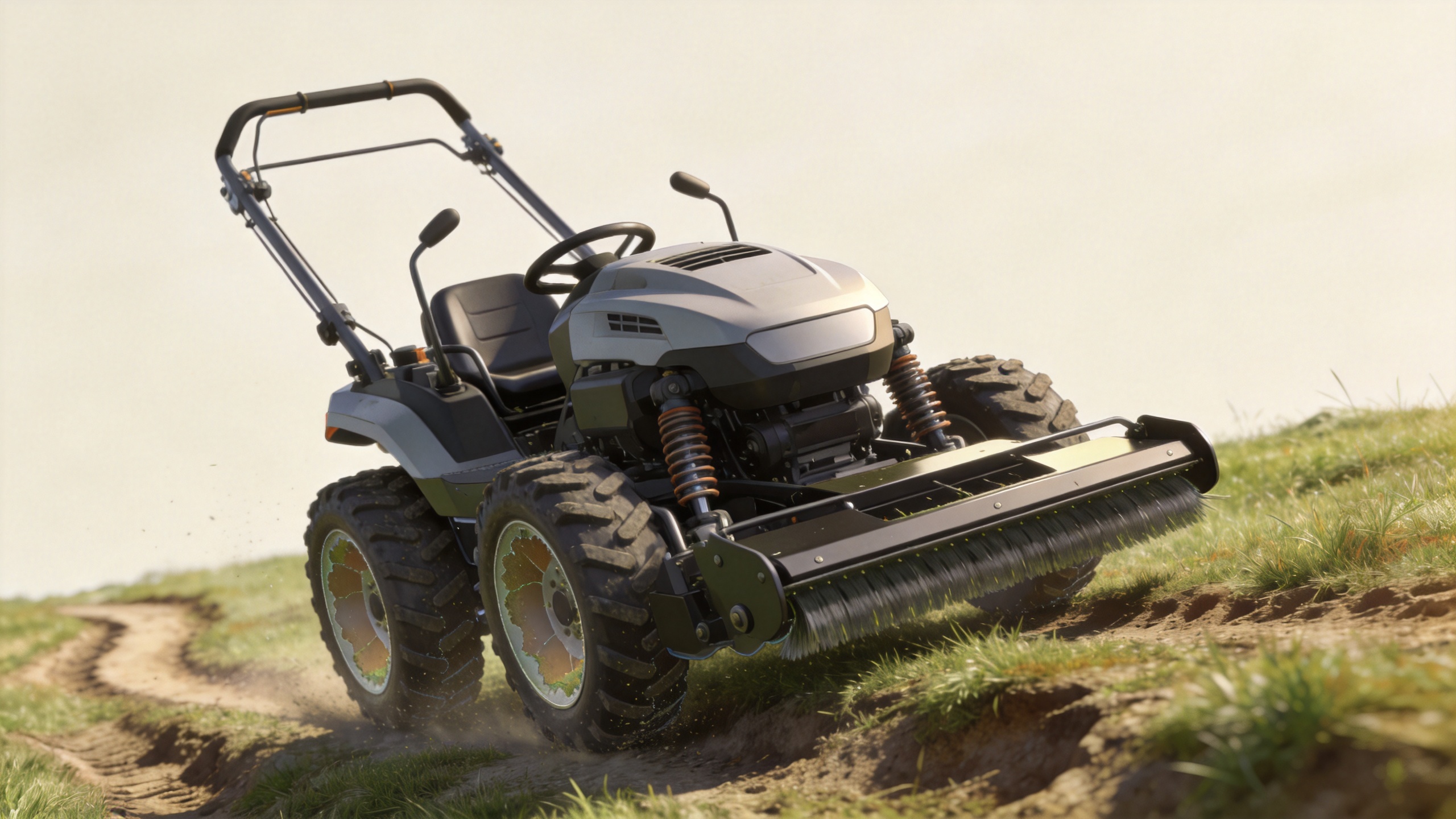
In a rough terrain lawn mower, shock absorption generally manages the energy created when a wheel or track crosses an irregularity. Springs support the machine and allow controlled vertical movement. Dampers, often called shock absorbers, slow that movement so the system does not rebound repeatedly after each impact. Tires add their own compliance, while seat suspension can reduce the jolts that reach the operator.
These elements work together but do not perform the same job. A soft seat may improve comfort without changing how the deck follows the ground. A flexible tire can soften small inputs but cannot replace chassis control over larger bumps. Likewise, a robust frame can carry loads well but still need damping to prevent uncontrolled oscillation. For that reason, compare the whole system rather than treating a single spring or seat feature as proof of rough-ground suitability.
Key design areas to evaluate
1. Wheel, axle, and chassis movement
Independent or articulated wheel movement can allow one side of a lawn mower to respond to a bump without forcing the entire machine to move by the same amount. On rough terrain, the aim is controlled contact and predictable response, not a floating feel. Ask how the axle arrangement, pivot points, and mounting hardware are designed to move and where that movement is limited.
2. Spring rate and damping control
Spring rate influences how much the machine deflects under load; damping influences how quickly it settles afterward. If the system is too soft for the actual equipment weight and terrain, it may move excessively. If it is too stiff, sharp impacts can still pass through the machine. A supplier should be able to discuss the intended operating conditions and the configuration boundaries rather than relying on a broad comfort claim.
3. Tire selection and contact patch
Tires are the first line of compliance. Their construction, pressure range, tread, and condition affect how a lawn mower follows uneven surfaces. Tire choices should be evaluated together with soil type and traction needs. A more aggressive tread may be relevant on some loose surfaces, yet it does not remove the need to inspect slopes, soft ground, obstacles, and turn areas before work begins.
4. Deck float and cutting-height stability
A mower deck needs enough controlled movement to follow modest contours without repeatedly striking the ground. Deck wheels, links, anti-scalp features, and height-adjustment mechanisms can all influence this behavior. The goal is not to force the deck through every depression; it is to keep cutting height reasonably consistent while avoiding unnecessary contact. Verify the deck arrangement for the intended vegetation and terrain rather than assuming a suspension feature alone protects cutting quality.
5. Operator isolation and control access
Seat suspension, vibration isolation, foot-platform design, and control placement matter because rough-ground work can create sustained jolts. Better isolation may reduce transmitted vibration, but it should not distract from visibility, emergency access, and stable posture. If the machine uses remote operation, route visibility, line of sight, and site exclusion measures still need their own review.
Use a site-first checklist before comparing designs
Before specifying a rough terrain lawn mower, document the parts of the task that create impacts or instability:
- Map ruts, roots, rocks, drainage channels, curbs, and sudden surface changes.
- Note the slope direction, loose or wet zones, and locations that limit a safe turning path.
- Record typical grass height, density, hidden debris risk, and the expected working frequency.
- Confirm access width, transport route, storage conditions, and the space available for inspection.
- Decide which questions require manufacturer documentation, a demonstration under representative conditions, or operator training.
This process keeps the discussion specific. Instead of asking for the “most suitable” lawn mower, the buyer can ask whether a particular suspension layout, tire option, deck arrangement, and operating procedure match the documented conditions.
Inspection points that protect shock-absorption performance
Suspension performance depends on condition as well as design. Before regular rough-ground work, inspect visible springs, dampers, mounts, bushings, fasteners, tires, wheel bearings, deck wheels, and linkages according to the manufacturer’s guidance. Look for leaks, damaged guards, unusual play, worn rubber mounts, loose hardware, or uneven tire condition. Any change in handling, repeated bottoming, abnormal noise, or uneven cut is a reason to pause and check the equipment.
It is tempting to treat faster travel as the reward for a smoother ride. In practice, speed should be chosen only after the terrain and machine response are evaluated. Uneven ground can hide obstacles and reduce the time available for correction. A shock-absorption system can reduce some impacts; it cannot eliminate rollover hazards, replace site inspection, or override the operating instructions for a specific lawn mower.
Questions to ask before purchasing a rough terrain lawn mower
- Which suspension or isolation components are included in the proposed configuration?
- What terrain, machine load, and operating conditions are those components intended to handle?
- How do tire options, deck support, and chassis layout work together on uneven ground?
- Which inspection intervals and replacement items should be planned for the suspension-related parts?
- What documentation, operating guidance, and representative demonstration conditions are available?
For buyers evaluating remote-control lawn mower solutions, Shandong Maide En Intelligent Technology can organize a requirements discussion around terrain, vegetation, route, and configuration questions. Final suitability should be confirmed against the relevant product documentation and the actual jobsite conditions.
Conclusion
The right shock-absorption design for a rough terrain lawn mower is a balanced system, not a single feature. Tires, chassis movement, springs, dampers, deck support, and operator isolation each address different parts of the problem. Start with the site, use the machine documentation to verify the configuration, and treat safety checks as part of every mowing plan. That approach gives a lawn mower a more realistic chance of delivering controlled work on uneven ground without overstating what suspension can do.