EN
What Working Range Does Remote control grass cutter Support
A remote grass cutter does not have one universal working range. The usable distance depends on the mower’s radio system, the terrain between the operator and machine, visibility, local interference, and the safety limits in the exact operating manual. In practical terms, the right question is not simply “How far can it go?” It is “How far can this machine be controlled safely and reliably on this site?”
As a technical explainer for remote-operated mowing equipment, I recommend separating advertised control range from working range. A published maximum may be useful for comparing a remote grass cutter, but it should not replace a site check, a line-of-sight assessment, or a test of the emergency-stop function before work begins.
Start with the manufacturer’s specified control range
The remote grass cutter range stated by the manufacturer is the first number to verify. It normally describes the maximum distance under stated conditions, often in an open area with a clear signal path. It is not automatically the distance an operator should use beside a road, behind a ridge, through dense vegetation, or around buildings.
Published capabilities vary widely by model. For context, third-party buyer guidance commonly describes consumer remote-control mower ranges around 50 to 200 metres, while some commercial slope-mower manufacturers publish much longer maximum distances; one commercial product page describes control from up to 1,000 feet. These examples are not interchangeable specifications. A remote grass cutter should be operated within the limit set for its own remote, receiver, and safety system.
When reviewing a remote control grass cutter quotation, ask whether the quoted distance is:
- a theoretical radio range or a recommended operating distance;
- measured in open ground or in a real mowing environment;
- valid with the supplied antenna and remote-control configuration;
- affected by terrain, vegetation, nearby structures, or electromagnetic interference; and
- subject to a required line-of-sight rule.
Why the usable range is usually shorter than the maximum range
A remote grass cutter communicates by radio, so obstacles matter. A rise in the ground can hide the machine. Tall grass, trees, metal fencing, parked vehicles, walls, and buildings can weaken or interrupt the path between the controller and mower. Even when the remote grass cutter still responds, poor visibility can make operation unsafe because the operator cannot judge blade clearance, obstacles, bystanders, or the mower’s route.
Slope work makes this distinction especially important. A long control range does not mean the operator should stand wherever the signal reaches. The operator needs a position with a stable view of the remote grass cutter, an escape path, and enough separation from the cutting zone. On a complex slope, moving to a new observation point may be safer than trying to control the machine across a blind section.
Weather and operating conditions can also reduce practical confidence. Rain, fog, dust, strong sunlight, battery condition, and a busy work area can change what an operator can see or how confidently a remote control grass cutter can be monitored. Before treating range as a fixed number, put it back into the actual mowing conditions.
Line of sight is a working-range requirement
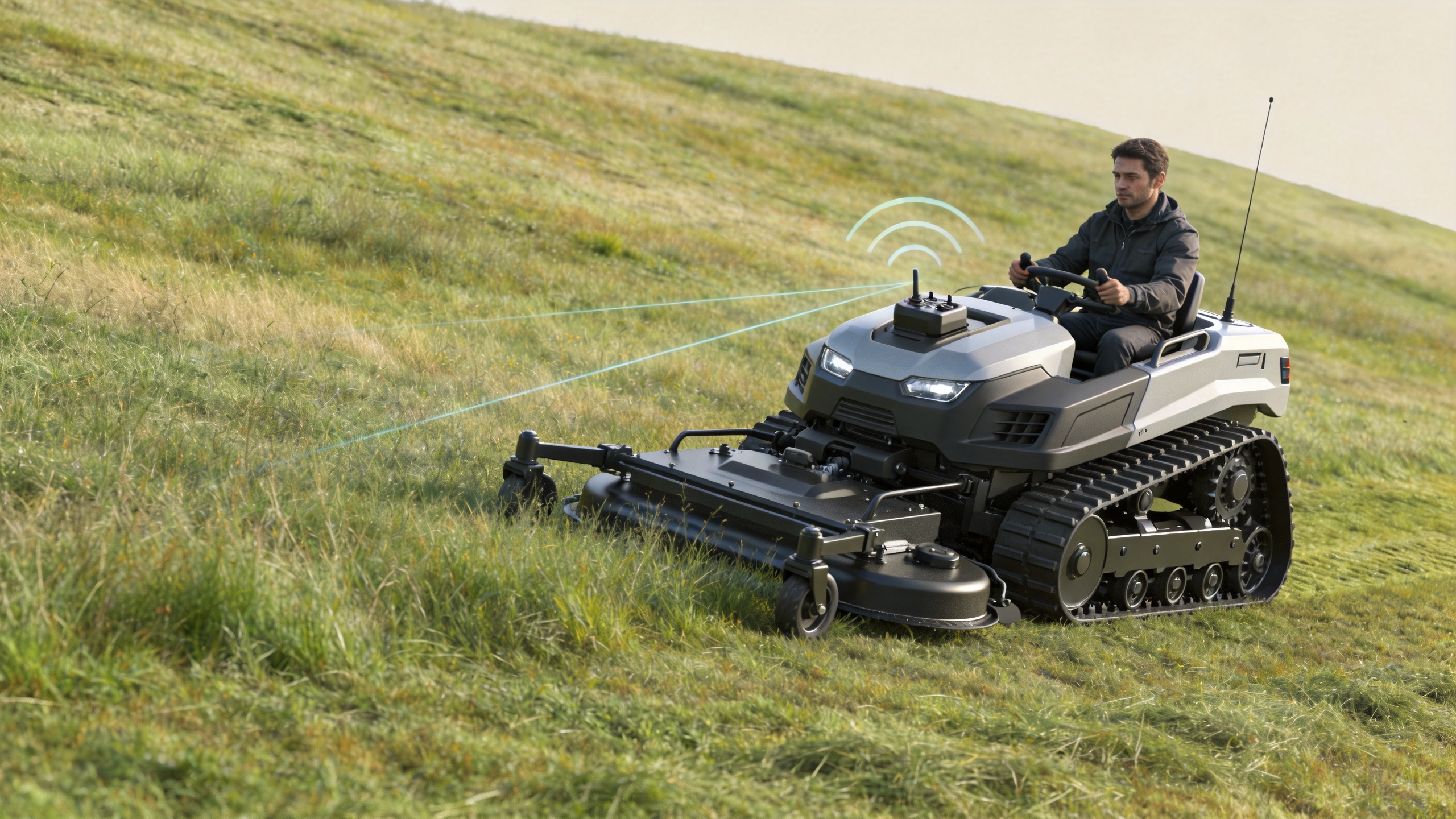
For most remote grass cutter tasks, clear line of sight is the governing limit. It means more than being able to see a small part of the mower. The operator should be able to observe its direction, travel surface, nearby people, unexpected obstacles, and the area where grass or debris may be discharged.
This is why a remote control grass cutter can have a radio specification that exceeds the practical range of a particular site. A wooded embankment, a drainage channel, a crest, or a group of shrubs can create blind areas long before the signal is lost. Do not rely on a range claim to justify work beyond visible supervision.
Before starting, walk the site and mark locations where the remote grass cutter could disappear from view. Decide where the operator will stand for each section and whether a spotter, exclusion zone, or a different work pattern is needed. If the route cannot be observed adequately, shorten the working range or change the plan.
How to confirm the working range for your site
Use a staged test rather than immediately sending a remote grass cutter to the far end of a property. Begin on level, open ground with the cutting function disengaged where the manual permits. Verify steering response, forward and reverse commands, stop response, and any loss-of-signal behaviour. Then repeat the check from the positions that will be used during mowing.
- Read the exact manual. Confirm the specified maximum range, required operating distance, visibility rules, and loss-of-signal response for the model.
- Inspect the site. Note slopes, crests, ditches, trees, fences, power sources, traffic, and public access.
- Set an exclusion zone. Keep people, animals, and vulnerable property outside the machine’s operating area.
- Test the stop function. Check the normal stop, emergency stop, and the documented fail-safe response before cutting begins.
- Set a conservative limit. Use the shortest distance that preserves reliable control and a clear view, not the most optimistic radio number.
- Reassess as conditions change. Move closer if visibility falls, obstacles enter the area, or the route changes.
What to request before selecting a remote grass cutter
For procurement, convert the range question into a verification list. Ask the supplier for the manual, the stated remote-control range, antenna details, the control-system frequency or technology where relevant, the emergency-stop description, and the loss-of-signal procedure. Also share site information: maximum slope, vegetation height and density, total mowing area, obstacle layout, access points, and whether the work is near roads or public spaces.
This approach is more useful than selecting a remote grass cutter only by a headline distance. Two machines with a similar claimed range may suit different tasks because their visibility needs, traction, remote layout, and safety features must fit the work plan. For a remote control grass cutter used in mixed terrain, reliable observation and repeatable stop performance deserve at least as much attention as the maximum distance.
Conclusion: use a safe working range, not just a signal range
A remote grass cutter may support anything from a modest local working distance to a much longer manufacturer-rated control range, depending on the model. Yet the real operating limit is set by the most restrictive condition: the manufacturer’s instructions, reliable radio response, clear line of sight, terrain, and the ability to stop safely. Confirm those conditions before each job, and keep the remote grass cutter within the range where the operator can make informed, controlled decisions.