EN
Why Custom Dimension Remote Lawn Mower Fits Limited Working Space
When evaluating a remote control lawn mower, a constrained site changes the buying question. Instead of asking only what a remote control lawn mower can cut, ask whether the machine can enter, turn, operate, and be parked without creating a new bottleneck. That is why a custom-dimension discussion can be useful for contractors, estates, orchards, and facilities with narrow gates, planted edges, service lanes, or small storage bays.
As a B2B equipment buyer, treat the machine footprint as one part of a site-fit review, not as a shortcut to a performance promise. A remote control lawn mower may remove the operator from the immediate cutting zone, but the route, surface, clearance, visibility, and work rules still need confirmation for the actual property.
Limited working space is more than a narrow entrance
For a remote control lawn mower, it is tempting to measure the smallest gate and choose a mower that is slightly narrower. In practice, entry width is only the first checkpoint. The machine also needs room for steering corrections, uneven edges, protective clearance from walls or plantings, and a controlled exit. A useful site review separates four dimensions:
- Access width: the narrowest fixed point on the route, including gates, posts, bridge rails, and parked vehicles.
- Travel envelope: the width needed while the mower tracks around corners or follows a curved path, rather than moving perfectly straight.
- Working envelope: the room required to cut near obstacles while keeping a sensible buffer from people, drainage edges, trees, and structures.
- Storage envelope: the clearance needed for parking, inspection, refueling or charging where applicable, and routine service access.
A custom-dimension request is worthwhile when one of these envelopes—not merely the cutting area—sets the limit. It should be based on recorded site measurements and a discussion of the proposed configuration, not on an assumption that every remote control lawn mower has the same turning behavior.
Where custom dimensions can make a real difference
Gateways, service corridors, and side access
Properties often have a broad lawn behind a narrow service entrance. For a remote control lawn mower, that entrance can determine whether routine deployment is practical. If a mower is intended to pass through that access routinely, measure the clear opening at the tightest point and note hinges, latches, raised thresholds, and changes in surface level. Also allow for a normal approach angle. A machine that fits only when aligned perfectly can be awkward to move in daily work.
Orchard rows and planted boundaries
Orchards and landscaped sites may offer ample length but little lateral freedom. A remote control lawn mower needs a route that respects both the body envelope and the required operating buffer. but little lateral freedom. Here, overall body width, track or wheel position, and the clearance required beside trunks, irrigation equipment, or retaining edges matter together. Ask the supplier to assess the intended route from a plan, photographs, and measurements. The goal is not to claim that a smaller machine is inherently better; it is to balance passage space with the cutting task and ground condition.
Turning zones that look larger than they are
A rectangular patch can appear roomy, yet a remote control lawn mower still needs a controlled place to reverse or redirect. while its ends are too short for controlled turns. Map the areas where the mower must reverse, change direction, or leave a strip for the next pass. If there is no adequate turning zone, a different route, work pattern, or machine arrangement may be more appropriate than simply reducing one external dimension.
Measure the site before discussing a custom configuration
A short site sheet makes a remote control lawn mower configuration conversation more productive. Record measurements in consistent units, identify the narrowest point, and mark any condition that changes seasonally or during normal operations.
- Draw the route: include unloading, entry, work area, turnaround points, and parking location.
- Measure usable clearances: record width and height where relevant, plus obstacles that cannot be moved.
- Note ground transitions: include curbs, ruts, soft ground, drainage channels, slopes, and surface changes.
- Identify operating exclusions: mark pedestrian paths, drop-offs, buildings, water, traffic areas, and places with limited line of sight.
- Describe the vegetation: grass height, density, woody growth, debris, and seasonal variation affect the task separately from the available space.
- Plan storage and support: confirm where inspection and maintenance can occur with adequate clearance.
Photos taken from both directions through the tightest access point can be as useful as the measurements. They help clarify protrusions and approach angles that a single number does not capture.
Dimensions should be checked with the operating task
Machine dimensions cannot be evaluated in isolation. A narrower remote control lawn mower may improve access, yet the site still needs an acceptable route, stable ground, usable control position, and a safe method for managing obstacles. Likewise, a compact body does not automatically confirm suitability for a slope, wet surface, or heavy vegetation.
Search results for this equipment category frequently emphasize remote operation and terrain applications. Those topics are important, but they leave a useful planning gap: verify access and turning space before comparing capability claims. Build the discussion around the property’s physical constraints first, then ask for configuration-specific data from the supplier.
Ask for evidence instead of assuming a standard fit
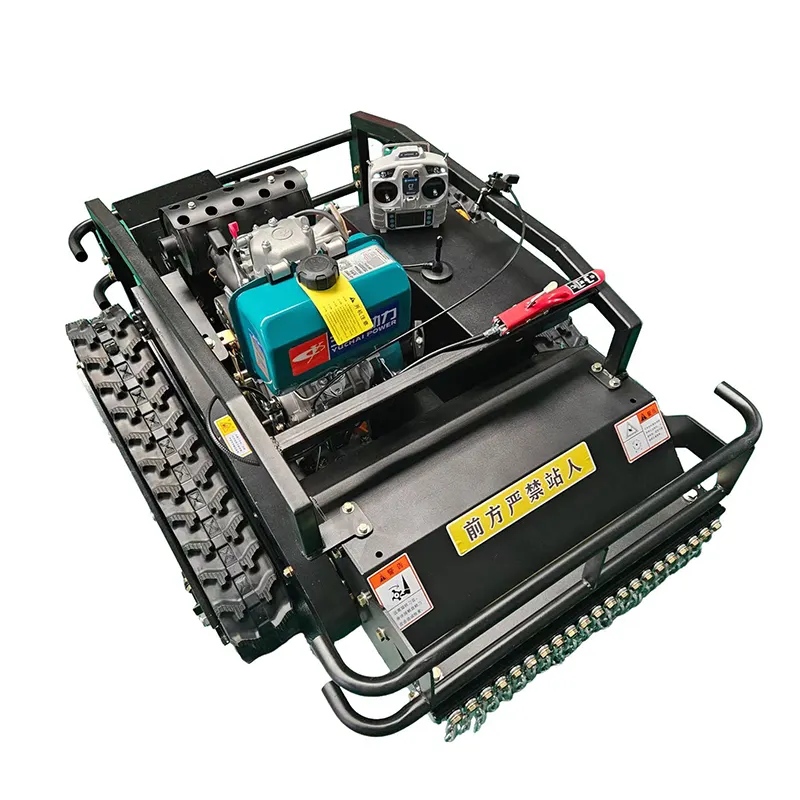
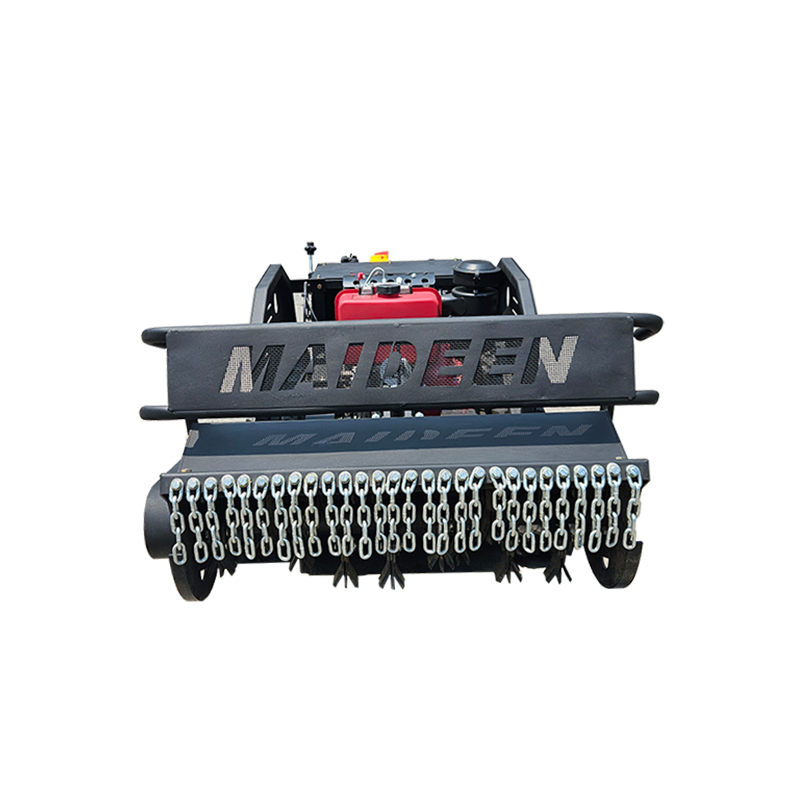
Before ordering a remote control lawn mower, request the proposed machine’s dimensional drawing and clarify what each measurement includes: cutting deck, tracks or wheels, guards, handles, attachments, and any components that extend during operation. Ask separately about transport position, operating position, turning requirements, minimum recommended clearance, and service access.
Safety documentation should also be product-specific. For example, search results for ISO 5395-3:2013 indicate that its scope excludes robotic and remote-controlled lawnmowers. That does not determine what documentation a particular machine has or needs; it is a reminder to ask the manufacturer or supplier for the relevant documentation, operating guidance, and local compliance information for the intended market.
A practical custom-dimension request checklist
| Share with the supplier | Why it matters |
|---|---|
| Narrowest route width and photographs | Supports an access and approach-angle review. |
| Work-zone sketch with obstacles | Helps assess turning, buffer space, and route planning. |
| Ground and vegetation conditions | Keeps the dimension discussion connected to the actual mowing task. |
| Storage and transport constraints | Prevents a site-fit solution that creates a handling problem later. |
| Target-market requirements | Enables a conversation about relevant documentation and configuration details. |
Shandong Maide En Intelligent Technology can use this kind of site information when discussing a remote control lawn mower configuration to structure an initial discussion around remote mower fit and configuration feasibility. Final suitability should be confirmed against the actual product information, site conditions, and operating procedures.
Conclusion: fit the machine to the whole route
A custom-dimension remote control lawn mower can be a practical option when limited working space is driven by access, maneuvering, or storage constraints. A sound decision process is straightforward: measure the complete route, distinguish straight-line width from turning space, verify the proposed configuration, and review safety and operating documentation before purchase. That approach gives buyers a clearer basis for discussing a machine that fits the property rather than just the gate.