EN
Why Heavy Duty Remote Lawn Mower Works For Long Continuous Hours
A remote control lawn mower is often chosen because a difficult mowing task is not really a short, tidy-lawn job. It may involve tall growth, uneven ground, long access routes, repeated passes, or an area that must be maintained without putting an operator beside the cutting deck. In that context, the question is not simply whether a machine can start and cut. The useful question is why a heavy-duty remote control lawn mower can support a long work window when the site, the machine, and the operator’s process are prepared together.
As a technical explainer for remote mowing equipment, I would separate the answer into power delivery, cutting load, heat control, terrain management, and routine checks. A heavier machine is not automatically right for every property. But when the grass, route, duty cycle, and maintenance plan match its design, a heavy-duty remote control lawn mower can keep moving through demanding work with fewer avoidable interruptions.
Continuous Hours Are a Process, Not a Single Specification
It is easy to focus on one number: engine output, battery capacity, deck width, or claimed runtime. On its own, though, none of those tells the whole story. That shortcut misses the point. A remote control lawn mower works for long continuous hours when each part of the working process stays within reasonable limits. Dense or wet vegetation raises cutting resistance. A steep or broken route changes traction demand. Dust and clippings affect cooling and visibility. The operator still needs a clear line of sight, a planned route, and a safe response if conditions change.
That is why heavy-duty designs commonly matter in commercial-style work. Their construction is intended to cope with repeated loads rather than an occasional light pass. The relevant benefit is not a promise of endless operation. It is the ability to plan a longer work session around practical inspections, refueling or charging, debris removal, and route adjustments instead of stopping because a lightly built system is being asked to do a job outside its normal duty.
1. A Stronger Powertrain Handles Changing Cutting Load
Grass is not a uniform material. Height, moisture, stem thickness, and density can change across the same site. A heavy-duty remote control lawn mower needs a powertrain that can keep the cutting system and drive system working together when load rises. If the machine loses momentum in heavy growth, the operator may need to reduce travel speed, change the cutting pattern, or make another pass. Those are normal adjustments, not signs that every machine has failed.
The important point is matching the power system to the task. A remote control lawn mower used for long work periods should have its manufacturer-specified fuel, battery, belt, blade, and drive checks completed before the shift. For battery-powered equipment, plan charging around the actual site and vegetation rather than assuming a catalog figure will apply. For engine-powered equipment, confirm fuel level, air intake condition, and any service requirements in the operator manual.
2. Heavy-Duty Chassis and Traction Reduce Unplanned Stops
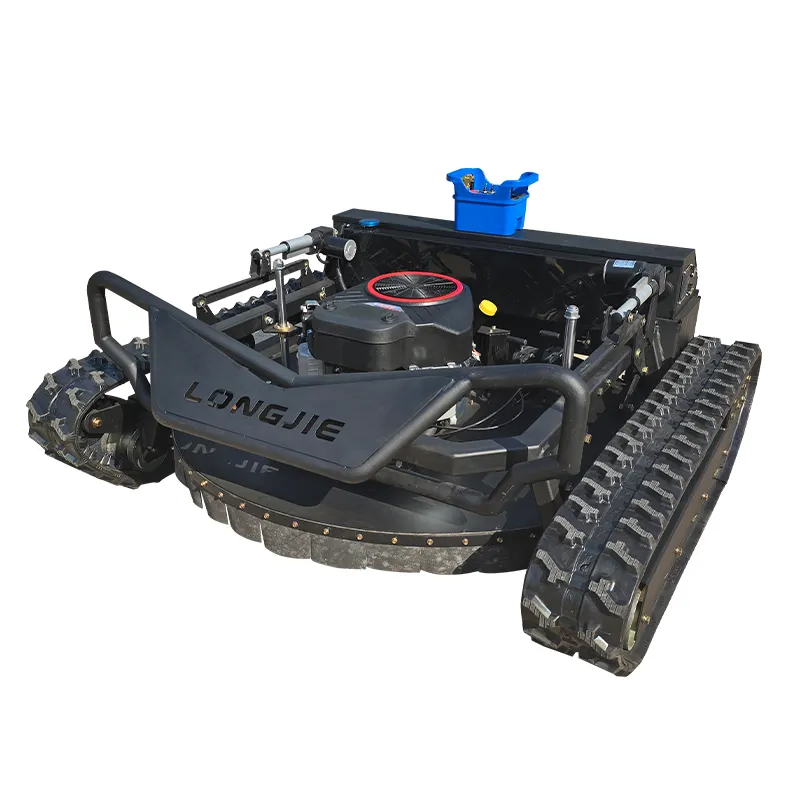
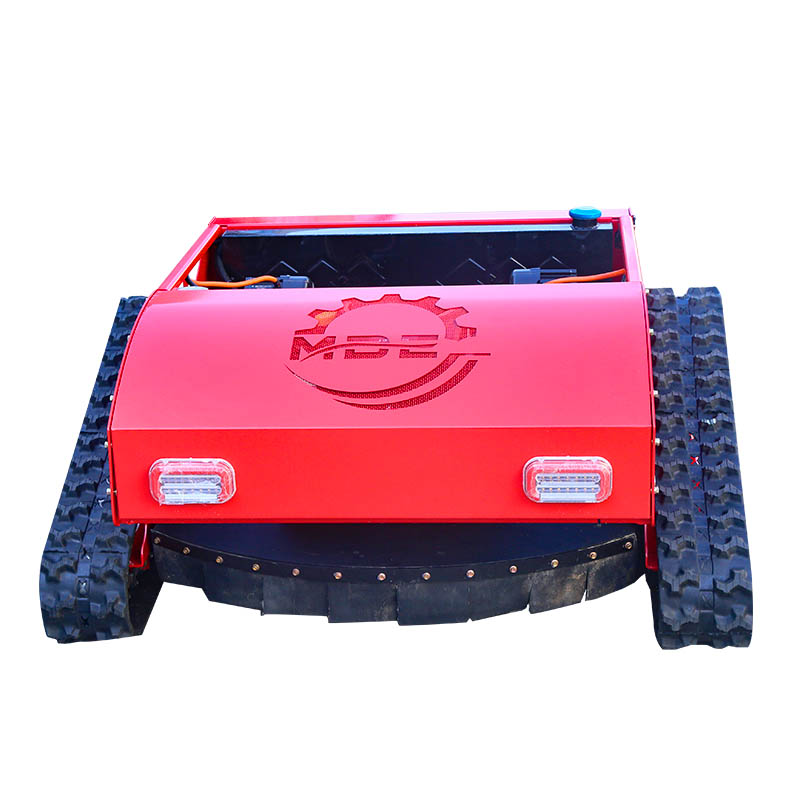
A long mowing session also depends on the path beneath the machine. Tracks or tires, ground clearance, weight distribution, and the connection between the drive system and chassis affect how a remote control lawn mower moves over ruts, loose soil, slopes, and rough vegetation. A stable platform can make route control more predictable, particularly where repeated turns or changes in surface would punish a lighter design.
Still, heavy equipment must not be treated as permission to ignore terrain. Before operating a remote control lawn mower, walk the route and mark hazards such as ditches, hidden stumps, retaining edges, washouts, wire, or loose debris. OSHA’s public riding-mower guidance emphasizes pre-use inspection and warns against operating near unprotected edges that create rollover hazards. The exact limits and slope ratings must come from the manual for the machine being used. Remote operation changes where the operator stands; it does not remove responsibility for route planning.
3. Heat, Airflow, and Cleaning Affect the Work Window
Many interruptions during extended mowing are related to heat buildup or accumulated debris rather than a dramatic component failure. A heavy-duty remote control lawn mower is better supported by a routine that keeps cooling areas, guards, cutting zones, and air paths clear according to the manufacturer’s instructions. When dry grass, dust, or clippings collect, they can affect airflow, inspection visibility, and safe operation.
Build short checks into the shift. Stop in a safe area, disengage the cutting system as instructed, and inspect only after the machine is secured. Look for packed clippings, loose hardware, abnormal vibration, fluid leaks, worn blades, damaged guards, and changes in track or tire condition. A remote control lawn mower that receives these planned checks is more likely to have a productive day than one that is pushed until a small issue becomes downtime.
4. Cutting Strategy Protects Both Output and Equipment
Long continuous work does not mean using maximum travel speed on every pass. The more reliable approach is to set a cutting pattern that suits the material. In tall or dense growth, a remote control lawn mower may need a slower ground speed, a narrower overlap, a staged cutting height, or a second finishing pass. This is where a heavy-duty build helps: the machine is designed for a more demanding cycle, while the operator uses a method that avoids repeatedly overloading the deck.
Break the site into sections. Start with boundaries and known obstacles, then use a route that keeps the machine visible and avoids needless travel across already cut ground. Pause after a difficult section to assess heat, debris, cutting quality, and route condition. So it helps not to judge efficiency only by uninterrupted minutes. Judge it by how much safe, consistent work the remote control lawn mower completes before the next planned service point.
5. Remote Control Helps Position the Operator Better
A central reason to choose a remote control lawn mower is that the operator can manage the machine from a position that may be more suitable than riding or walking directly beside the cutting area. That can be useful around rough ground, tall vegetation, or a route with limited access. Yet remote control is not an unattended mode. Signal range, visibility, obstacles, bystanders, and emergency-stop familiarity all matter throughout the shift.
Before a long session, test steering response, stopping response, and any required safety functions in a clear area. Keep people and animals away from the work zone, and stop when sight lines are lost or site conditions are unclear. A remote control lawn mower supports continuous work best when the operator is actively supervising it—not when the remote is treated as a substitute for a trained work plan.
A Practical Long-Hour Checklist
- Before start: inspect guards, fasteners, blades, tracks or tires, controls, fuel or charge status, and the planned route.
- During work: adjust speed and cutting approach for vegetation; watch for vibration, debris buildup, loss of traction, or reduced visibility.
- At planned pauses: secure the remote control lawn mower, clear debris only as the manual permits, and recheck the route as light or ground conditions change.
- After work: clean the machine, record issues, and follow the manufacturer’s service schedule based on operating hours and calendar time.
Choose Capacity With the Whole Job in View
Why does a heavy-duty remote control lawn mower work for long continuous hours? Because its stronger construction can support repeated cutting and travel loads when it is correctly matched to the site. The lasting advantage comes from the system around it: realistic route planning, appropriate cutting strategy, clean airflow, scheduled inspections, and an operator who knows when to pause.
For a purchase discussion, prepare the site area, vegetation type, ground condition, typical slope, access width, expected work cycle, and maintenance resources. Then ask the supplier to confirm the specific model’s approved operating limits, safety requirements, and service intervals. That evidence-based approach is a sound basis for selecting a remote control lawn mower, rather than assuming that heavy duty means unlimited operation.