EN
Why RC Track Mowers Are Gaining Popularity in Orchard Maintenance
Orchard maintenance is not simply a matter of cutting grass between trees. It is repeated ground work carried out around trunks, irrigation lines, uneven rows, changing cover crops, and seasonal debris. That is why more orchard managers are looking closely at the rc lawn mower category. A tracked remote-control machine can change where the operator stands and how a route is planned, but it should be evaluated as part of an orchard-floor program rather than as a shortcut that solves every mowing problem.
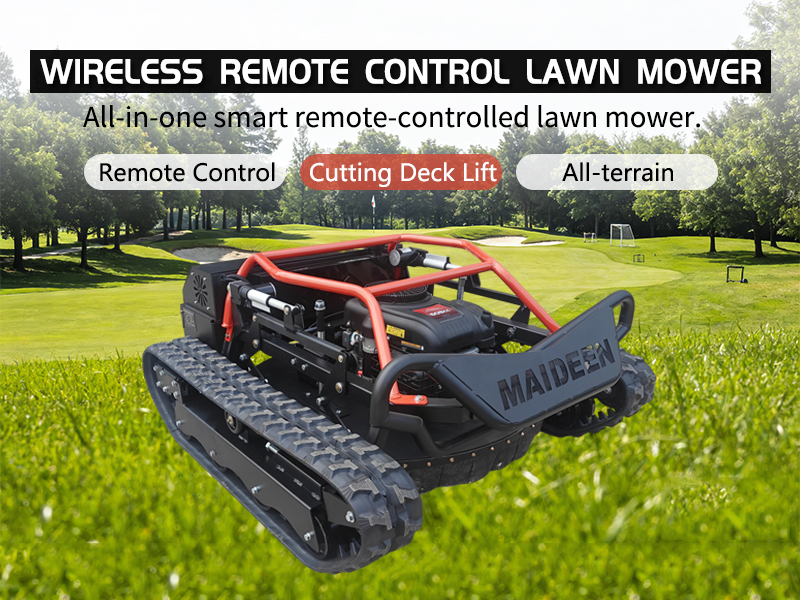
An rc track mower is attracting attention because it pairs remote operation with a track-based undercarriage. In practical terms, that combination can be relevant where walking behind equipment is tiring, where access is awkward, or where ground conditions vary across one block. The right rc lawn mower decision still starts with the orchard itself: row width, slope, grass height, ground firmness, obstacles, visibility, and the operator’s safety procedure.
Orchard Floors Create a Different Mowing Task
Orchard-floor management affects more than appearance. Managed vegetation can support equipment traction, soil protection, water movement, and dust control when the overall ground-cover system is appropriate. Mowing may also be timed around crop-management needs. For example, extension guidance notes that cutting tall cover crops can be part of frost-management practice because a shorter cover can allow more solar heat to reach the soil during the day. That does not make one mowing schedule right for every orchard; it illustrates why mowing is a recurring operational decision.
Conventional equipment can work well in open, regular blocks. The challenge is that many orchard rows include tight turns, low branches, uneven headlands, damp patches, and boundaries that demand attention. A crew member may have to slow down repeatedly to reposition equipment or judge a safe route. In those conditions, interest in an rc lawn mower tends to grow because the operator can concentrate on steering and observation from a position away from the immediate cutting area.
Why Tracks Matter in an Orchard
The appeal of tracks is not a promise that every surface becomes easy. It is a way to distribute contact differently from a wheeled layout and to pursue steadier travel where soil, grass cover, or minor undulations change the machine’s behavior. An rc track mower may therefore be worth assessing for blocks with mixed surfaces, modest slopes, or ground that changes after rain. The key word is assessing: traction, turning behavior, and safe operating limits must be confirmed against the actual machine documentation and the site.
There is a useful correction to a common assumption here. More traction does not remove the need for route planning. An rc lawn mower still needs enough space for turns, a clear approach to tree rows, and a plan for drainage edges, rocks, exposed roots, and parked equipment. In fact, remote operation makes pre-work observation more important, not less important, because the operator must retain reliable sightlines while the machine moves.
Remote Operation Changes the Operator’s Role
The strongest reason for considering an rc lawn mower is often operator separation. On a difficult row, the person directing the machine may be able to stand away from the immediate path instead of walking alongside it. That can be useful when vegetation, slope, dust, or debris make close-proximity work less comfortable. It is not a substitute for a safety system, training, or the manufacturer’s instructions. Before work begins, the operator should check the work zone, establish a no-entry area, identify blind spots, and keep bystanders clear.
For orchard teams, this changes the job from “walk and cut” to “inspect, position, monitor, and review.” A remote-control setup works most reliably when the operator can see the route, stop the machine promptly, and avoid treating the tool as unattended equipment. An rc track mower can reduce some physical burden, but it also asks for disciplined attention to boundaries and changing surface conditions.
Where an RC Lawn Mower Can Fit Well
An rc lawn mower is most likely to earn attention in orchards where the mowing task has one or more of the following characteristics:
- Rows have enough clearance for the machine and a predictable turning plan.
- Ground conditions alternate between firm, grassy, uneven, or lightly sloped areas.
- Operators need to limit close walking near cutting work, debris, or difficult footing.
- Mowing is repeated often enough that route consistency and operator comfort matter.
- The site can be inspected before each pass for branches, stones, wire, irrigation components, and people.
Notice what is missing from that list: a claim that every orchard needs an rc lawn mower. Narrow rows, concealed hazards, poor visibility, severe surface changes, or conditions outside the equipment’s stated limits can change the conclusion. A machine that looks suitable in a smooth demonstration area may not fit a block with tight tree spacing and irregular ground.
Questions to Ask Before Choosing an RC Track Mower
Instead of beginning with a headline specification, build a site checklist. First, measure the tightest working sections: row width, headland room, tree-clearance points, and gateway access. Next, record the surface conditions that occur through the season. Grass height, cover density, wet spots, ruts, and loose material all influence the route. Then define who will operate the rc lawn mower, what training is required, and where that person can stand with a clear view.
| Check area | What to confirm | Why it matters |
|---|---|---|
| Row geometry | Clearance, turn space, trunk protection zones | Determines whether an rc lawn mower can travel without risky corrections. |
| Ground conditions | Slope, firmness, wet areas, vegetation density, obstacles | Shows whether an rc track mower is being considered for a realistic task. |
| Operator position | Visibility, safe stand-off location, communication plan | Keeps remote operation deliberate rather than unattended. |
| Maintenance support | Inspection routine, cleaning, wear parts, service information | Helps the rc lawn mower remain part of a repeatable program. |
Popularity Comes From a Better Match, Not a Trend Alone
RC track mowers are gaining visibility in orchard work because they address several practical questions at once: how to cover changing ground, how to reduce close operator exposure, and how to organize repeat mowing across rows. The rc lawn mower is not automatically a universal choice, and tracks are not a license to ignore terrain limits. Still, when orchard geometry, conditions, and safety procedures are compatible, the format can be a sensible option to investigate.
The next step is simple: map a representative block, identify its difficult sections, and compare the documented limits and operating requirements of any rc lawn mower against that map. A careful evaluation will say more than a generic feature list. It will show whether an rc track mower can support the orchard’s actual mowing routine while keeping safety and maintenance decisions in view.