EN
Why Tracked Mowers Work Better on Soft Muddy Ground
A tracked lawn mower is often easier to control on soft, muddy ground because its tracks spread the machine’s load across a broader contact area. That does not turn a waterlogged site into a safe workplace, but it can make a meaningful difference where wheeled equipment starts to sink, spin, or leave deep ruts. For grounds teams, orchard operators, and property managers, the right question is not simply whether a mower has tracks. It is whether the machine, the soil, the slope, and the work plan still suit one another.
From a remote-mower technical perspective, muddy-ground decisions are more usefully made by separating three things: flotation, traction, and stability. A tracked lawn mower can improve the first two in many conditions. Stability and safe operation still depend on slope, obstacles, drainage, visibility, vegetation, and the manufacturer’s operating instructions.
Why soft ground changes the mowing job
Soft ground gives way under a machine. When a wheel’s smaller contact patch carries the same load, the force is concentrated in a limited area. The surface can compress, the wheel can sink, and the tread may lose its bite. Once that happens, a mower may need more throttle without moving cleanly forward. The result can be wheel spin, torn turf, a wandering route, or a recovery problem.
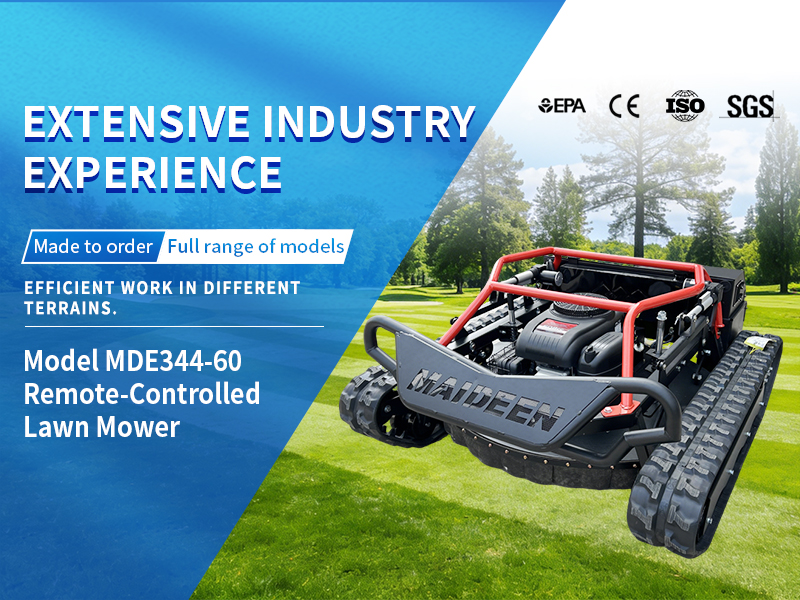
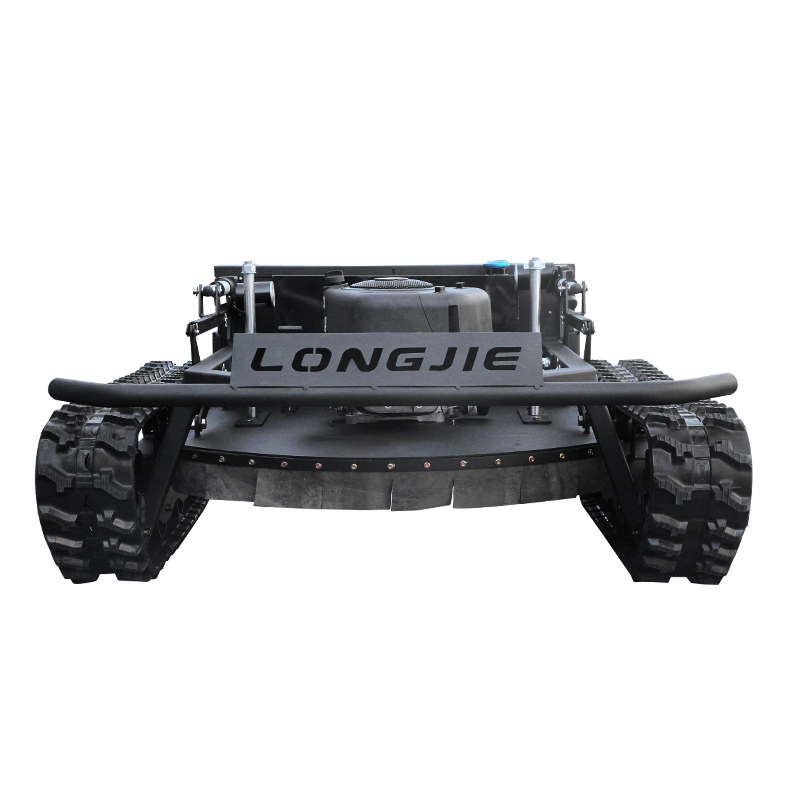
A tracked lawn mower uses a longer, wider contact footprint than a typical wheeled layout. Spreading the load over more surface area can lower ground pressure at the soil surface. In practical terms, that can help the machine stay nearer the surface instead of punching down through a soft top layer. It is a mechanics principle, not a promise that every tracked mower will float over every muddy site.
Soil moisture matters as much as the visible mud. A firm surface with a wet top layer may still support a tracked lawn mower well. Saturated ground with hidden voids, drainage channels, or peat-like soil may not. Before mowing, walk or inspect the route, identify low spots, and consider whether a loaded machine could be recovered without damaging the site further.

Tracks create useful traction without relying on one small patch
The benefit of tracks is not only lower pressure. A rubber track presents many tread sections to the ground as it moves. That larger engaged area can provide more usable grip on loose soil, wet grass, rough field edges, and shallow ruts. A tracked lawn mower is therefore often a better fit when the surface changes every few metres instead of remaining consistently dry and level.
There is an important correction here: more traction is not the same as unlimited traction. Mud can pack into track patterns, slick clay can shear under the track, and submerged grass can hide holes, stones, roots, or ditches. The operator should treat improved grip as a margin for controlled work, not as permission to enter an unsafe area.
- On soft turf: tracks may reduce concentrated rutting compared with a smaller wheel contact area.
- On uneven ground: a broader footprint can help the machine maintain forward progress while the surface varies.
- Near slopes: track grip may assist control, but route direction, surface condition, and the manufacturer’s limits remain decisive.
- In wet vegetation: tracks can be helpful, yet wet grass can still be slippery and obscure hazards.
Why a tracked lawn mower can protect the work route
Muddy-ground mowing is not just about completing one pass. It is about leaving a route that remains manageable for the next pass, the next machine, and the site owner. When a wheel spins, it can excavate a hole and expose soil. A tracked lawn mower may travel with less concentrated disturbance when conditions are suitable, which can make route planning more predictable.
That said, low ground pressure is not a guarantee of zero turf damage. Turning sharply on saturated ground can scrub the surface. Repeated passes in the same line can still compact or disturb the soil. A sensible plan uses wide turns where possible, avoids sudden direction changes at the wettest points, and stops before damage becomes cumulative.
Start with a route check, not a specification sheet
It is tempting to compare engine output or cutting width first. On muddy ground, the more useful starting point is the work route. Mark drainage paths, standing water, culvert edges, depressions, and areas where the vegetation conceals the soil. Confirm access and exit points. Then assess how a tracked lawn mower would approach the cut, turn, and leave the area if traction changes halfway through the job.
Remote operation can add distance, not remove responsibility
Many tracked mowers are considered alongside remote operation because distance can keep the operator away from certain exposure areas. This can be especially useful when a route is rough, wet, or bordered by vegetation. However, a tracked lawn mower still needs clear line of sight, an exclusion zone, and an operator who can stop work quickly.
Remote control does not solve a poor site decision. It does not reveal a hidden washout, make a steep saturated bank stable, or replace a pre-use inspection. If the mower begins to slide, loses predictable steering, or approaches a water edge or drop-off, the safe response is to stop and reassess rather than test the limits of the tracks.
Where tracked mowers are most likely to help
A tracked lawn mower can be a practical option for maintenance teams working on damp field margins, orchard rows, rough grassland, drainage-affected grounds, and sites that remain soft after rain. The strongest case is usually a repeatable task with variable surface conditions, a clear route, adequate visibility, and a defined recovery plan.
For an occasional patch of wet lawn, waiting for better conditions may be the better decision. Tracked mowers can be slower or more complex than wheeled alternatives on easy, dry ground. The value comes from matching the configuration to the conditions—not assuming that a track system is automatically better everywhere.
A practical pre-mowing checklist for muddy ground
- Check the soil: look for standing water, deep impressions, soft edges, and hidden depressions.
- Check the route: plan a stable approach, turns, and exit path before starting the cut.
- Check the slope: follow the equipment manual and avoid side-to-side mowing where slope guidance calls for an up-and-down route.
- Check visibility: remove debris and ensure the operator can see boundaries, people, and hazards.
- Check recovery: know how work will stop and how the mower can be retrieved if it loses traction.
- Check the machine: inspect tracks, guards, controls, and cutting components according to the manufacturer’s instructions.
Make the decision around conditions, not a single feature
The advantage of a tracked lawn mower on soft muddy ground comes from distributing load and maintaining traction across a larger contact area. Those benefits can reduce rutting and improve controlled travel when the site is still suitable for work. But tracks do not override saturated soil, unsafe slopes, poor drainage, hidden obstacles, or operating limits.
For buyers and maintenance managers, the most useful next step is to document the typical ground condition, slope, grass density, work frequency, access route, and required safety controls. With that information, a supplier can help assess whether a tracked lawn mower is appropriate for the task and which configuration details need to be confirmed before deployment.