EN
EN
How Does Robotic Remote Control Mower Combine Remote and Automatic Mowing?
A robot lawnmower can combine remote and automatic mowing when its control system is designed to let an operator use each mode for the job it suits. Remote control is useful for positioning, inspecting an unfamiliar area, or handling a section that needs direct judgment. Automatic mowing is useful when a documented work area, route, and operating conditions allow the machine to follow its programmed logic. The useful question is not which mode is better in every case. It is how a robotic remote control mower moves safely between them.
From a remote-mower technical perspective, the answer starts with the worksite. A robot lawnmower should be assessed against terrain, vegetation, boundaries, communication conditions, and the operating instructions for that specific model. Remote capability and automation may sit in the same machine, but their available functions, sensing methods, and safeguards can differ significantly by configuration.
Two modes, two different operator roles
Remote control means the operator is actively directing movement through a controller or another approved interface. That can be valuable during initial positioning, turning around obstacles, moving through a narrow access route, or stopping work when conditions change. It does not remove the need for a clear line of sight, an exclusion area, or attention to blade and ground hazards.
Automatic mowing shifts part of the route-following task to the robot lawnmower. Depending on the documented system, the mower may use a defined boundary, a planned work area, positioning technology, onboard sensors, or a combination of these. Automatic operation is not a reason to leave the site unmanaged. Before enabling it, the operator should confirm what the machine is actually specified to detect, where it is permitted to operate, and what action is required if it loses position, communication, or a safe operating condition.
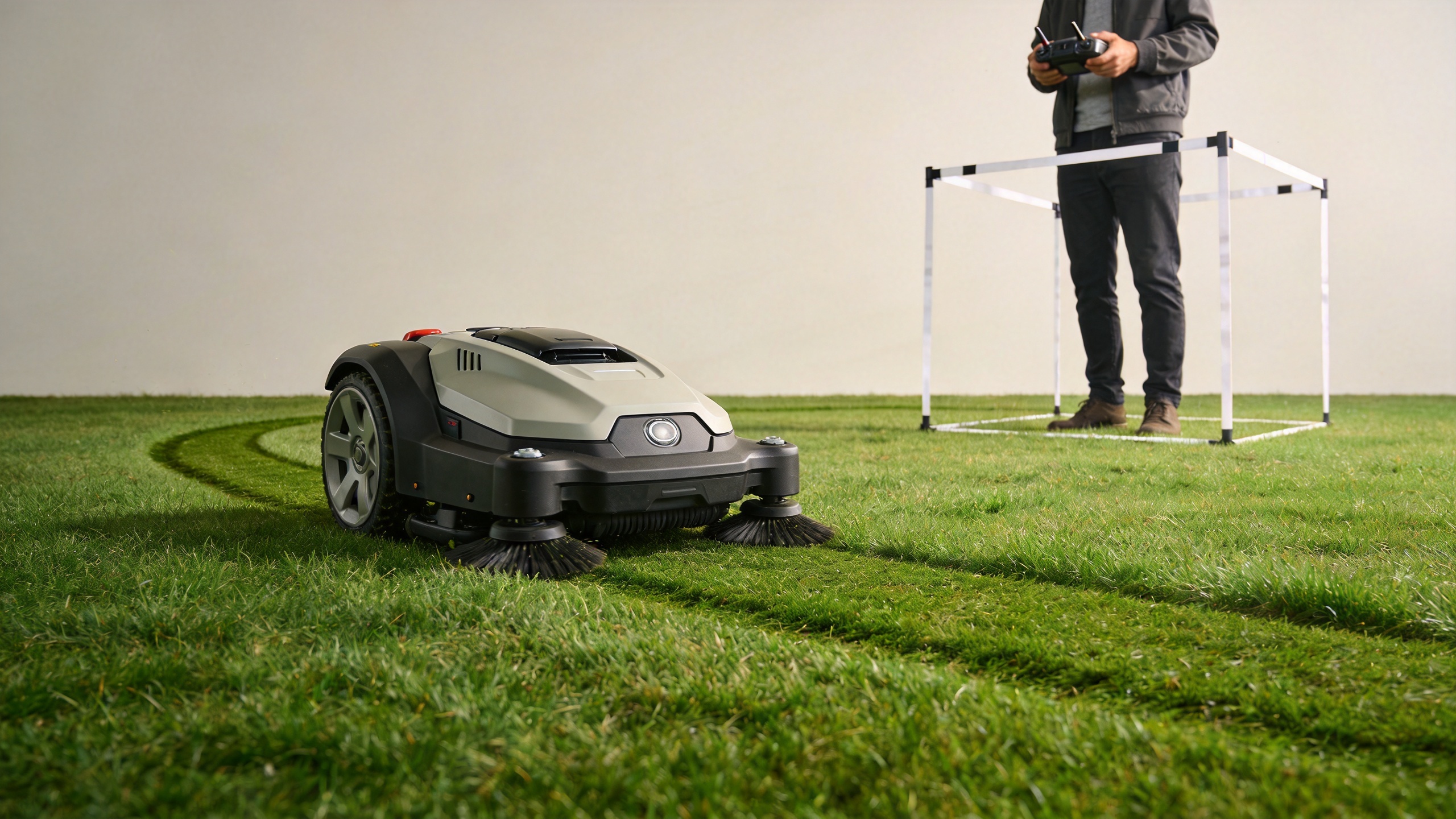
In practical terms, the robotic remote control mower combines both modes by making remote control the supervised setup and intervention layer, while automatic mowing performs repeatable route work only after the required conditions have been verified.
How the handoff from remote to automatic mowing should work
A reliable handoff is usually a sequence rather than a single button press. The exact screens, permissions, and interlocks must come from the manufacturer manual, but the decision logic can be organized into three stages.
1. Prepare the work area in remote mode
Use remote control to inspect access points, verify that the intended zone is free of people and avoidable debris, and identify features that may change the route: drainage edges, tree roots, parked equipment, exposed rocks, steep transitions, and low branches. This is where a site-first approach matters. Rather than starting with a feature list, put the robot lawnmower into the actual conditions it must handle.
Confirm the route boundary and operating zone according to the equipment documentation. If the worksite includes slopes, uneven ground, wet areas, or changing grass density, the planned automatic area may need to be reduced or divided into smaller sections. A robotic remote control mower should not be assumed to have the same slope, obstacle, or signal tolerance as another model.
2. Verify automatic-mode prerequisites
Before switching modes, check the approved emergency-stop method, controller status, battery or power condition, communications link, weather suitability, and exclusion zone. Search results for robotic mowing commonly focus on automated navigation and obstacle handling, but a procurement or operations team should treat those as questions to verify, not universal promises. Ask for the applicable operation manual, safety instructions, and configuration list for the proposed robot lawnmower.
Also confirm who remains responsible for supervision. Some systems may use remote-stop functions, authentication, or automatic-mode interlocks; others may have different procedures. If a safety feature is important to the site plan, it should be written into the equipment specification and demonstrated under the intended working conditions.
3. Enable automatic work and keep an intervention plan
Once the approved area and conditions are confirmed, automatic mowing can handle repetitive coverage within that defined zone. The operator should remain ready to pause or stop the mower if people enter the area, debris appears, the terrain changes, signal quality drops, or the machine behaves outside the documented operating pattern. The ability to take control back is what makes the combined approach practical: remote control is not a backup to ignore, but a planned intervention method.
What a robot lawnmower can automate—and what still needs human judgment
| Task | Automatic mowing may assist when documented | Human judgment remains necessary |
|---|---|---|
| Coverage of a defined area | Following an approved route, boundary, or programmed work zone | Confirming that the zone is appropriate for current conditions |
| Obstacle response | Using model-specific sensing or route logic | Clearing hazards and verifying what the system is designed to recognize |
| Mode changes | Providing an interface to activate automatic work | Checking prerequisites, personnel clearance, and emergency controls |
| Route recovery | Returning to a programmed state where supported | Stopping, inspecting, and deciding whether work can safely continue |
That distinction prevents a common misunderstanding: automation can reduce repeated steering tasks, but it does not transfer site accountability to the mower. For a robotic remote control mower, the safest workflow is to decide in advance when remote guidance is required and when automatic coverage is permitted.
Choosing the right operating strategy for the site
Start with the job, then compare features. A regular, well-defined grass area may be a better candidate for automatic mowing than a site with frequent changing obstacles, uncertain boundaries, or many tight turns. Where conditions vary across the property, divide the work into zones. Use remote control for entry, inspection, edge work, and exceptions; reserve automation for the portions that meet the machine’s documented requirements.
This approach also improves purchasing discussions. Instead of asking whether a robot lawnmower is “fully automatic,” provide the supplier with the terrain profile, grass condition, maximum slope to be evaluated, access width, obstacle types, expected work frequency, communications environment, and supervision plan. Then ask which control modes, safety functions, and operating limits are documented for the exact configuration.
Pre-operation checklist for combined mowing modes
- Review the current site for people, animals, debris, holes, wet areas, and changing access conditions.
- Confirm the robot lawnmower’s approved work zone and any boundary or route setup required by its manual.
- Test the specified remote-control link and emergency-stop procedure before cutting begins.
- Set an exclusion area and keep the operator in the required supervision position.
- Use remote operation to inspect uncertain sections instead of forcing automatic mowing into an unsuitable area.
- Pause automatic work if weather, ground conditions, obstacles, or communications no longer match the plan.
- After work, inspect the mower, cutting area, and any events that should change the next route plan.
Key takeaway
A robotic remote control mower combines remote and automatic mowing by assigning each mode a clear role. Remote control supports setup, inspection, tight-area handling, and intervention. Automatic mowing supports repeatable work inside a verified operating zone. A sound result comes from a documented transition process, active supervision, and a site plan that respects the specific robot lawnmower’s manual rather than assuming every automated feature applies everywhere.
Before selecting or deploying equipment, prepare a short site brief covering terrain, vegetation, route boundaries, access, operating frequency, and the safety controls you need confirmed. That gives suppliers and operators a practical basis for evaluating the right mowing workflow.