EN
What Blade Types Fit Crawler Lawn Mower for Grass Cutting?
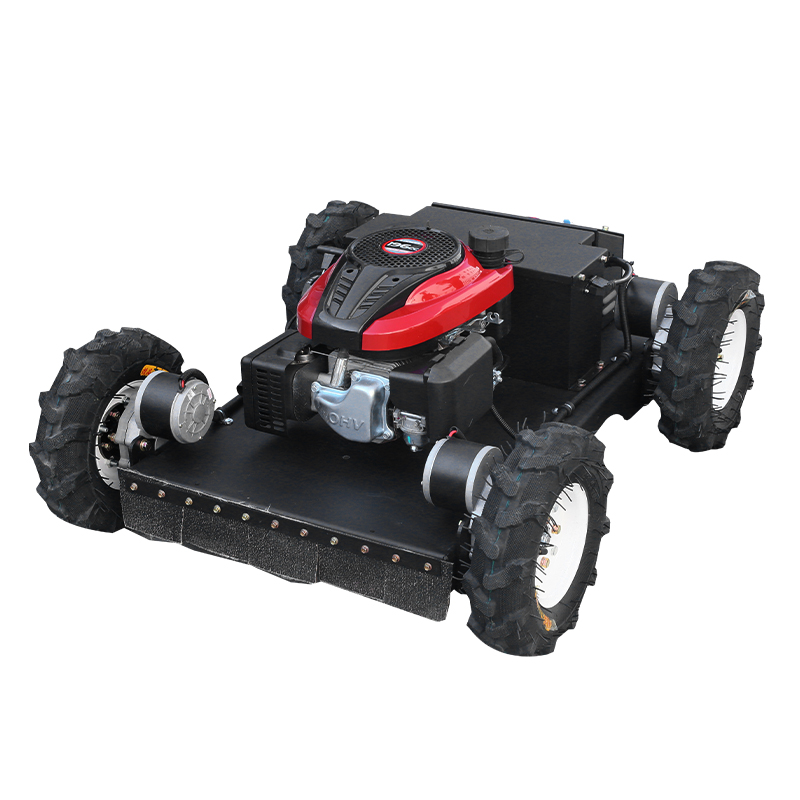
Choosing a crawler lawn mower is not only about tracks, remote control, or engine power. The cutting system determines whether the machine leaves a tidy finish, handles tall grass without repeated passes, or spends too much time striking material outside its intended use. As a technical explainer for remote mowing equipment, I start with the task: describe the grass, the ground, the finish you need, and the obstacles that may enter the cutting path. That approach makes crawler lawn mower for grass cutting decisions much clearer.
A crawler lawn mower can be paired with a rotary deck or a flail rotor, depending on its design. Within a flail system, knife-like Y flails and heavier hammer flails are common categories. The right choice is not universal: the same crawler lawn mower may be useful on a maintained grassy site with one blade set and unsuitable on dense, woody growth with that same set. Confirm the approved blade type, rotor, guards, and operating limits in the supplier's documentation before changing parts.
Start with the grass, not the blade name
Before comparing a crawler lawn mower blade type, walk the site or review recent field photos. Note grass height, stem thickness, moisture, density, hidden debris, slopes, ditches, and the required cutting finish. Short, regularly maintained turf calls for a different approach from long meadow grass, orchard alleys, roadsides, or an area that has missed several cutting cycles. Tracks may help a crawler lawn mower move over uneven ground, but they do not make every cutting attachment appropriate.
- Managed grass: usually prioritizes an even appearance and efficient routine passes.
- Long or dense grass: needs a system that can process more material without forcing a finish intended for lawn-like turf.
- Mixed vegetation: requires an honest inspection of stems, saplings, stones, wire, and other hazards before any blade decision.
- Wet or uneven ground: calls for slower planning, safe clearances, and confirmation of the specific crawler lawn mower operating instructions.
Rotary blades: a practical fit for routine grass work
A rotary deck generally uses one or more large blades rotating around a vertical axis. On a compatible crawler lawn mower, this layout can be a sensible choice for routine grass cutting over open ground when the grass is maintained and the desired result is a conventional cut. Rotary systems are often discussed for efficient coverage, but “efficient” still depends on blade sharpness, deck condition, travel speed, grass volume, and the machine's approved configuration.
For a crawler lawn mower for grass cutting, a rotary deck may fit when the site is reasonably clear, the grass is not excessively heavy, and the operator can maintain a safe route. It is less helpful to ask whether rotary is “better” in the abstract. Ask whether the deck is designed for the mowing height, grass condition, discharge arrangement, and terrain you actually have. Do not fit a substitute blade simply because it appears similar in size or mounting pattern.
Flail rotors: many small cutting elements, different priorities
A flail mower uses many small flails mounted on a horizontal rotor within a cutting chamber. That different layout changes how a crawler lawn mower processes material. Flail systems are commonly considered where grass is taller, conditions are rougher, or a more mulched result is wanted. Yet the appropriate flail profile depends on the rotor and the work; online photos alone are not enough to select it.
Y blades and lighter knife flails
Y blades, paired knives, or other lighter flail styles are often considered for grass and lighter vegetation on a compatible crawler lawn mower. Their multiple cutting points can suit routine vegetation management where a fine, distributed cut is desirable. They are not a promise that a machine will handle every overgrown area. Check the manufacturer's specified blade set, quantity, fasteners, balance requirements, and replacement procedure.
Hammer flails
Hammer-style flails are heavier components often discussed for tougher material. On a crawler lawn mower, they may be relevant only when the rotor, drive system, enclosure, and intended task support them. For ordinary grass, a heavier hammer is not automatically the smarter selection; extra mass can be unnecessary if the job is primarily finish mowing. If mixed growth includes woody material, stop treating it as a simple lawn task and obtain configuration guidance for the exact machine.
A blade-selection checklist for crawler lawn mower work
- Define the vegetation: record average height, thick patches, and any woody stems.
- Set the result: decide whether the priority is a tidy lawn finish, general grass control, or rough-area maintenance.
- Verify the cutting system: confirm whether the actual crawler lawn mower has a rotary deck, flail rotor, or another approved attachment.
- Confirm approved parts: use the blade profile, dimensions, bolt hardware, and rotor balance specification supplied for that configuration.
- Inspect the site: remove or mark stones, wire, branches, holes, drainage edges, and bystanders' access routes.
- Plan a conservative first pass: in tall grass, assess the response at a controlled pace rather than assuming the crawler lawn mower should cut at maximum travel speed.
This checklist is useful because it turns a vague blade question into an evidence-based discussion. Buyers can send a supplier photos, grass height, site dimensions, slope details, desired finish, and a list of hazards. In return, they should request confirmation of the compatible crawler lawn mower blade configuration, replacement intervals, safe operating guidance, and parts availability.
Safety and maintenance are part of blade fit
Blade fit is also a safety question. Shut down and isolate the machine according to its manual before inspection, cleaning, or replacement. Replace worn, cracked, bent, or missing parts as a balanced set when the manufacturer requires it. Uneven flail wear or an incorrectly installed rotary blade can affect vibration and cut quality. Guards, shields, fasteners, and the cutting chamber matter as much as the cutting edge.
A remote-operated crawler lawn mower is not risk-free merely because the operator stands at a distance. Confirm the work zone, keep people and animals clear, follow the equipment manual, and reassess conditions when grass is wet, visibility is poor, or debris appears. The machine's specified slope and terrain limits are configuration-specific and should be verified, not assumed.
Choose the system that matches the job
For routine, maintained grass, a compatible rotary deck may be the straightforward choice for a crawler lawn mower. For taller grass or rougher vegetation, an approved flail setup may better suit the task, with lighter knife or Y-flail styles often worth discussing for grass and hammer flails reserved for applications the supplier confirms. A suitable crawler lawn mower for grass cutting setup is one whose blades, rotor or deck, guards, terrain plan, and maintenance routine all match the real site, rather than just the product label.