EN
What Features Make An Orchard Weeder Suitable For Orchard Rows
Choosing an orchard weeder is less about finding the largest cutting deck and more about matching a machine to a narrow, living work zone. Tree trunks, low limbs, irrigation hardware, uneven soil, and repeated turns all change the job. From an equipment-selection perspective, the useful question is: can the machine manage vegetation in your orchard rows without asking the operator to trade control, clearance, or safety for speed?
That distinction matters because row middles and the strip near trees are not the same task. Orchard alleyways are often maintained as mown grass or cover crop, whereas the tree row may need more deliberate weed management. A mower that works comfortably in open alleys may not be the right orchard weeder for working close to trunks, posts, or the canopy edge.
Start with the actual orchard-row work zone
Before comparing machines, map a representative block rather than relying on its total acreage. Measure the narrowest passable row, note the turning room at headlands, and identify slopes, drainage swales, exposed roots, rocks, irrigation lines, and low branches. In many orchard systems, the maintained weed-free strip is discussed in feet on either side of the trees; that planning reference is helpful, but the correct working width still depends on your planting system and local agronomy.
An orchard weeder should therefore have a controllable working envelope. When reviewing an orchard weeder specification, record both transport width and active working width, then compare them with the narrowest row rather than the average row. Overall machine width, cutter reach, side clearance, and the space needed to turn all deserve separate checks. A compact machine that can repeat a safe route may be more useful than a wider unit that forces frequent corrections near trees.
1. Row-width fit and maneuverability
Look for dimensions that match the tightest usable section of the orchard, not only the easiest straight row. Adequate clearance on both sides allows for natural steering variation and reduces the likelihood of brushing trunks or hardware. A short turning radius and predictable direction changes matter at row ends, especially where headlands are limited.
For remote or tracked equipment, stable low-speed control can be just as important as maximum travel speed. The operator needs time to correct line position before a cutter or wheel reaches a tree guard, trellis component, or irrigation riser. If a supplier lists a nominal width, ask whether it includes guards, side implements, and any attachment in its working position.
2. Protection around trunks and obstacles
A row-capable orchard weeder needs a way to handle the objects that make orchards different from open fields. Depending on the working method, useful features may include guarded cutting zones, mechanical feelers, sensors, breakaway protection, adjustable offsets, or an implement that retracts when it reaches a trunk. The appropriate system depends on tree age, trunk protection, row geometry, and the operator’s ability to monitor the route.
Do not assume that an obstacle feature makes every planting safe. Young trees, low branches, uneven trunk guards, and buried or flexible irrigation components should be reviewed during an on-site demonstration. A conservative clearance rule is more useful than relying on a feature name alone.
3. Ground-following ability and traction
Orchard floors are rarely perfectly flat. Wheel ruts, berms, leaf litter, soft spots, and cross slopes can alter cutting height and machine stability. A suitable orchard weeder should maintain predictable contact with the ground while leaving the operator enough control. For every orchard weeder under review, ask how ground-following changes when a wheel or track crosses a rut, a berm, or a damp patch. to slow down or stop when the surface changes.
Check how the cutting or weeding component follows contours, how height is adjusted, and whether the chassis can remain stable on the slopes that exist in the intended block. Tracks may help distribute contact over soft ground in some conditions, but they do not remove the need to evaluate slope limits, soil moisture, and the manufacturer’s operating guidance. Efficiency is valuable; site inspection and safe operating distance come first.
4. A weeding method that fits the vegetation
The word “weeder” covers different approaches: mowing or flailing vegetation, shallow mechanical cultivation, brushing, finger-style tools, and other targeted systems. Each has a different relationship with soil disturbance, woody trunks, residue, and regrowth. Mechanical weed management is one option within a broader orchard-floor program, alongside approaches such as mulching or other site-specific practices.
Match the working method to the vegetation and the purpose of the pass. If the goal is to keep a grassy alley tidy, a cutting system may be appropriate. If the concern is vegetation close to the tree line, ask how the tool reaches that band, what protects the trunks, and whether it disturbs soil or throws debris in a way that conflicts with the orchard’s management plan.
5. Remote-control visibility and fail-safe behavior
A remote-controlled machine changes where the operator stands, not the need for attentive supervision. A workable remote-control orchard weeder setup gives the operator a view of the machine, its discharge area, and the next obstacle before the machine reaches it. In an orchard, trunks and foliage can interrupt sightlines, and a row can hide a rut or obstacle until the machine is close to it. For any remote-control orchard weeder, assess the usable viewing position, control response at low speed, emergency-stop access, and the behavior of the machine if communication is interrupted.
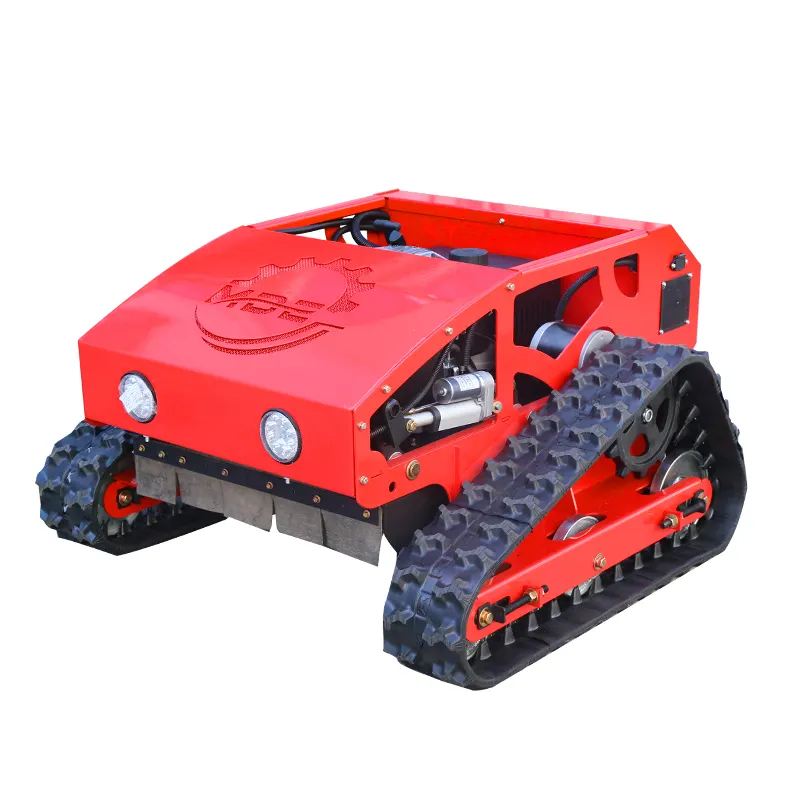
The auxiliary phrase massproduced crawler remote control lawn mower may describe a broad equipment category, but orchard suitability must be proven at the row level. A crawler machine intended for general grass cutting is not automatically configured for close work around trees. Confirm guards, attachments, machine width, control range, terrain limits, and service documentation for the exact configuration under consideration.
6. Service access and repeatable daily checks
Orchard work exposes equipment to dust, sap, plant residue, and repeated impacts from uneven terrain. A practical orchard weeder makes routine inspection straightforward. A serviceable orchard weeder also makes it easy to document these checks across repeated row passes: operators should be able to examine cutting components, guards, belts or drive parts, fasteners, tires or tracks, and emergency controls without dismantling the machine. Parts availability, maintenance intervals, and a clear service contact should be part of the purchase conversation.
Power specifications deserve attention, but a machine is easier to keep productive when daily checks and replacement items are understood before purchase. Ask for the operating manual, maintenance schedule, parts list, and the exact support route for your market.
How to compare two orchard weeder configurations
Use the same brief for both machines. For each orchard weeder, record machine width, required clearance, obstacle protection, low-speed response, slope guidance, and service access. Then mark whether the proposed orchard weeder can complete the narrowest pass without a workaround. This makes comparison more useful than engine or battery figures alone.
Where the equipment will make repeated passes near trunks, request a demonstration with the actual attachment fitted. The demonstration should show how the orchard weeder approaches a trunk, reverses or turns at a headland, reacts to a change in ground level, and stops. If the proposed orchard weeder needs a different guard, offset, or operating limit for your block, make that configuration part of the written quotation.
A supplier checklist for orchard-row suitability
- What are the machine width and working width with the proposed attachment installed?
- What minimum row width, turning space, slope, and ground conditions does the manufacturer specify?
- How does the machine protect trunks, guards, irrigation components, and low obstacles?
- Which vegetation types and cutting or weeding methods is the proposed configuration designed to handle?
- How are height, offset, speed, and emergency stop controlled during close-row work?
- What daily inspections, wear parts, and maintenance intervals apply?
- Can the supplier demonstrate the exact configuration in conditions comparable to your orchard?
Make the final decision from conditions, not labels
The right orchard weeder is one whose width, protection, ground response, control system, and maintenance plan all fit the rows it will enter. A purchasing team should score each orchard weeder against the same row-width, obstacle, terrain, control, and service checklist instead of selecting from a category label. Start with the tightest spaces and highest-risk obstacles, then compare configurations against those conditions. That approach gives purchasing, technical, and operations teams a shared checklist and avoids treating a general lawn machine as an orchard-row solution without verification.
For a tailored equipment discussion, prepare a short site brief with row spacing, tree age, terrain photos, dominant vegetation, irrigation layout, and the work frequency you expect. Those inputs make it much easier to determine which features are necessary, which are optional, and which claims should be verified in a demonstration.