EN
What Risks Come With Homemade rc mower In Field Operation
A homemade rc mower can look like a practical way to keep an operator away from rough grass, but distance is not the same as control. In field operation, an rc lawn mower combines a cutting system, drive system, radio link, power source, and moving machine in one package. If any one of those parts behaves unexpectedly, the operator may be farther away when a fast decision is needed. This article is a risk-planning guide, not an approval to build or operate one.
The most useful starting point is not motor size or cutting width. It is the work site: slope, wet spots, holes, hidden debris, boundary drop-offs, people, animals, and the operator’s line of sight. A homemade rc mower has no assumed factory validation, so its limits should be treated as unknown until a qualified review, controlled testing, and documented checks establish otherwise.
Why field risk changes with a homemade RC machine
A commercial rc lawn mower may have documented controls and operating limits. A homemade build may use capable components, but the system questions remain: Does the blade stop if the signal is lost? Does propulsion stop on a controller fault? Can the machine be immobilized without approaching the deck? Are wiring, guards, brakes, and control logic suitable for vibration and moisture?
Field conditions also change during the job. Grass can hide wire, rocks, stumps, holes, and debris. A route that seems clear nearby may become blind behind a hedge, rise, or ditch.
1. Uncontrolled movement and loss of radio control
The first major risk is a machine that keeps moving, turns unexpectedly, or cannot be stopped when the radio link weakens. Interference, low controller power, damaged antennas, receiver resets, programming errors, or loose connectors can interrupt commands. A homemade rc mower should not assume that the remote link will remain available.
Before every operation, test intended loss-of-signal behavior with cutting disabled and the machine secured. A safe-state design should stop travel after signal loss, reboot, low voltage, or implausible commands. Include an emergency stop independent of the normal remote command path. Do not test failure behavior near people, property, water, slopes, or a live blade.
If you cannot see the front path, rear path, and likely escape route, you cannot reliably judge whether an rc lawn mower is clear to proceed. A helper does not replace a defined stop signal, exclusion zone, and one accountable operator.
2. Blade, debris, and entanglement hazards
A cutting deck can throw stones, metal fragments, branches, or broken blade pieces. It can also pull in wire, long grass, fabric, or hidden litter. Before mowing, walk the area and remove debris rather than assuming tall grass will absorb it.
Published U.S. consumer mower requirements illustrate a safer-stop principle: blade operation is tied to deliberate control, and covered walk-behind rotary mowers have blade-stopping expectations. They do not certify a homemade rc mower, but show why “it usually stops” is not an adequate plan. A remote cutting system needs tested guarding, positive disable controls, and a documented isolation procedure.
Do not approach the deck to clear material while it is energized or idling. Isolate power, verify that blades and drives have stopped, then investigate. Without a safe isolation procedure, do not use the machine in the field.
3. Slope, rollover, and runaway risk
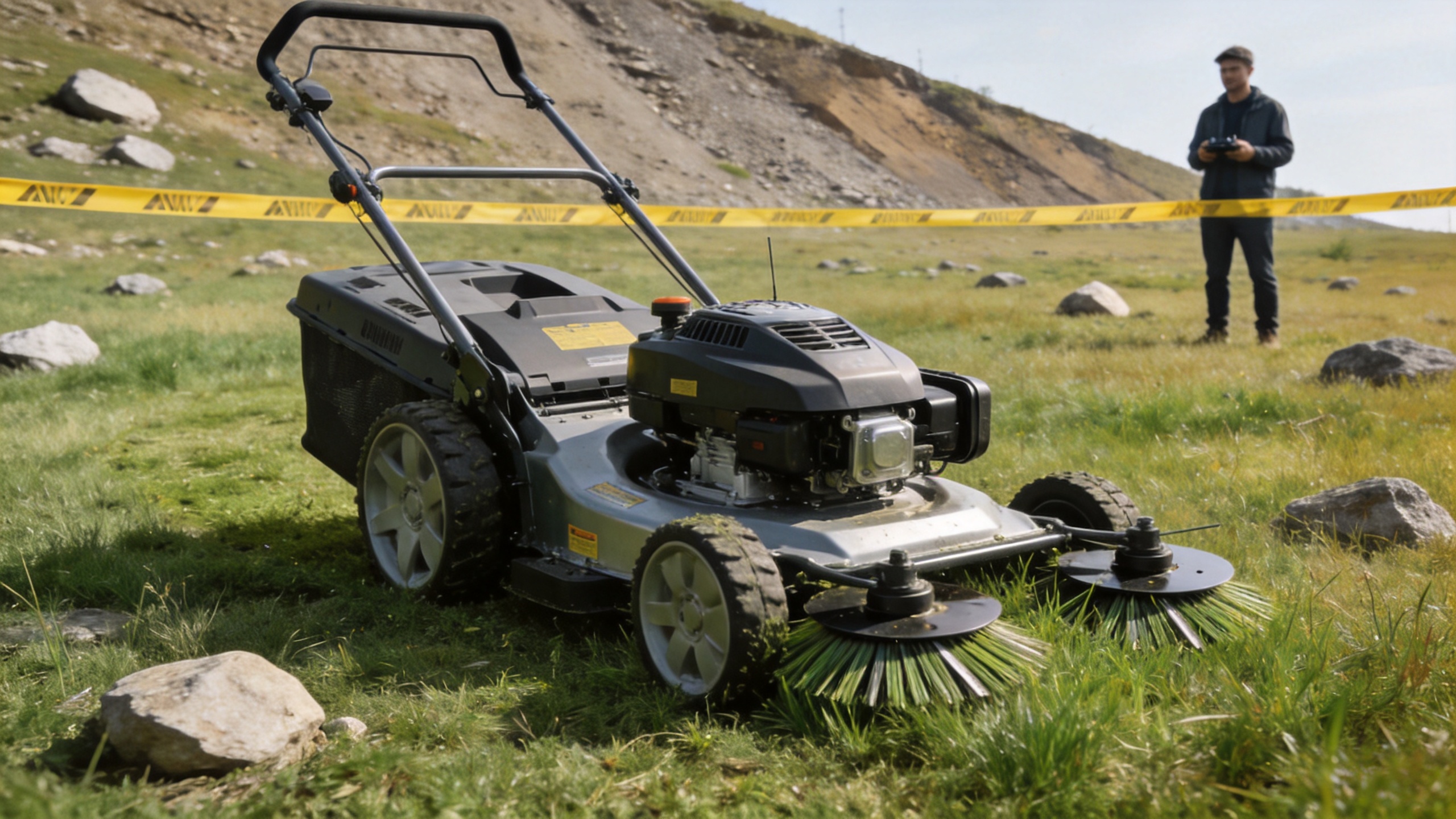
Slope risk is more than traction. A machine can slide, lose steering, roll over, or continue downhill after a control fault. Wet grass, loose soil, uneven ground, a high center of gravity, and a sudden turn can change its behavior. OSHA guidance for riding mowers advises following manufacturer slope limits and, where no limit is available, avoiding slopes over 15 degrees. A homemade build has no validated limit, so this is a warning against inventing a rating—not permission to use 15 degrees.
Exclude unknown slopes until stability has been evaluated under controlled, non-cutting conditions. Keep people below and beside the potential path. Mark ditches, culverts, retaining edges, and soft shoulders as no-go areas. Tracks, wide tires, or a powerful motor do not prove safe recovery from a slide.
4. Mechanical, electrical, and fire hazards
Vibration and impact can loosen fasteners, crack mounts, chafe cables, and fatigue welds. Components that work on a stand may fail under load, heat, mud, or repeated turning. Battery builds add damaged-cell, fusing, enclosure, connector, and charging risks; engines add hot surfaces, fuel, exhaust, and unintended starts.
Inspect guards, fasteners, steering, brakes, wiring, connectors, power condition, blades, wheels or tracks, and emergency controls. Stop after a strike, unusual vibration, control glitch, overheating smell, or unexplained behavior.
5. Human factors: false confidence and unclear responsibility
Remote control can make an rc lawn mower feel less hazardous because the operator is not seated on it. That is incomplete: the operator still controls travel, blade use, access, and stopping decisions. Informal handoffs are a further risk when one person built the machine and another drives it.
Assign one trained operator. Keep bystanders, children, pets, and coworkers outside a defined exclusion zone. Agree on an immediate shutdown call. Avoid distractions, isolated lone work, fatigue, poor lighting, and reduced sight or hearing. If the site cannot be controlled, choose another method.
A field checklist before using a homemade RC mower
- Survey the site: identify slopes, holes, drop-offs, wire, rocks, hidden obstacles, traffic, people, animals, and escape paths.
- Define the exclusion zone: keep others out before energizing the machine and maintain a clear line of sight.
- Inspect the machine: examine guards, deck, blades, fasteners, tires or tracks, steering, wiring, batteries or fuel system, and visible damage.
- Prove the stop functions: with cutting disabled and the machine secured, check normal stop, emergency stop, and intended signal-loss behavior.
- Plan the route: start with a low-risk, open section; avoid unknown slopes, ditches, gravel, and blind corners.
- Set a stop threshold: stop for changing ground conditions, poor visibility, debris strikes, control delay, overheating, unusual noise, or any person entering the zone.
When the safer choice is not to operate it
Do not deploy a homemade rc mower simply because it starts and moves. Do not operate near public access, roads, occupied buildings, steep or wet ground, waterways, concealed debris, or places where a runaway machine could reach people or property. Do not use it when emergency stop, radio-loss response, guarding, or power isolation is unverified.
When evaluating an rc lawn mower rather than building one, request written information about terrain, operating limits, safety controls, service support, and training. Shandong Maide En Intelligent Technology can help structure field-condition questions; final suitability should be confirmed against product documentation and the site.
Frequently asked questions
Is a homemade RC mower safe if it has an emergency stop?
An emergency stop is important, but it does not prove the system is safe. It must work independently and be tested with guarding, braking, blade stopping, loss-of-signal behavior, electrical protection, and field controls.
Can I use a homemade RC mower on a steep field?
Not without a documented evaluation of the specific machine and site. With no validated limit, treat steep, wet, uneven, or near-edge terrain as unsuitable rather than guessing from motor power or tire type.
What should I do if the mower strikes an object?
Stop it, isolate power, wait for all motion to cease, inspect for damage, and do not resume until the cause and condition are understood. A strike can damage blades, guards, mounts, wiring, or the drive system even when the mower still runs.
Bottom line
The central risk of a homemade rc mower is not one component; it is uncertainty across the whole system. Treat every field use as a controlled operation: inspect the site, protect the exclusion zone, validate independent stopping behavior, avoid unverified slopes and blind routes, and stop at the first sign of abnormal behavior. A capable rc lawn mower can only be part of a safer mowing plan when the machine, site, and operating method are all evaluated together.