EN
What Safety Practices Apply To All Mowers
Mowers differ in size, power source, drive system, and operator position, but the core safety routine should not change. A walk-behind unit, a riding machine, and a remote-controlled model all use moving blades, can throw debris, and need a clear operating area. The safest approach is to treat every mowing task as a short sequence: inspect, prepare the site, operate deliberately, shut down fully, and maintain only when energy is isolated.
This guide is written from the viewpoint of an equipment operator preparing a site rather than a buyer comparing claims. Manufacturer instructions for specific mowers take priority, especially for slope limits, controls, guarding, and service procedures. The practices below are the common baseline to apply before any mowing session.
Start With the Operator, Not the Engine
Before starting mowers, the operator should be alert, appropriately dressed, and familiar with the controls. Avoid loose clothing that can catch on moving parts. Wear sturdy, slip-resistant footwear, eye protection, and hearing protection when the machine and task call for it. Gloves can help during inspection and cleanup, but they are not a reason to reach toward a blade or belt.
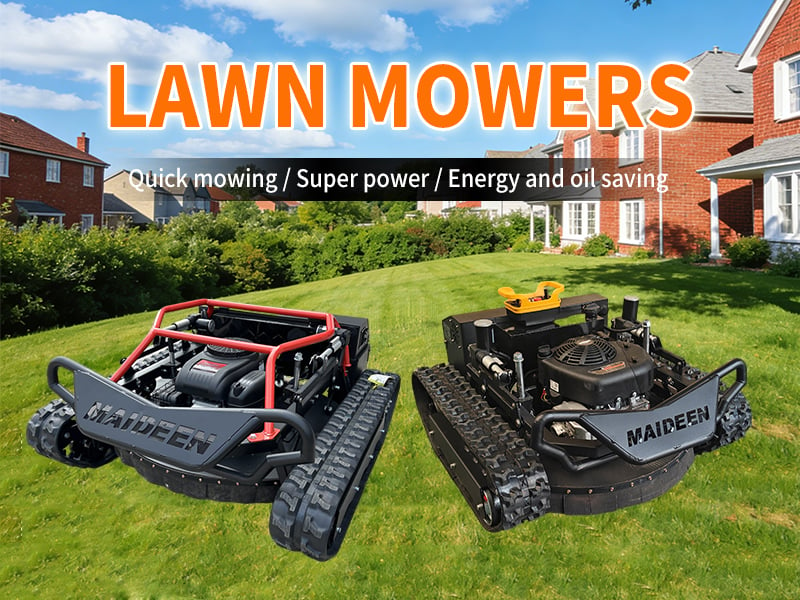
Read the operating manual for the particular machine and verify that a trained adult is in control. Do not let a passenger ride on mowers unless a manufacturer has specifically designed and approved a seat for that purpose. Children and untrained bystanders should stay out of the work zone. If the job involves a custom dimension remote lawn mower, the remote-control range, stop function, signal reliability, and exclusion zone need to be checked before blades are engaged.
Inspect Mowers Before Each Use
A quick pre-start check prevents many avoidable problems. Walk around mowers with the engine or motor off. Look for loose hardware, fluid leaks, damaged tires or tracks, cracked guards, worn belts, and debris packed around the deck. Make sure guards, shields, discharge components, and safety interlocks are present and functional. Do not bypass an interlock simply to save time.
Check the blade area only after the machine is shut down and its energy source has been made safe according to the manual. For gasoline mowers, that can include removing the key and disconnecting the spark-plug lead before clearing or servicing. For battery-powered mowers, remove the battery when the manual directs it. Operators should also check that controls return properly, brakes work, and emergency-stop functions are accessible. A defect is a reason to remove mowers from service, not a reason to work around the defect.
Prepare the Mowing Area First
Most mowers can turn small objects into dangerous projectiles. Walk the intended route and remove stones, wire, toys, branches, tools, and loose metal. Mark holes, stumps, ditches, steep drop-offs, irrigation parts, and other hazards that may be hidden by tall grass. Establish a clear buffer that keeps people, pets, and vehicles away from the discharge path.
Do not rely on hearing alone to know whether someone has entered the area. Pause mowers if visibility is poor, a person approaches, or a new obstacle appears. Wet grass, uneven ground, loose soil, and poor light change traction and control. In those conditions, postponing the task may be the safer decision. The need to finish a route does not outweigh the need to reassess the site.
Use Safe Starting and Operating Habits
Start mowers only from the position specified by the manufacturer. For ride-on equipment, that usually means seated at the controls, with the transmission and blade controls in the required safe settings. Keep hands and feet away from moving parts and the underside of the deck. Maintain a firm grip or stable operating posture, and keep attention on the travel path rather than on a phone or conversation.
Travel at a speed that allows time to stop or steer around a hazard. Make wide, controlled turns and slow down before uneven ground, obstacles, and changes in grade. Do not mow across a slope unless the manufacturer expressly permits that method. Follow the machine's stated slope limit; there is no universal angle that is safe for all mowers. For riding mowers with rollover protection, use the restraint system exactly as instructed and do not operate with required protective equipment removed.
Backing deserves special care. Look behind and around the machine before reversing, and avoid reversing when another route is practical. Remote operation does not eliminate this duty: the operator of a custom dimension remote lawn mower must keep the machine in view and stop it immediately if the site is no longer controlled.
Keep Clear of Blades, Chutes, and Discharge Areas
Do not reach into a discharge chute, grass catcher, or deck while mowers are running. A blade may continue to coast after power is switched off, so wait until every moving part has stopped. If grass clumps or debris block the chute, follow the shutdown sequence in the manual, isolate the energy source, and use an appropriate tool rather than a hand to remove material.
Keep the discharge directed away from people, roads, windows, and parked equipment. Do not remove guards to make bagging or cleanup easier. If the guard, catcher, or chute is damaged, stop using the machine until it is repaired. These rules apply to small residential mowers as much as to commercial or remote-controlled equipment.
Shut Down Deliberately and Maintain Safely
Safe work continues after the last pass. Park mowers on stable, level ground where possible, disengage blades, set the brake if equipped, turn off the power, remove the key, and wait for complete stop before leaving. Do not leave a running machine unattended. Refuel only after a gasoline engine has cooled and away from ignition sources. Recharge batteries in the location and manner specified by the manufacturer.
For cleaning, blade adjustment, or inspection underneath mowers, use the maker's service procedure and suitable support methods. Do not depend on a jack alone or place any part of the body under an unsupported machine. Record recurring problems such as vibration, difficult steering, or unreliable stop controls so they can be inspected before the next job.
A Simple Universal Mower Safety Checklist
- Read the model-specific instructions and confirm the operator is ready.
- Inspect mowers, guards, controls, tires or tracks, and emergency-stop functions.
- Clear the work area and keep children, pets, and bystanders outside the exclusion zone.
- Match speed, route, and direction to the ground conditions and manufacturer limits.
- Keep hands and feet away from blades, chutes, and moving parts.
- Stop, isolate energy, and wait for complete blade stop before clearing or servicing.
- Park, secure, and maintain mowers only after proper shutdown.
Final Takeaway
The universal rule for mowers is simple: control the machine, control the site, and stop whenever either control is uncertain. Good preparation, intact safeguards, deliberate operating habits, and complete shutdown are more dependable than trying to react after a hazard develops. Use this checklist as a starting point, then apply the manual and local safety requirements for the exact equipment and terrain in front of you.