EN
Why Flail Cutting Crawler Remote Control Lawn Mower Clears Thick Weeds Efficiently
When tall grass and dense weeds have been left to mature, a tidy-lawn approach is usually the wrong starting point. A crawler remote control lawn mower equipped with a flail cutting system is designed around a different job: repeatedly striking, cutting, and dispersing fibrous vegetation while the operator manages the machine from a safer working position. The result is not a promise that every overgrown site will be easy; it is a practical way to match a mower’s cutting action, traction, and operating routine to difficult vegetation.
As a technical explanation, this article separates the cutting principle from the site conditions that decide whether it will work well. A crawler remote control lawn mower can be a useful option when the ground, growth, access route, and operating rules have been checked first.
Start with the job, not the appearance of the mower
Thick weeds are challenging because they vary in height, stem toughness, moisture, and density. A large-looking machine is not automatically the better answer. Before choosing a crawler remote control lawn mower, map the task: identify grass versus woody stems, note hidden debris, mark ditches and tree lines, and estimate how often the area needs attention. Those details affect whether the cutting deck can process material steadily rather than being forced through it.
For a field, orchard margin, embankment, or unmanaged green space, divide the work into preparation, cutting, and review. Preparation means checking access and clearing hazards. Cutting means choosing a measured travel pace and overlapping passes. Review means inspecting the cut area, the deck, and the route before continuing. This task-first view is more useful than comparing a single advertised feature in isolation.
How flail cutting works on thick weeds
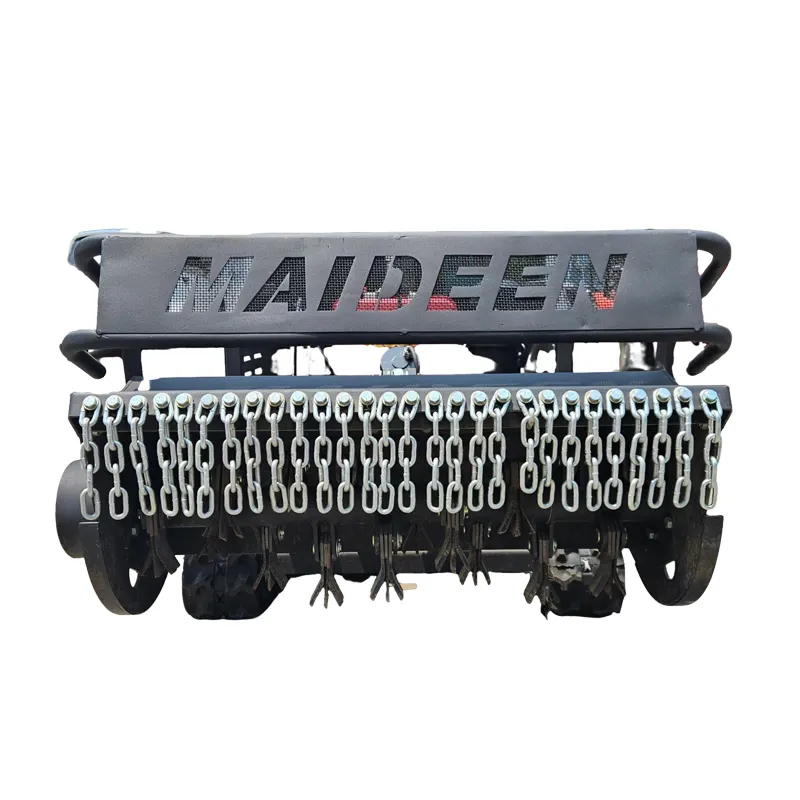
A flail system uses many small, swinging blades or hammers mounted along a rotating horizontal drum. As the drum turns, the flails strike vegetation repeatedly. Their swinging movement helps the cutting assembly follow uneven material and reduces the tendency to rely on one fixed blade edge for every stem. For grass and weeds, that repeated action cuts and breaks material into smaller pieces that can be distributed across the ground.
This explains why a crawler remote control lawn mower with a flail deck can suit dense, fibrous growth. Instead of treating every pass like finish mowing, the deck is working through a volume of vegetation. The operator can adapt the pace to how the material feeds into the cutting zone. Where grass height and weed density rise, a slower pass, a narrower overlap, or an initial cut at a suitable setting may help the deck maintain a more consistent load.
It is important not to turn that principle into an absolute claim. Flail cutting is commonly associated with grass and weeds; very thick woody brush, embedded wire, stones, or unknown debris require a separate assessment. A crawler remote control lawn mower should not be used as a substitute for site preparation or for an attachment selected for a different vegetation class.
Why crawler travel matters when vegetation is heavy
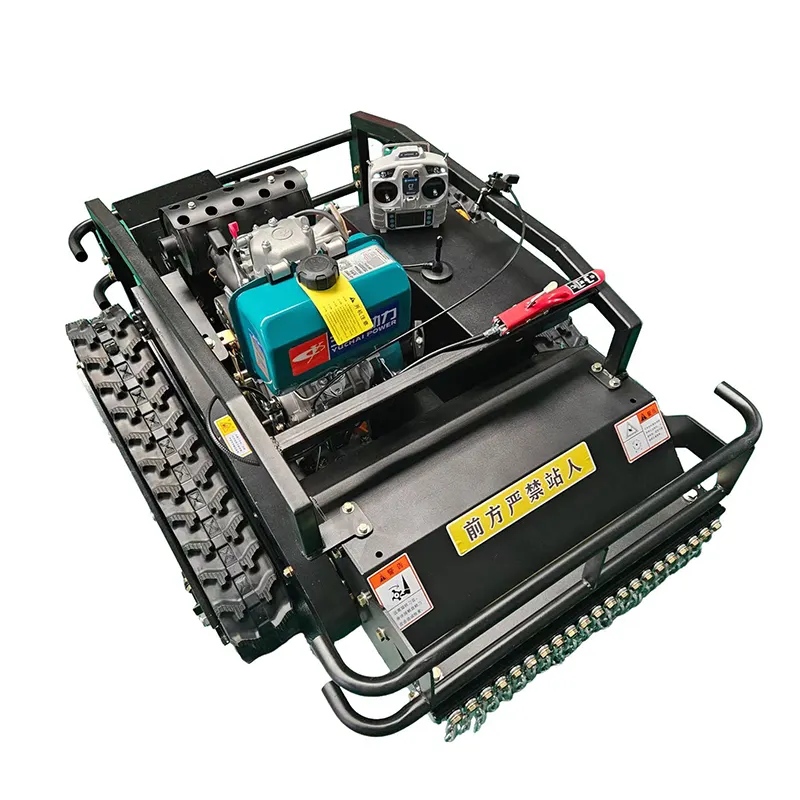
The cutting deck does the vegetation work, but the undercarriage affects how consistently the deck can be presented to the ground. Crawler travel spreads the machine’s contact over tracks rather than relying only on wheels. On suitable surfaces, this can help a crawler remote control lawn mower move through ground that is uneven, soft, or interrupted by shallow surface changes. The practical advantage is steadier route control, not a guarantee for every slope or wet site.
Track traction does not remove the need to assess grade, ground firmness, side-slope exposure, and stopping distance. In fact, dense vegetation can conceal holes, stumps, wire, and changes in traction. Remote operation changes the operator’s position; it does not eliminate the operator’s responsibility to maintain a clear view, respect the equipment instructions, and keep people and animals outside the working area.
Remote control supports distance, visibility, and route discipline
For some tasks, the value of a crawler remote control lawn mower is the ability to position the operator away from the immediate cutting path while still controlling direction and speed. That can be helpful near thick vegetation, slopes, or areas where the ground surface deserves careful observation. However, remote control is most effective when the planned route remains visible. Blind corners, gullies, parked equipment, and dense brush can all change the decision.
A disciplined operating sequence is simple: walk the route first, define a safe exclusion zone, check that control and stop functions respond correctly, then begin from the least complicated section. Keep passes deliberate rather than chasing maximum travel speed. If the mower’s sound, discharge pattern, traction, or response changes, pause and inspect according to the manufacturer’s instructions. A crawler remote control lawn mower is efficient when it enables controlled work, not when it encourages rushed work.
Conditions that improve flail-cutting efficiency
Efficiency comes from matching the system to the material. The following checks make a crawler remote control lawn mower easier to evaluate for heavy weed work:
- Vegetation type: Confirm whether the target is grass and herbaceous weeds or whether woody stems require another method.
- Density and height: A denser stand may call for slower travel, overlap, or staged cutting rather than one aggressive pass.
- Ground surface: Check for ruts, holes, loose material, drainage edges, and changes in firmness that may affect traction or deck clearance.
- Obstacles: Remove or mark wire, stones, irrigation components, branches, and other concealed objects before operating.
- Access and turning: Confirm that entry, exit, and turning areas suit the machine’s actual dimensions and route plan.
- Maintenance readiness: Ask how flails, fasteners, guards, belts or driveline components, and routine inspections are handled for the intended use.
With those inputs, the question becomes more precise: not “Will any crawler remote control lawn mower clear this site?” but “Is this flail deck, undercarriage, and operating plan appropriate for this material and terrain?” That is the more reliable buying and operating question.
Common misconceptions to avoid
“Thicker weeds only require more speed”
More speed can reduce the time available for vegetation to be cut and processed. In a thick patch, measured travel can be more productive than forcing the deck. The correct pace depends on the mower’s documented capability, the material, and the conditions underfoot.
“Crawler tracks make every slope manageable”
Tracks can support traction in appropriate conditions, but slopes still need a site-specific risk review. Surface moisture, hidden obstacles, side-slope angle, load distribution, and route visibility matter. Do not replace operating guidance or local safety rules with a general statement about crawler travel.
“Remote control means the operator can stand anywhere”
The operator still needs a safe, visible position with a clear escape path and reliable control. A crawler remote control lawn mower should be stopped if visibility is lost or an unassessed hazard enters the work zone.
A practical verification checklist before purchase or deployment
Before specifying a crawler remote control lawn mower, prepare a concise site brief for the supplier or technical team. Include photos of typical weeds, the tallest and densest sections, ground and slope observations, access width, obstacles, desired cutting frequency, and the operator’s planned position. Then request current documentation for the exact proposed configuration, including cutting system details, operating limits, safety instructions, service intervals, and available support.
Shandong Maide En Intelligent Technology Co., Ltd. can use this kind of condition-based discussion to help buyers organize remote lawn mower requirements. A productive conversation starts with the jobsite, not an assumption that a single configuration fits all ground or vegetation conditions.
Conclusion
Flail cutting helps a crawler remote control lawn mower handle thick weeds because a rotating drum carries multiple swinging cutting elements through dense, fibrous vegetation. Crawler travel and remote control can support a controlled operating approach when conditions are suitable. The efficient outcome still depends on thoughtful site preparation, a realistic assessment of vegetation, a visible route, and documented operating boundaries. Put those checks first, and the machine can be assessed as a tool for a specific vegetation-management task rather than as a universal solution.