EN
Why RC Lawnmowers Offer Precision Control On Slopes
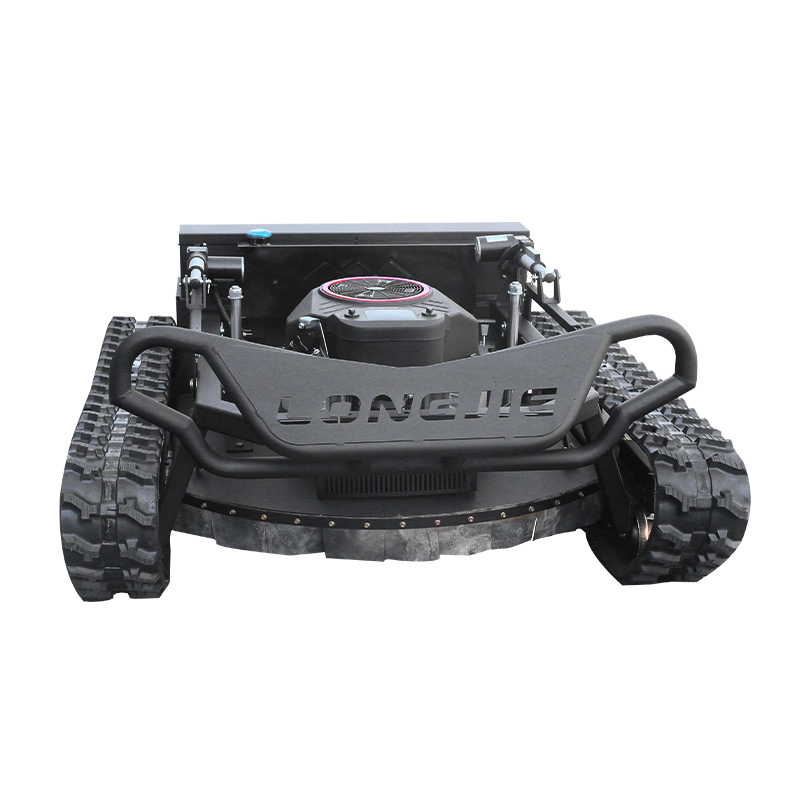
For a property manager facing banks, orchard rows, utility corridors, or rough perimeter ground, the hard part of mowing is rarely the grass alone. It is choosing a route that keeps the machine clear of hazards while the person directing the work can see what is happening. That is where an RC lawnmower can change the conversation. Rather than requiring the operator to ride or walk immediately beside the cutting path, remote control lets the operator select a better observation point and make smaller, more deliberate corrections.
That does not make any hillside automatically suitable for mowing. Slope angle, surface firmness, vegetation, weather, hidden holes, drop-offs, and the particular machine’s approved limits still decide whether work should proceed. But on a site that has been assessed and where the equipment is appropriate, an RC lawnmower can give a crew more control over position, pace, and turning decisions.
Precision starts with a better view of the slope
In other words, an RC lawnmower gives the operator a chance to observe before committing the machine to the next section of ground. That extra perspective is useful only when the operator remains attentive and follows the equipment instructions.
On a conventional mower, the person operating the machine is tied to its position. A dip in the ground, a wet patch, or a drainage edge may become obvious only when the mower is close to it. With an RC lawnmower, the operator can stand where the slope, cutting boundary, and obstacles are easier to read. That higher-level view helps with route planning: identify a safe entry, decide where turns will happen, establish buffer zones, and leave difficult edges for another approved method if needed.
The advantage is not simply distance. It is decision time. When the operator has a clear line of sight, small steering changes can be made before the mower reaches a rut, a fence line, or a change in surface. If visibility is lost, the correct response is to stop and reposition, not to continue on assumption.
Remote steering supports controlled line placement
A well-matched RC lawnmower can help turn a broad mowing area into shorter, visible passes. The operator should still choose each pass based on the actual surface, weather, and documented machine limits.
Slopes punish abrupt inputs. A quick direction change can shift a machine’s path at exactly the point where traction and weight transfer are already changing. An RC lawnmower allows the operator to concentrate on line placement instead of balancing their own body on the ground beside the machine. On a well-planned pass, the operator can track the cutting edge against a visible reference, ease off before a turn, and keep the machine away from known hazards.
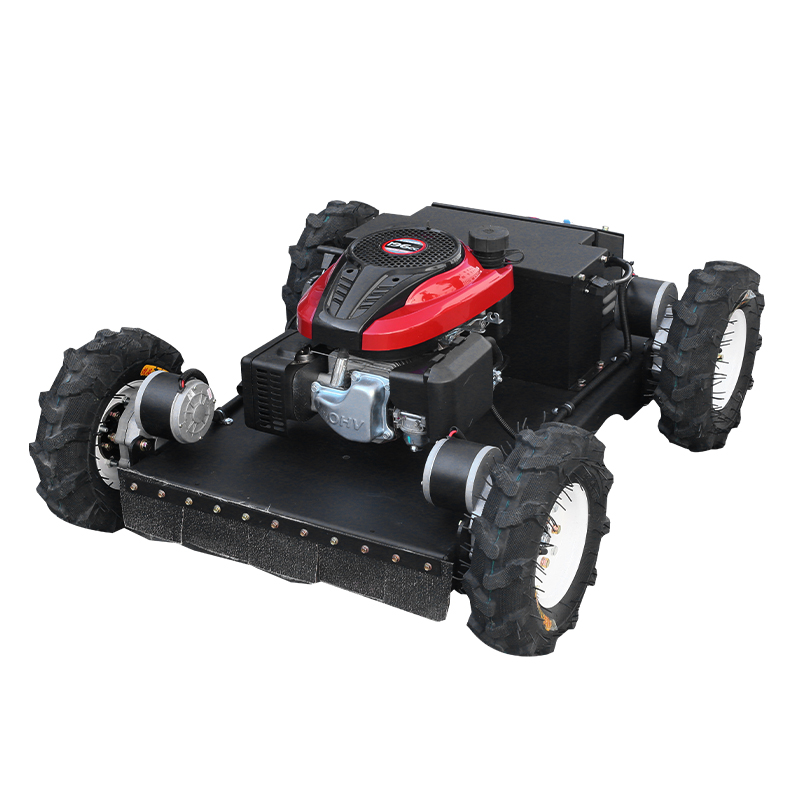
For an offroad remote lawn mower, this matters on terrain that is not uniformly smooth. Grass may hide shallow ruts, embedded stones, exposed roots, or transitions from firm soil to loose material. Remote control does not remove those risks, but it can make the response more measured: pause, inspect, adjust the route, or stop the task if site conditions are beyond the approved operating envelope.
Why speed control matters more on uneven ground
When an RC lawnmower approaches a change in grade, a prudent control input is often a smaller one made early. That approach helps preserve time for observation rather than treating the remote control as permission to rush.
Precision is also about pace. A mower moving downhill or around a corner needs room for the surface and machine response to be evaluated. OSHA guidance for riding mowers emphasizes following manufacturer slope limits, reducing speed on descents and around sharp turns, and avoiding sudden starts, stops, or turns. Those principles remain useful when evaluating remote equipment, even though a remote machine must be used only under its own manufacturer instructions and site rules.
An RC lawnmower gives the operator a practical way to make pace changes while remaining in a safer observation position. Instead of rushing to finish a long pass, the operator can slow at a transition, check the route, and resume only when the machine is stable and the path remains clear. This is especially valuable when grass height or ground texture makes surface changes difficult to spot from a seated position.
Control is a route-planning process, not a feature list
For an RC lawnmower, documented limits are part of the control system, not an afterthought. A route that is comfortable for one configuration may be unsuitable for another, so field conditions and manufacturer information must be considered together.
It is tempting to compare slope-mowing equipment by a single claimed grade, engine specification, or remote range. In practice, a better selection discussion starts with the job. Measure or map the relevant slopes, note wet areas and drainage paths, identify ditches and unprotected edges, record vegetation density, and consider how the machine will enter, turn, stop, and leave the work zone. A capable RC lawnmower still needs enough traction, stability, visibility, and control response for the actual site.
Ask a supplier for the documentation that applies to the exact configuration under consideration. Confirm approved slope limits, controls, emergency-stop arrangement, operating range, maintenance requirements, guard condition, and training expectations. If the site includes drop-offs, water, public access, overhead obstructions, or uncertain ground, build a conservative exclusion zone and obtain a competent safety assessment. No blog article can replace the operator manual, local rules, or a site-specific risk review.
A practical pre-operation checklist for slope work
Use this list before every slope task involving an RC lawnmower; it is a planning aid rather than a substitute for the model-specific manual or a formal risk assessment.
Before sending an RC lawnmower onto a slope, a crew can use a short, repeatable check:
- Confirm the machine: Verify the exact model, its operating manual, guards, controls, stopping function, and manufacturer-approved conditions.
- Walk or inspect the site: Look for holes, loose soil, wet grass, stones, concealed debris, ditches, retaining edges, and areas with poor radio visibility.
- Set the route: Choose a start point, turning areas, stop locations, and boundaries that leave a margin from hazards.
- Choose an observation point: Stand where the machine, cutting path, and escape or stop area stay visible. Do not rely on intermittent sight lines.
- Plan communication: Keep bystanders and other workers outside the work zone and agree on stop signals before the machine starts.
- Reassess as conditions change: Stop after rain, when traction changes, when vegetation conceals the path, or whenever a new hazard appears.
Where an RC lawnmower can fit
An offroad remote lawn mower can be useful when a crew needs to keep the person directing the work outside the immediate cutting path, but it should be deployed only after traction, ground condition, and sight lines have been checked.
An RC lawnmower is most compelling when the mowing task exposes an operator to awkward footing, irregular terrain, or a need to watch several boundaries at once. Roadside banks, solar-site margins, embankments, orchards, and large landscaped slopes may all benefit from a remote-control workflow if the machine is suitable and the work is properly planned. It may be less appropriate when the area is too confined, the surface is unstable, visibility is poor, or local requirements call for a different method.
The useful question is not “Can remote control mow this slope?” It is “Can this particular machine be operated within its documented limits while the crew retains clear visibility, a controlled route, and a reliable way to stop?” Framed that way, the value of an RC lawnmower becomes clearer: it can help operators place the machine more deliberately and keep themselves out of the immediate cutting zone, while still requiring disciplined site assessment and training.
Final takeaway
The practical strength of an RC lawnmower is controlled positioning: the operator can monitor the machine from a more useful place while keeping the route conservative. That benefit depends on the right equipment, trained use, and a site assessment that is repeated whenever conditions change.
Precision on slopes comes from visibility, gradual inputs, route planning, and the willingness to stop when conditions change. An RC lawnmower supports those habits by separating the operator from the machine’s immediate path and allowing control decisions from a better vantage point. Before selecting one, match the equipment to verified terrain conditions and obtain the model-specific documentation needed for safe, informed operation.